
UK Honors Beagle 2: The Mars Mission That Failed, Then Succeeded
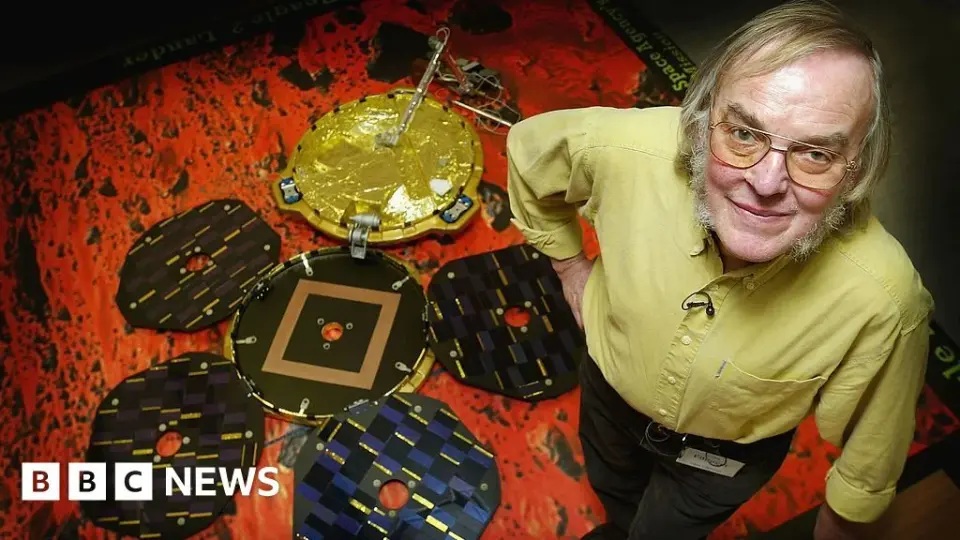
A series of plaques has been unveiled across the UK to honor Beagle 2, the first British spacecraft to land on Mars. Led by Professor Colin Pillinger, the mission was long considered a failure after it failed to transmit data in 2003. However, NASA later confirmed it had landed successfully, just 5km from its target, with a minor technical fault preventing communication. The recent tributes, including ceremonies in Milton Keynes and Bristol, recognize the project's role in advancing UK space capabilities and its unique cultural outreach, which involved collaborations with Britpop band Blur and artist Damien Hirst.
Key points
- Plaques commemorating Beagle 2 were unveiled in Milton Keynes and Bristol to honor the mission and its lead, Professor Colin Pillinger.
- Beagle 2, built for approximately £50m, launched in 2003 on the ESA’s Mars Express but failed to signal after landing, leading to initial criticism of its management and finances.
- NASA imagery revealed in 2014 that the lander had successfully deployed its parachutes and airbags, but its solar panels failed to open fully, trapping the antenna.
- Pillinger, who died in 2014, used cultural figures like Blur and Damien Hirst to secure public interest and funding for the project.
- The Open University highlighted the mission's legacy in fostering interdisciplinary space research and demonstrating UK capability in planetary exploration.
Background
Beagle 2 was conceived in the late 1990s by Colin Pillinger at The Open University in Milton Keynes. At the time, the UK lacked a dedicated space agency, so Pillinger proposed hitching a ride on the European Space Agency’s Mars Express. The project was notable for its unconventional marketing, including a replica lander wheeled through a supermarket trolley and a call-sign composed by the band Blur. Although the mission was initially viewed as a failure due to the lack of post-landing communication, it was later vindicated by NASA’s discovery of the intact lander on Mars. This recent wave of tributes follows earlier scientific efforts, such as NASA’s analysis of Scottish rocks to understand Martian biosignatures, highlighting the ongoing importance of planetary science in the UK.
How outlets are covering it
BBC and MKFM emphasize the technical and institutional legacy of Beagle 2, focusing on the success of the landing sequence and the Open University’s current space research initiatives. BBC highlights the cultural strategy used by Pillinger to secure funding, while MKFM notes the plaque’s role in inspiring future scientists. Bristol24/7 focuses on the personal and local impact, describing Pillinger as a 'visionary' and 'stubborn lad' from Kingswood, and detailing the emotional response from his family. All sources agree on the technical cause of the communication failure (solar panels) and the eventual vindication by NASA, but differ in emphasis: BBC and MKFM focus on the national and academic significance, while Bristol24/7 highlights the human and local narrative. No source disputes the core facts, but they vary in their portrayal of Pillinger’s role, with BBC and MKFM noting his collaborative approach, while Bristol24/7 emphasizes his individual drive.
Why it matters
The unveiling of these plaques marks a shift in how the UK views its space history, moving from a narrative of failure to one of resilience and innovation. It underscores the importance of public engagement and cultural collaboration in securing funding for scientific projects, a strategy that may influence future UK space initiatives. Additionally, the mission’s success, despite its initial setback, demonstrates the value of perseverance in space exploration and the potential for international collaboration, as Beagle 2 was a UK project on an ESA spacecraft. This recognition also highlights the Open University’s growing role in space research, positioning it as a key player in the UK’s space sector.
What to watch
The UK Space Agency is likely to continue supporting projects that build on the Beagle 2 legacy, potentially through new missions or research initiatives at The Open University. The success of the cultural outreach strategy used for Beagle 2 may inspire similar approaches for future UK space projects, aiming to secure public and private funding. Additionally, the recognition of Beagle 2’s success may lead to increased investment in UK space capabilities, as the government seeks to position the UK as a leader in space exploration and technology. The Open University may also expand its space research programs, leveraging the momentum from the plaque unveiling and the mission’s legacy.
Want the full story? Read the original reporting
Read on BBC