
Bristol Researchers Demonstrate Brain Organoids Can Decode Braille Signals
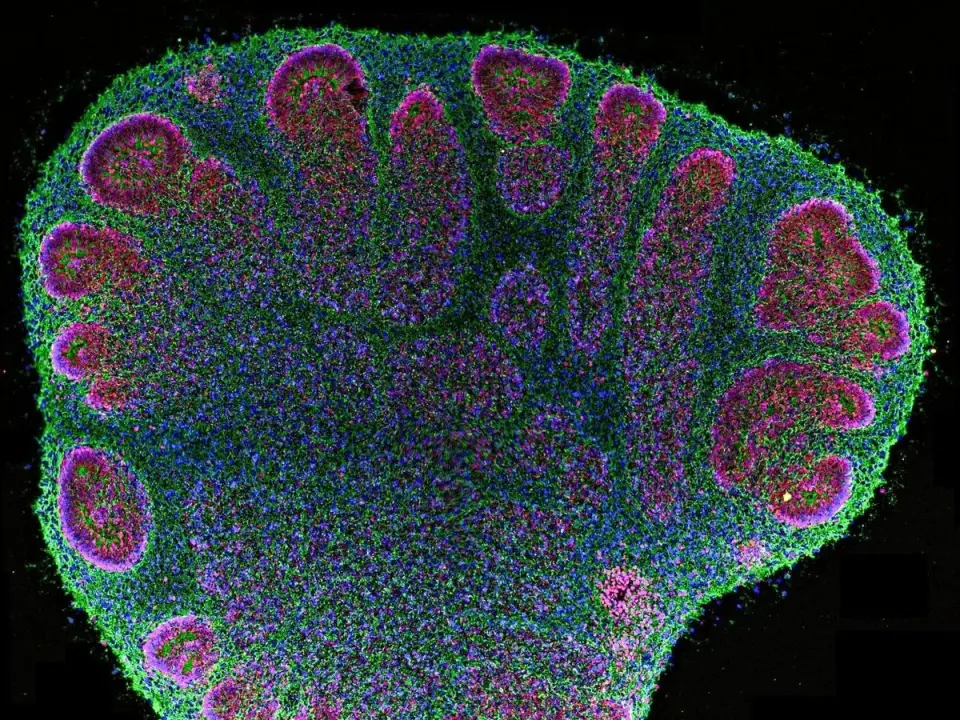
A study published in Frontiers in Artificial Intelligence shows that human brain organoids can classify Braille letters with 83% accuracy when three are combined. The experiment, led by Tianyi Liu at the University of Bristol, converted tactile sensor data into electrical stimuli for neural tissue. While single organoids achieved 61% accuracy, the ensemble approach proved more robust against noise. The researchers emphasize this is an open-loop test of signal processing, not evidence of learning or long-term adaptation, marking a step toward energy-efficient biological computing.
Key points
- Researchers at the University of Bristol successfully transmitted electrical signals corresponding to 26 Braille letters to human brain organoids.
- A single organoid, containing approximately 10,000 neurons, classified the letters with 61% accuracy.
- An ensemble of three organoids achieved 83% accuracy, outperforming single units and showing greater resilience to artificial noise.
- The experiment used a tactile sensor to scan Braille patterns, which were converted into electrical stimulation for the organoids on multielectrode arrays.
- The study confirms that biological neural networks can process tactile information but does not demonstrate learning or permanent changes in the tissue.
- The findings support the development of biohybrid computing systems that leverage the energy efficiency of biological neural networks.
Background
This development follows recent advancements in using human neural tissue for research, such as the creation of xenocortical mice at Stanford University in September 2026 to model brain disorders. Additionally, studies from Baylor College of Medicine in October 2026 indicated that unconscious brains retain complex information processing capabilities, reinforcing the potential of neural tissue for computational tasks beyond traditional silicon-based systems.
How outlets are covering it
404 Media frames the breakthrough as a significant step toward 'organoid intelligence,' highlighting the potential for biological 'wetware' to replace artificial neural networks. Frontiers and Mirage News emphasize the practical implications for energy-efficient biohybrid computing, noting that the organoids effectively relayed signals for a decoder. DongA Science focuses on the technical specifics, such as the use of support vector machine algorithms to analyze neural activity. All sources agree that while the results are promising, they do not prove that the organoids 'learned' Braille, as the experiment was open-loop. Liu and Ward-Cherrier stress the limitations regarding standardization and scalability compared to electronic chips, while acknowledging the unique advantages of biological processing.
Why it matters
This research validates the feasibility of using living neural tissue for information processing, potentially leading to computing systems that are far more energy-efficient than current silicon-based processors. It opens the door for future closed-loop experiments where organoids could adapt to new tasks through ongoing interaction, bridging the gap between artificial and biological intelligence.
What to watch
The research team plans to move beyond Braille recognition to investigate how organoids process other tactile stimuli, such as textures and edges. They aim to develop closed-loop systems where organoids receive feedback from their actions, allowing researchers to test if biological neural networks can adapt and learn through experience. Further studies will also address the challenges of standardizing organoid responses to improve reliability and reproducibility.
- Computers Made of Human Brain Tissue Identify Braille Letters In Breakthrough 404 Media
- Mini brain organoids ‘reading’ Braille marks key step towards biohybrid computing Frontiers
- Mini brain organoids 'read' braille in key step toward biohybrid computing Tech Xplore
- Mini Brain Organoids Read Braille in Biohybrid Computing Breakthrough Mirage News
- Bristol University brain organoids read 26 braille letters with 83% accuracy DongA Science
Want the full story? Read the original reporting
Read on 404 Media