
Tiny Galaxy Sends Ionizing Light, Illuminating the Early Universe's Fog
TL;DR
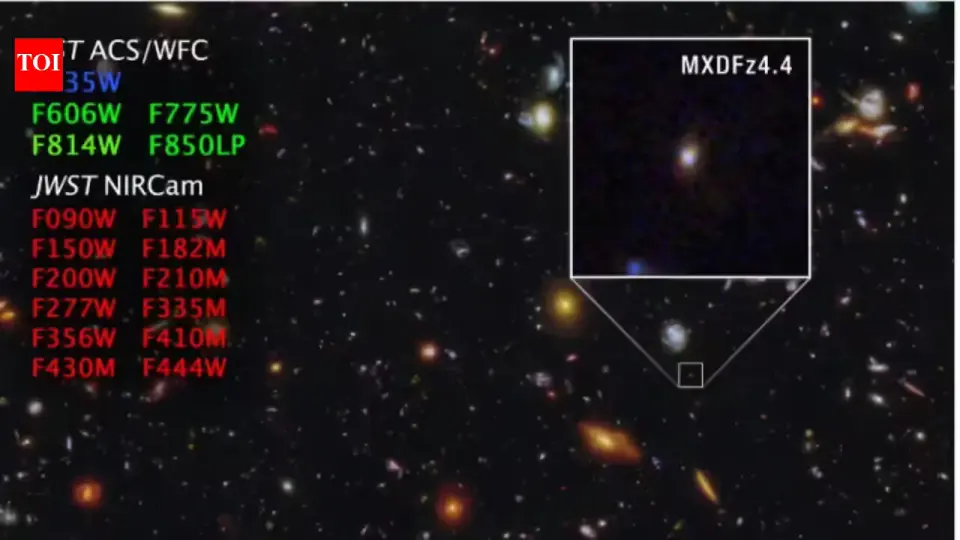
Astronomers using Hubble, with confirmation from the James Webb Space Telescope and the Very Large Telescope, detected ultraviolet light escaping from MXDFz4.4, a tiny but intensely star-forming galaxy about 250 million years after the end of the Epoch of Reionization. The escaping light suggests the galaxy carved channels in its gas, allowing ionizing photons to travel into intergalactic space and helping clear the hydrogen fog that blanketed the early universe. This is one of the clearest glimpses yet of a galaxy from that era contributing to reionization, and it hints that more such galaxies may lie hidden in the deepest space images.
Topics:science#epoch-of-reionization#hubble#ionizing-radiation#james-webb-space-telescope#mxdfz44#science
- Hubble has spotted ‘impossible’ light in deep space, and scientists are trying to explain where it came f The Times of India
- Hubble Detects Ultraviolet Light from Tiny Starburst Galaxy in Early Universe Sci.News
- One of the most distant 'leaky' galaxies ever found may reveal how the universe reionized Phys.org
- 🔭 Hubble sees an object it shouldn't have seen Techno-Science.net
- Hubble telescope spots 'impossible' light from a galaxy that shouldn't have been visible Live Science
Want the full story? Read the original reporting
Read on The Times of India