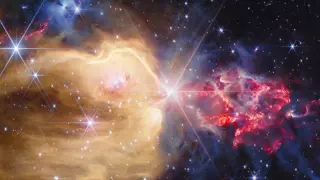
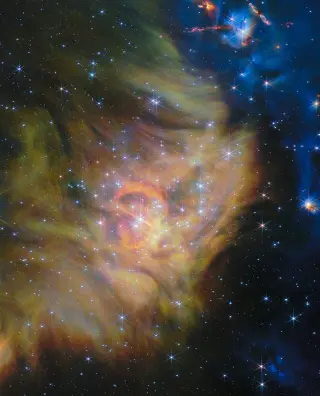
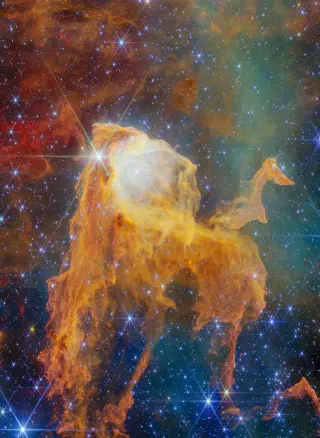
The James Webb Space Telescope has released a new near-infrared image of the Flower Bud Nebula (NGC 7129), revealing over 100 young protostars forming within a dense cloud of gas and dust located 3,300 light-years away.
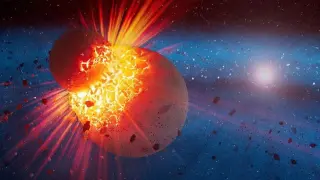
Astronomers used the James Webb Space Telescope to analyze 21 'extreme debris disks' around young stars, revealing that these systems are the aftermath of violent planetary collisions. The study, published in The Astrophysical Journal, categorizes these disks into silica-rich and silica-poor types, linking them to impacts between Mars-sized and Moon-sized bodies, respectively. These findings offer new insights into the formation of the Moon and the evolution of rocky planets in our own solar system.
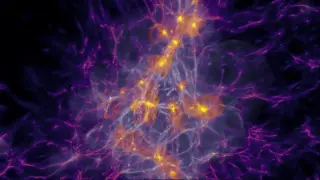
A new high-resolution simulation called MEGATRON bridges the gap between early universe observations and local stellar chemistry. Led by researchers at the University of Bath, Chicago, and Paris, the project models the formation of the first stars and galaxies from 2023 to 2030. By tracking gas, radiation, and chemical evolution simultaneously, MEGATRON explains how Population III stars enriched the cosmos with heavy elements. The simulation successfully reproduces the 'iron plateau' in dwarf galaxies, suggesting that single massive stellar explosions seeded these systems with iron. This work provides a physical link between James Webb Space Telescope data of distant galaxies and the chemical fingerprints preserved in ancient Milky Way stars.
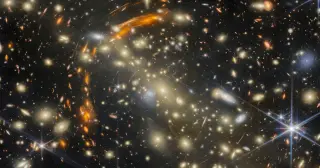
The James Webb Space Telescope has released its latest Picture of the Month, showcasing the galaxy cluster MACS J0454.1-0300. This image highlights extreme gravitational lensing, where the cluster’s mass bends light from background galaxies, creating warped, multiplied, and magnified views. The cluster is located five billion light-years away, allowing scientists to observe the universe as it existed eight billion years ago. Notably, the image captures a rare configuration where four or more images of the same background galaxy appear, a phenomenon seen in only 10-20% of clusters. Webb’s superior sensitivity reveals hundreds of galaxies missed by Hubble’s 2014 observation of the same area, demonstrating its ability to detect fainter, redder light and push the limits of cosmic observation.
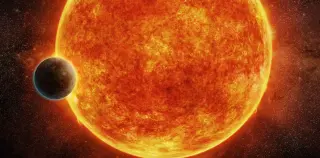
Astronomers have detected a possible helium atmosphere around the rocky exoplanet LHS 1140b, marking a significant but tentative step in the search for life beyond Earth. This observation suggests the planet may possess a stable secondary atmosphere, which could potentially support liquid water. However, the finding is not yet confirmed, as a second observation failed to detect the gas, and the planet's classification as a super-Earth or mini-Neptune remains uncertain due to a lack of local examples.
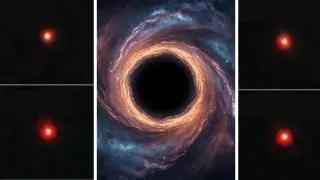
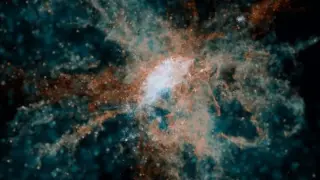
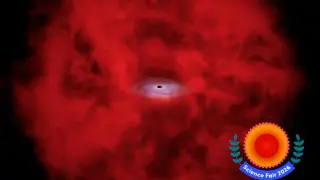
New simulations and spectral analyses suggest that 'little red dots' seen by the James Webb Space Telescope are not galaxies, but supermassive black holes rapidly accreting gas in the early universe. This finding helps explain how massive black holes formed within a billion years of the Big Bang.
Astronomers have identified HD 3167 b, a rocky super-Earth located 154 light-years away, as the coldest known lava world with evidence of an atmosphere. Despite orbiting its host star in just one Earth day, the planet retains an atmosphere, defying expectations that such close proximity would strip away gases. This discovery, published in The Astrophysical Journal Letters, provides a critical data point for understanding the temperature threshold at which rocky planets lose their atmospheres and offers insights into the early, molten stages of Earth's formation.
The James Webb Space Telescope (JWST) has released one of its largest panoramic images to date, capturing the IC 348 star-forming region in the constellation Perseus. Located approximately 1,000 light-years from Earth, this near-infrared view reveals a dense cluster of young stars, protostellar jets, and faint substellar objects. The image highlights a critical scientific goal: identifying the faintest brown dwarfs, with the lightest candidates estimated at just two Jupiter masses, helping astronomers define the lower mass limit for star formation.
JWST observations show that galaxies began dispersing heavy elements into the intergalactic medium just 500 million years after the Big Bang, challenging the view that the early universe was chemically pristine.
Astronomers are using the James Webb Space Telescope to investigate 'little red dots,' a new class of objects in the early universe that may represent rapidly growing black holes. Recent simulations and observations suggest these objects formed within 500 million to 1.5 billion years after the Big Bang, challenging existing models of how supermassive black holes achieved their size so quickly. While some researchers propose they are 'black hole stars'—black holes enveloped in dense gas cocoons—others remain skeptical, noting that the data does not perfectly fit any single theoretical model.
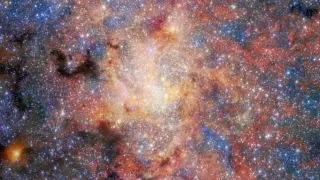
The James Webb Space Telescope has identified water and oxygen-rich dust surrounding the star IRS 3, located just 0.55 light-years from the supermassive black hole Sagittarius A* at the center of the Milky Way. This marks the first detection of water in this extreme environment, demonstrating that stars can maintain chemical envelopes despite intense gravitational forces.
Researchers from the Max Planck Institute have published a study in Nature demonstrating that the mysterious 'little red dots' observed by the James Webb Space Telescope are likely the early growth phases of supermassive black holes. Using the ATERUI III supercomputer, the team simulated conditions in the early universe and found that intense ultraviolet radiation from nearby galaxies suppressed normal star formation, allowing massive stars to collapse into heavy black hole seeds. These seeds then accreted matter at super-Eddington rates, growing rapidly into the overmassive black holes seen in JWST data. This model provides a unified explanation for the abundance and properties of these objects without requiring exotic theories.
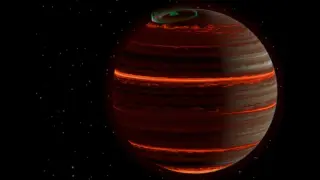
A new JWST-based study of SIMP 0136, a nearby brown dwarf about 20 light-years away, shows atmospheric variability is driven by temperature differences and cloud structure, revealing three recurring weather states that persist across many rotations. While this method won’t predict tomorrow’s conditions yet, it offers a fast way to identify the forces shaping alien atmospheres and could be extended to many brown dwarfs and giant exoplanets to better understand distant weather systems.
A new JWST analysis of 217 Little Red Dots (LRDs) in the early universe finds faint light from surrounding host galaxies, which are unusually compact (~1,400 light-years across) and metal-poor. The results suggest LRDs may be connected to bursts of star formation in their hosts (not just a central engine), offering a host-galaxy perspective on their origin and evolution. The study, led by Jorge Zavala (UMass Amherst), calls for spectroscopy and searches for local analogs, and was published in Nature Astronomy.
NASA’s James Webb Space Telescope images a dust pillar in the Carina Nebula about 7,500 light-years away, revealing a compact cluster of roughly 70 very young stars—including a massive star ~19 solar masses—formed under winds and radiation from nearby Eta Carinae; the pillar’s head is being excavated by ongoing star formation, effectively creating a “treasure chest” of newborn stars.