
Worm jaws reveal a new metal-like material class
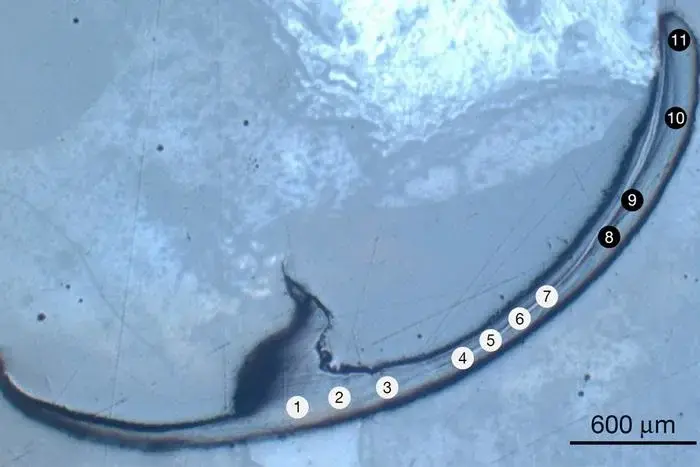
Researchers studying the ancient predatory bristle worm Perinereis cultrifera show its jaw tips are harder than their centers due to higher metal-ion concentrations in a protein matrix, with a size-dependent elasticity and a strain-gradient response. They argue these properties define a distinct bio-metal category—a blend of polymer-like structure and metal-like mechanics—supported by manifold micromechanics modeling and Peach–Koehler force concepts. The work, from TU Wien and the University of Vienna, suggests a framework for comparing natural hard tissues that don’t use a conventional metal lattice and sets the stage for studying how genetics might influence such material properties across more species.
- Bio-metals: Ancient sea worms hold the secret to a strange new class of materials Yahoo
- Hard but lightweight ‘bio-metal’ material discovered in sea worm jaws New Scientist
- Cross-section of a bristle worm jaw sample (IMAGE) EurekAlert!
- Exploring “bio-metals”: The metallic mystery of an ancient sea worm’s jaw Open Access Government
- Bristle Worm Jaws Incorporate Metal Ions to Mimic Synthetic Alloys geneonline.com
Want the full story? Read the original reporting
Read on Yahoo