
Hubble uncovers a distant galaxy that pierced the early universe's hydrogen fog
TL;DR
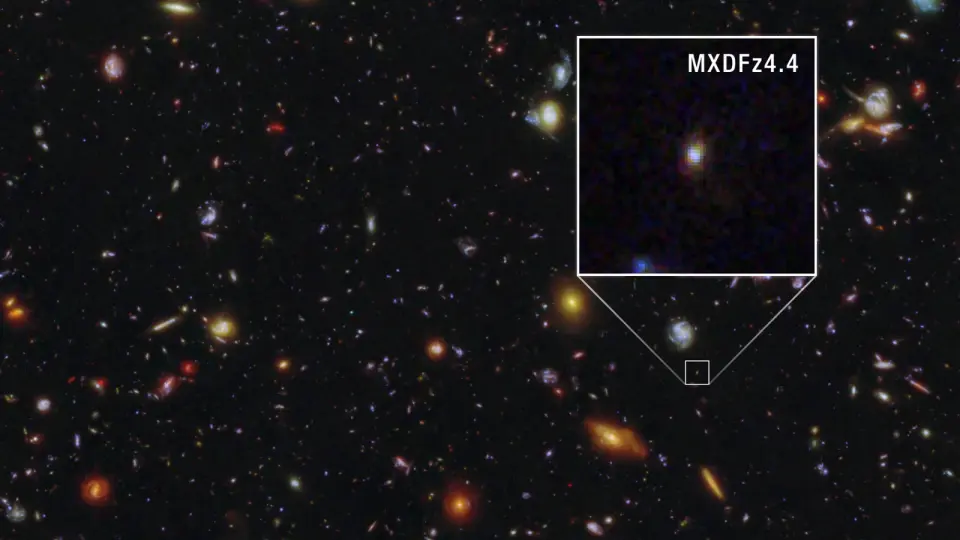
The Hubble Space Telescope detected ultraviolet light from MXDFz4.4, a compact, star-forming galaxy at redshift 4.4, showing bursts of ionizing UV radiation from a dense cluster of hot, massive stars. This radiation helped ionize surrounding neutral hydrogen, offering a closer look at the Epoch of Reionization when the universe became transparent to ultraviolet light. The finding, supported by JWST observations that reveal the galaxy’s star-formation history, suggests that bursts from young star clusters in early galaxies played a major role in clearing the fog of neutral hydrogen in the early universe; the results appear in The Astrophysical Journal.
Topics:sciencespace#early-universe#epoch-of-reionization#hubble-space-telescope#ionizing-ultraviolet#mxdfz44#space
- Hubble Space Telescope images galaxy scientists thought was impossible to find Space
- Galaxy MXDFz4.4 (Hubble and Webb Image) NASA Science (.gov)
- Hubble details early galaxy transforming neighbourhood ESA/Hubble
- Hubble Spots a Compact Galaxy Clearing Paths Through the Young Universe’s Gas TechEBlog -
- Hubble Details Early Galaxy Transforming Neighborhood NASA Science (.gov)
Want the full story? Read the original reporting
Read on Space