
Tokyo Team Demonstrates Pulsed Magnetic Aerobraking to Expand Reentry Shock Layers
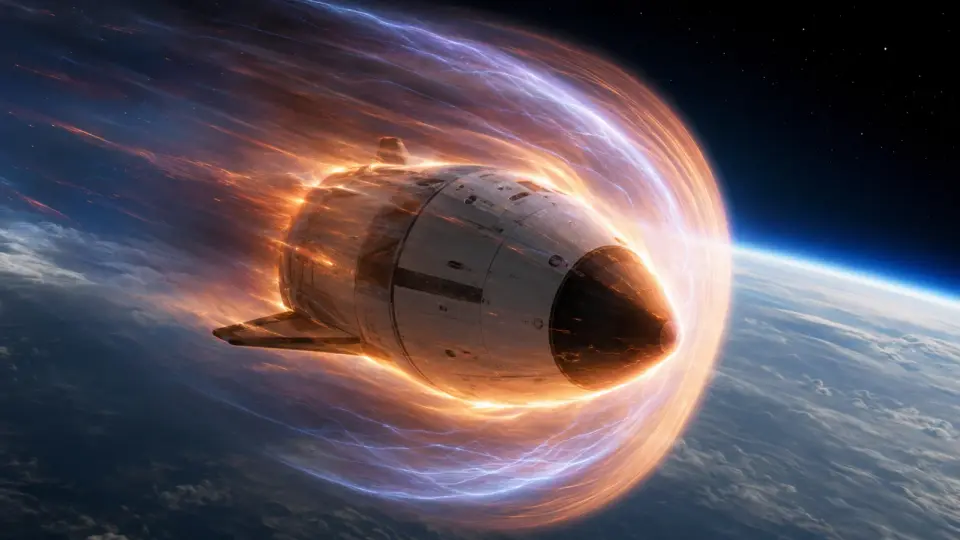
Researchers at Tokyo Metropolitan University have developed a new laboratory system to test magnetohydrodynamic (MHD) aerobraking, a technique that uses magnetic fields to push superheated plasma away from spacecraft during atmospheric reentry. Led by Associate Professor Kohei Shimamura, the team replaced traditional permanent magnets with a pulsed electromagnet system capable of generating fields up to 1.58 tesla. In tests using a hypersonic expansion tube, this magnetic field expanded the shock layer around miniature models by approximately 16%, potentially reducing heat transfer and increasing aerodynamic drag. While not a flight-ready shield, this setup allows for precise, variable testing of magnetic configurations that were previously impossible with fixed permanent magnets, marking a significant step toward future reusable spacecraft thermal protection.
Key points
- The new system uses a pulse-forming network to generate magnetic fields of 1.24 and 1.58 tesla, significantly stronger than the 0.8 tesla limit of standard permanent neodymium magnets.
- Experiments in a hypersonic expansion tube showed that applying the magnetic field increased the thickness of the glowing shock layer by 15.7% to 16.2%, consistent with theoretical predictions.
- The pulsed electromagnet allows for customizable coil geometries, enabling researchers to tailor magnetic field shapes to different spacecraft nose designs, unlike fixed permanent magnets.
- The technique aims to reduce heat flux and increase drag simultaneously, offering a potential alternative to heavy, ablative thermal protection systems for reusable vehicles.
- The current setup is a laboratory tool for short-duration tests, not a continuous flight system, but it bridges the gap between numerical simulations and real-world reentry conditions.
Background
This development follows recent concerns about the durability of traditional heat shields, such as the char loss observed on the Orion capsule during Artemis II, which prompted NASA to plan more permeable materials for future missions. While current thermal protection relies on passive, often expendable materials that add weight and require maintenance, MHD aerobraking offers a potential active solution. Previous numerical studies suggested that magnetic fields could reduce wall heat flux by nearly half, but experimental validation was limited by the fixed geometry of permanent magnets. This new pulsed system addresses that bottleneck by allowing dynamic testing of various field strengths and shapes.
How outlets are covering it
The Brighter Side of News provides the most detailed technical breakdown, highlighting the specific coil configurations (49-turn vs. 54-turn) and the spectroscopic evidence of increased electron temperature. Universe Space Tech and Eurasia Review emphasize the broader implications for reusable spacecraft, noting that current ablative shields are costly and heavy, making magnetic braking an attractive alternative for deceleration. Zamin.uz frames the story as a move away from heavy thermal insulation, citing Ixbt.com, and highlights the precision required to synchronize the magnetic pulse with the shockwave. All sources agree that while the technology is not yet flight-ready, it represents a crucial step in validating MHD aerobraking for future missions.
Why it matters
Successful implementation of MHD aerobraking could significantly reduce the weight and maintenance costs associated with spacecraft thermal protection systems. By actively pushing heat away and increasing drag, magnetic fields could allow for more efficient reentry profiles and potentially extend the lifespan of reusable spacecraft, making space travel more sustainable and cost-effective for future missions to Earth, Mars, and beyond.
What to watch
The research team plans to use this laboratory platform to bridge the gap between theoretical MHD studies and tests involving actual reentry vehicles. Future work will likely focus on scaling up the magnetic field strengths and testing continuous operation, moving closer to developing a flight-ready magnetic heat shield for reusable spacecraft.
- Powerful new magnetic system could help spacecraft survive the brutal heat of reentry The Brighter Side of News
- Magnetic braking will facilitate the spacecraft in decelerating more safely and expeditiously Universe Space Tech
- Lab Testing Magnet-Powered Brakes For High-Speed Spacecraft Reentry Eurasia Review
- University of Tokyo tests a 'magnetic shield' for spacecraft Zamin.uz
- Magnetic brakes tested in lab to slow high-speed spacecraft reentry Bioengineer.org
Want the full story? Read the original reporting
Read on The Brighter Side of News