
Caltech robot autonomously assembles first space structure, validating DARPA's NOM4D program
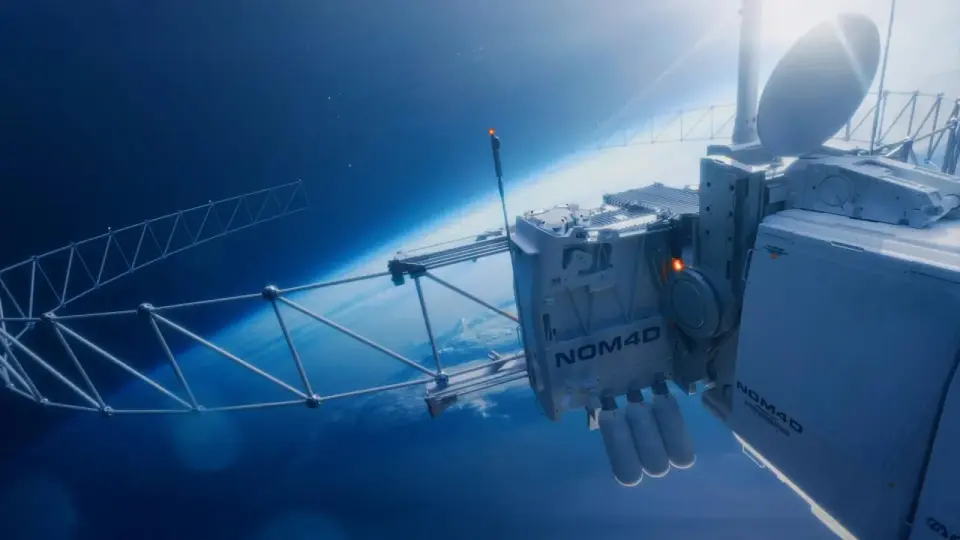
A robotic system developed by Caltech successfully assembled a structural section in low Earth orbit for the first time, marking a milestone in autonomous space construction. The demonstration, part of DARPA's NOM4D program, proved that large structures can be built from raw materials in orbit rather than being folded or manually assembled by astronauts. Although the mission did not complete the full antenna due to technical challenges, it validated the feasibility of scaling construction to kilometer-sized structures for future telescopes and solar arrays.
Key points
- Caltech's ASTRA payload launched on March 30, 2026, aboard Momentus Inc.'s Vigoride 7 vehicle via SpaceX's Transporter-16 mission.
- The robot autonomously assembled a third truss bay using composite tubes, aluminum joints, and a Kapton reflective film, though it did not complete the full 11-bay antenna.
- DARPA's NOM4D program aims to enable construction of structures hundreds of meters to kilometers in scale, overcoming the size limits of rocket fairings.
- The team used a ground-based flight spare to troubleshoot issues, communicating with the orbital unit during limited 15-minute windows each day.
- The demonstration is the third phase of NOM4D, following lab tests, and is one of only two projects to reach this orbital demonstration stage.
Background
This development follows earlier discussions in space engineering about the limitations of folding large structures for launch or relying on human assembly. The NOM4D program was established in 2022 to explore in-orbit manufacturing as a third option. While our archive contains unrelated stories on historical discoveries and media events, this news represents a significant shift in how large space infrastructure might be constructed in the future.
How outlets are covering it
All sources agree that the ASTRA demonstration is a historic first for autonomous space assembly. However, they differ in emphasis: ScienceDaily and Caltech highlight the technical challenges and the incomplete nature of the antenna, noting that the team faced scheduling constraints and had to troubleshoot via a ground spare. DARPA emphasizes the scalability of the technology, comparing it to 'Tinkertoys' and focusing on the potential for kilometer-scale structures. Interesting Engineering focuses on the robotic mechanics and the lightweight nature of the Kapton film. All sources confirm the launch date and the involvement of Momentus Inc. and SpaceX, but DARPA and Caltech provide more detail on the program's broader goals, while Interesting Engineering offers a more concise technical overview.
Why it matters
This demonstration proves that large space structures can be built from raw materials in orbit, bypassing the size constraints of rocket fairings. This could enable the construction of massive telescopes, radio antennas, and solar arrays that are currently impossible to launch or fold. It also validates a new approach to space manufacturing that could reduce reliance on human astronauts for assembly tasks.
What to watch
The ASTRA mission is expected to conclude in December 2026. The team will analyze the data to refine the design and improve reliability. DARPA's NOM4D program will continue with a second project from the University of Illinois Urbana-Champaign, which will test carbon tube hardening on the International Space Station. Future applications may include large solar arrays for space solar power and giant telescopes for astronomy.
- Caltech robot makes history by building a structure in space Science Daily
- NOM4D program demonstrates automated in-space assembly darpa.mil
- Caltech Robotic Space Demo Successfully Builds in Space Caltech
- Defence-backed US robot builds space structure without human assistance for first time Interesting Engineering
- DARPA’s NOM4D program demonstrates in-orbit assembly heise online
Want the full story? Read the original reporting
Read on Science Daily