
Edinburgh and Michelin Develop Passive Rubber Blades to Cut Tidal Turbine Costs
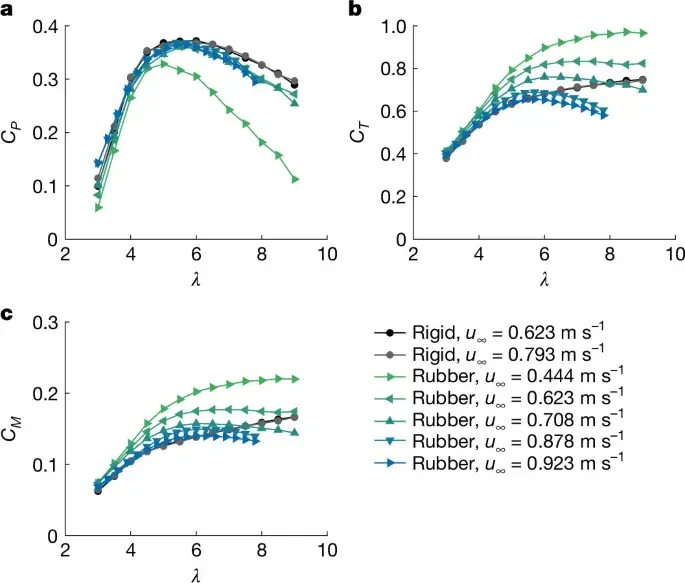
Researchers at the University of Edinburgh and Michelin have demonstrated that flexible rubber blades can match the energy output of conventional rigid tidal turbines while reducing structural fatigue by up to 29%. By eliminating complex active pitch control systems, this passive design lowers maintenance costs and could make tidal energy more viable in turbulent waters.
Key points
- Experiments at the University of Edinburgh’s FloWave facility showed that chordwise-flexible rubber blades achieve the same total energy yield as rigid blades with active pitch control.
- The flexible design reduces high-frequency load fluctuations, which drive mechanical fatigue, by up to 29% compared to rigid baselines.
- The blades use a rigid steel spar with a flexible rubber trailing edge, allowing them to passively flatten and shed excess load in high-flow conditions without mechanical actuators.
- Rubber’s density matches seawater, enabling buoyancy-neutral blades that reduce mass-related load variations.
- The technology could lower the levelized cost of energy by removing expensive, failure-prone mechanical components and extending turbine lifespan beyond 20 years.
Background
Tidal energy is a predictable renewable resource, with the UK targeting 1 GW of capacity by 2035 and global projections exceeding 300 GW by 2050. However, harsh hydrodynamic loads have historically forced developers to use complex, expensive active pitch systems to protect turbines. Recent industry trends, such as the upcycling of wind turbine blades, highlight the growing focus on material durability and lifecycle management in renewable energy infrastructure.
How outlets are covering it
Nature emphasizes the technical mechanism of chordwise flexibility and its ability to match active pitch control performance in simulated tidal cycles. Bioengineer.org highlights the collaboration between the University of Edinburgh and Michelin, noting that Michelin has filed a patent for the technology. Both sources agree that the primary benefit is the elimination of mechanical failure points, but Nature focuses on the fluid-structure interaction physics, while Bioengineer.org frames the innovation as a cost-reduction strategy for commercial deployment.
Why it matters
This innovation addresses the primary barrier to tidal energy adoption: high capital and maintenance costs. By replacing active mechanical systems with passive material flexibility, the technology could unlock previously unusable, high-energy tidal sites and significantly reduce the levelized cost of electricity, accelerating the transition to sustainable marine energy.
What to watch
The research team will likely focus on scaling the technology to utility-level turbines and validating the long-term fatigue life of rubber blades in real-world marine environments. Michelin and the University of Edinburgh may pursue commercial partnerships to integrate these blades into existing tidal turbine designs.
- Flexible rubber blades for tidal turbines Nature
- Shape-shifting rubber blades could make tidal power cheaper Tech Xplore
- Flexing Rubber Blades Show Tidal Power Promise The Engineer
- Rubber tidal blades match pitch-controlled turbines and cut load swings by up to 29% Interesting Engineering
- Flexible Rubber Blades Match Tidal Power Output While Cutting Fatigue Damage Bioengineer.org
Want the full story? Read the original reporting
Read on Nature