
DEEP's Vanguard Station Marks First Private US Underwater Habitat in 40 Years
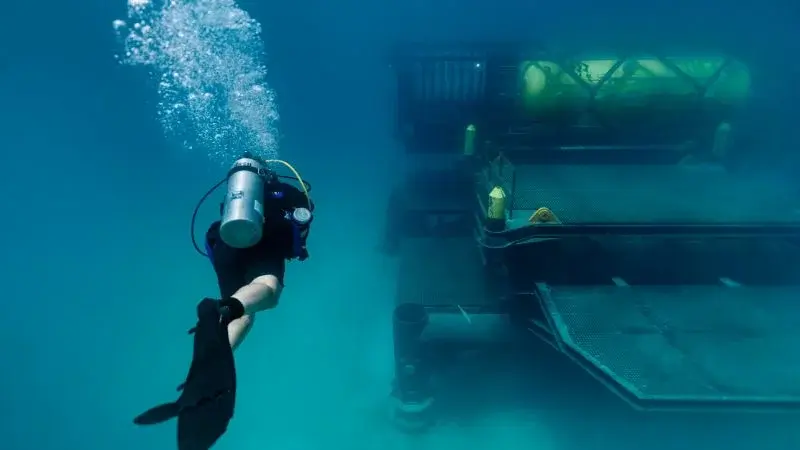
UK-based DEEP has deployed Vanguard, the first privately funded underwater habitat in US waters in four decades, to Tennessee Reef in the Florida Keys. The station, located 56 feet below the surface, will host up to four aquanauts for five-to-seven-day missions focused on coral reef restoration and human-machine collaboration. Florida has committed $935,000 to support six research teams, while DEEP plans a larger 'Sentinel' base and a global network of habitats. This development follows a 40-year gap since the last US subsea station, Aquarius Reef Base, which remains the only operational underwater laboratory in the world.
Key points
- Vanguard was deployed in June 2026 at Tennessee Reef, 4.6 nautical miles south of Long Key, Florida.
- The station is 35 feet long and 8 feet wide, designed for four occupants on 5- or 7-day missions.
- Florida committed $935,000 to fund six research teams from state universities and institutions.
- Research priorities include coral reef restoration, environmental monitoring, and human-machine collaboration.
- DEEP, founded in 2021 and majority-owned by Canadian Robert MacGregor, is planning a larger 'Sentinel' habitat and a global network of stations.
- Vanguard uses a support buoy for air, power, and communications, and captures gray water and waste for surface treatment.
Background
The deployment of Vanguard follows a 40-year gap in US underwater habitation since the Aquarius Reef Base was established in 1986. Aquarius, operated by Florida International University, has hosted over 150 saturation missions and 462 aquanauts, supporting over 800 research papers. Earlier underwater habitats, such as Cousteau's Conshelf and the US Navy's Sealab, were government-funded and often short-lived. DEEP's Vanguard is the first privately funded subsea habitat in US waters in decades, marking a shift from government-led to private-sector-driven underwater research.
How outlets are covering it
CNN emphasizes Vanguard's significance as the first US subsea station in 40 years and its potential to revive underwater research, comparing it to the International Space Station's sustained presence. 2oceansvibe highlights DEEP's private funding and the station's modular design, noting its limited capacity and the need for a two-week training program for researchers. Keys News focuses on the $935,000 state funding and the specific research priorities, emphasizing the expansion of access for Florida scientists. All sources agree on the station's location, depth, and mission duration, but differ in emphasis: CNN on historical context, 2oceansvibe on private-sector innovation, and Keys News on state funding and research access.
Why it matters
Vanguard's deployment signals a potential new era of private-sector-led underwater research, addressing the long-standing gap in US subsea habitation. By enabling longer, more efficient research missions through saturation diving, it could accelerate coral reef restoration and environmental monitoring. The state's $935,000 investment and DEEP's expansion plans suggest a growing commitment to underwater science, potentially influencing future policy and funding for marine research. However, the station's limited capacity and the need for sustained funding raise questions about its long-term viability and impact.
What to watch
DEEP plans to begin full missions in November 2026, with demo missions in October. The company is developing a larger 'Sentinel' habitat, capable of accommodating six aquanauts at depths over 650 feet for a month. DEEP has announced a $100 million investment and plans for an engineering hub in Florida and a manufacturing base in Houston, Texas. Florida's funding will support six research teams between November 2026 and June 2027, with proposals due by September 1. DEEP aims to expand into a global network of subsea habitats, potentially including defense and tourism applications.
- DEEP Vanguard may usher in a new era of underwater living cnn.com
- Inside quest to make humans aquatic by living in subsea 'hamster-style' homes The Sun
- Private Vanguard Underwater Station Could Spark a New Ocean Exploration Race mezha.net
- Startup Develops Permanent Underwater Base For Ocean Researchers [Watch] 2oceansvibe.com
- State gives $935K to DEEP for underwater research keysnews.com
Want the full story? Read the original reporting
Read on cnn.com