
Hidden Chiral Superlattice in UOTe Drives Record-Breaking Spintronics
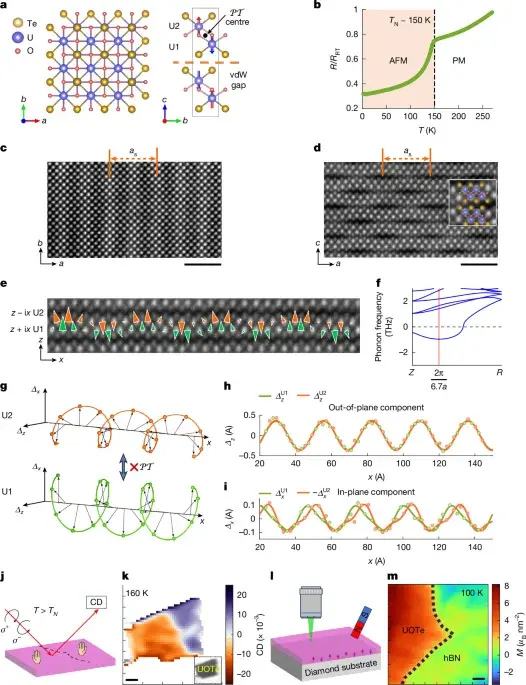
Researchers led by Su-Yang Xu and Philip Kim at Harvard have demonstrated that the collinear antiferromagnet uranium oxytelluride (UOTe) hosts a spontaneous chiral superlattice. This structural feature, arising from frozen chiral phonons, generates large Berry curvature and spin-split bands. The study reports an anomalous Hall angle of 0.14 near the 150 K Néel temperature, among the largest recorded in bulk magnets, and confirms spin-polarized currents, offering a new route for antiferromagnetic spintronics.
Key points
- UOTe exhibits a spontaneous chiral superlattice formed by frozen chiral phonons at a finite wave vector, creating 2D planar chirality in the crystal structure.
- The chiral superlattice modulates electron orbital Bloch wavefunctions, generating large Berry curvature and a Berry curvature dipole detectable via the nonlinear Hall effect.
- Below the 150 K Néel temperature, the material shows an anomalous Hall angle of approximately 0.14, a value among the largest in bulk magnets, driven by the coupling of Berry curvature to collinear antiferromagnetic order.
- Spin Hanle precession measurements confirm the generation of spin-polarized currents from the collinear antiferromagnet, a long-standing goal for spintronic applications.
- The team proposes a design principle based on ionic size and bond-mismatch energy competitions to identify similar chiral superlattices in other compounds, potentially enabling room-temperature topological antiferromagnets.
Background
This discovery builds on recent advances in topological materials and chirality, including the 2026 Nobel Prize in Chemistry awarded for work on molecular homochirality. It also complements earlier findings on topological data transmission and altermagnetism, where researchers seek magnetic materials with spin-split bands but no net magnetization. The study provides a new mechanism for achieving these properties through real-space structural engineering rather than traditional spin-orbit coupling or non-collinear spin textures.
How outlets are covering it
Nature presents the findings as a fundamental breakthrough in quantum geometry, emphasizing the conceptual inversion of using lattice chirality rather than spin arrangement to generate topology. Bioengineer.org highlights the technological implications, framing the discovery as a solution to the 'curse' of antiferromagnets lacking net magnetization, and stresses the potential for dense, fast, low-power electronics. Both sources agree on the magnitude of the anomalous Hall effect and the role of frozen chiral phonons, but Nature focuses on the underlying physics and design principles, while Bioengineer.org emphasizes the practical spintronic applications and the contrast with ferromagnetic limitations.
Why it matters
The ability to generate spin-polarized currents and large topological responses from collinear antiferromagnets could enable new classes of spintronic devices with terahertz switching speeds and immunity to magnetic perturbations. The proposed design principles offer a pathway to discover room-temperature topological antiferromagnets, potentially bridging the gap between fundamental physics and practical quantum technologies.
What to watch
Researchers will apply the bond-mismatch design principles to screen the approximately 500 compounds in the Inorganic Crystal Structure Database that are isostructural to UOTe. The goal is to identify new chiral superlattice antiferromagnets that operate at or above room temperature, advancing the development of practical topological spintronic devices.
Want the full story? Read the original reporting
Read on Nature