
Sperm Whale’s Fatty Head Organ Confirmed as Ship-Sinking Weapon
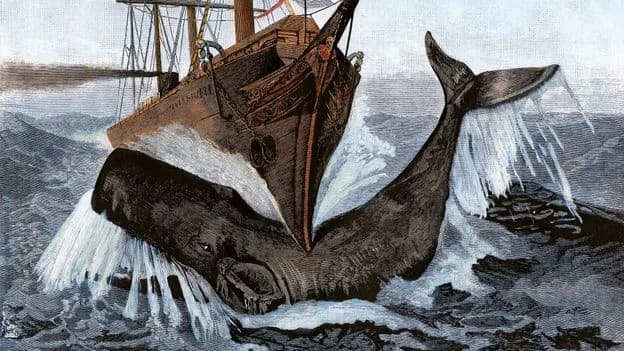
New research confirms that the spermaceti organ in sperm whales' heads functions as a battering ram, capable of delivering impacts strong enough to sink ships. This validates a theory proposed by 19th-century whaler Owen Chase, who survived the sinking of the Essex, the incident that inspired Herman Melville's Moby Dick. While the organ was historically harvested for oil, its role in combat and social behavior is only now being fully understood through modern drone footage and biomechanical analysis.
Key points
- The 1820 sinking of the whaleship Essex by a sperm whale, which inspired Moby Dick, was caused by the animal using its head as a weapon, a theory proposed by survivor Owen Chase.
- The spermaceti organ, a fatty structure in the whale's head weighing up to 9kg, acts as a buffer that allows the animal to ram without sustaining brain damage.
- Ecophysiologist Alec Burslem captured drone footage of sperm whales head-butting near the Balearic Islands and Azores, confirming the behavior exists in nature.
- A fully grown sperm whale striking at 4.5 meters per second could generate a force of approximately 1,200 kilonewtons, comparable to being hit by a bus at 65 km/h.
- Historical records show only three whaling ships were sunk by whales, all by sperm whales, including the Essex, the Ann Alexander in 1851, and the Kathleen in 1902.
Background
Previous coverage in August 2026 highlighted drone footage capturing sperm whales in head-on collisions, providing the first direct empirical evidence for the battering ram hypothesis. Additionally, earlier reports noted that sperm whales possess the largest brain by weight among animals, further emphasizing the complexity of the cranial structures involved in this behavior. The historical context of whaling, including recent moves by Iceland to ban commercial whaling, underscores the long-standing human interaction with these animals, which was driven by the demand for spermaceti oil.
Why it matters
This discovery bridges a 200-year gap between historical anecdote and modern scientific validation, resolving a long-standing debate in marine biology. It highlights the underestimated physical capabilities of marine mammals and provides a concrete explanation for historical maritime disasters. Understanding the function of the spermaceti organ also aids in conservation efforts, as researchers emphasize the need to protect these animals while they are still being studied, given that their full behavioral repertoire remains largely unknown.
What to watch
Researchers plan to continue using drone technology to monitor sperm whale behavior in the wild to determine how frequently head-butting occurs and its specific social or mating purposes. Further studies will likely explore the acoustic functions of the spermaceti organ, which may serve dual roles in combat and communication, as females use sound to assess the size of a male's organ for mating decisions.
Want the full story? Read the original reporting
Read on bbc.com