
1963: NASA's 'Flying Bathtub' Proves Wingless Lifting Bodies Can Land Safely
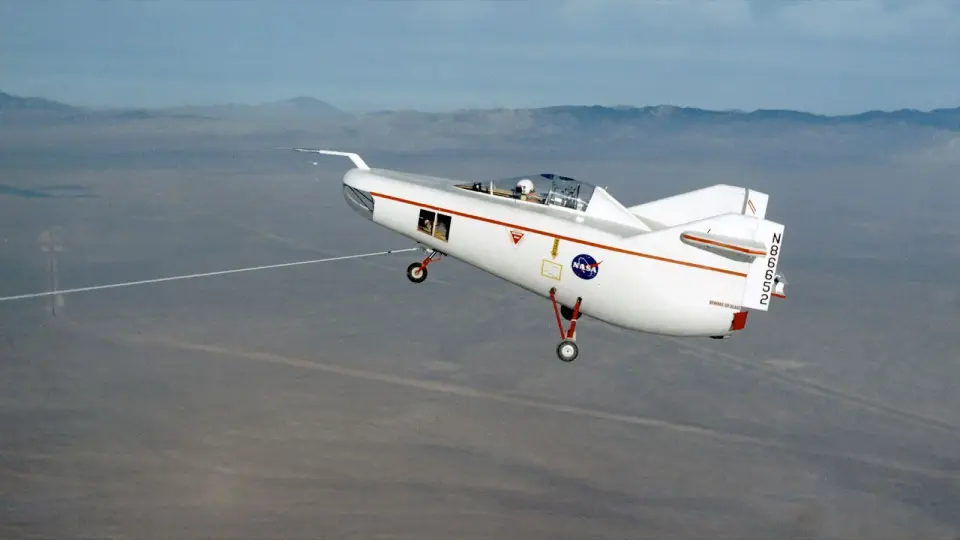
On August 16, 1963, NASA successfully tested the M2-F1, a wingless lifting-body prototype, by towing it to 5,200 feet and releasing it for a controlled glide and landing in California. This milestone validated an alternative to ballistic reentry for returning crewed spacecraft to Earth, paving the way for future lifting-body research and test vehicles.
Key points
- The M2-F1, described as resembling a 'flying bathtub,' completed its first glide flight on August 16, 1963.
- The aircraft was towed to 5,200 feet by a C-47 Skytrain and released for a two-minute descent.
- Test pilot Milt Thompson successfully landed the glider in California.
- The flight proved that a wingless lifting-body could be controlled and landed safely, offering an alternative to ballistic reentry.
- Although NASA initially chose capsule designs for Mercury, Gemini, and Apollo, the M2-F1 led to further lifting-body research, including the M2-F2, M2-F3, HL-10, and X-24A/B.
Background
This historical event occurred during the Cold War space race, when NASA was racing the Soviet Union for space access and lunar exploration. While NASA ultimately selected traditional capsule and heat shield designs for its early crewed programs, the lifting-body concept continued to evolve. Modern aerospace developments, such as China’s recent sea-based recovery of a reusable orbital booster and the U.S. eVTOL pilot program, reflect ongoing efforts to improve spacecraft and aircraft recovery and landing technologies, though these are distinct from the 1960s lifting-body research.
Why it matters
The M2-F1’s successful glide flight demonstrated a viable alternative to ballistic reentry, enhancing the safety and flexibility of returning crewed spacecraft to Earth. This research contributed to the development of a family of lifting-body test vehicles, influencing future aerospace design and recovery methods.
What to watch
No immediate future developments are mentioned in the source, as this is a historical retrospective. However, the legacy of lifting-body research continues to inform modern aerospace engineering and spacecraft recovery concepts.
Want the full story? Read the original reporting
Read on Space