Tag

Space Exploration

All articles tagged with #space exploration

FAA grounds SpaceX Starship V3 as mishap probe begins
space-exploration1 hour ago

FAA grounds SpaceX Starship V3 as mishap probe begins

After SpaceX's Starship V3 debut on May 22, the FAA labeled the flight a mishap and grounded the vehicle pending a SpaceX-led investigation overseen by the agency. Return to flight will depend on corrective actions that do not affect public safety, with no timeline disclosed. Starship V3 is a 408-foot deep-space-capable variant; the May flight saw the upper stage survive reentry while the booster ended with a hard splashdown in the Gulf of Mexico.

Roscosmos cosmonauts set for five-hour ISS spacewalk
space-exploration2 hours ago

Roscosmos cosmonauts set for five-hour ISS spacewalk

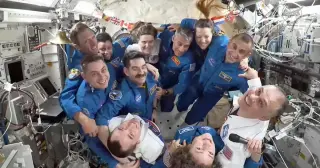
Two Russian cosmonauts, Sergei Kud-Sverchkov and Sergei Mikaev, will conduct a five-hour extravehicular activity outside the ISS to install a solar radiation experiment on the Zvezda module and remove hardware from Poisk and Nauka, with a possible photo of a Kurs antenna on Progress 94 if time allows. Coverage starts at 9:45 a.m. EDT (1345 GMT), with the EVA planned to begin around 10:15 a.m. EDT. Kud-Sverchkov has flown a spacewalk before, while Mikaev is on his first EVA; this is the second spacewalk of 2026.

Satellite Eyes Reveal Subsea Volcano Eruption, but Seafloor Remains a Puzzle
space-exploration20 hours ago

Satellite Eyes Reveal Subsea Volcano Eruption, but Seafloor Remains a Puzzle

NASA satellites imaged an underwater volcanic eruption in the Bismarck Sea near Papua New Guinea, but scientists lack high‑resolution seafloor maps to pin down the vent or how the eruption reshaped the seafloor; thermal anomalies and a growing plume indicate a shallow source, and a new island might form, though the timeline and exact effects remain uncertain, highlighting how satellite data guide deep‑ocean and future off‑Earth exploration.

Galileo’s 58-Minute Descent Unveils Jupiter’s Hidden Atmosphere
space1 day ago

Galileo’s 58-Minute Descent Unveils Jupiter’s Hidden Atmosphere

Galileo’s 1995 Jupiter probe descended into the gas giant, transmitting for about 58 minutes before the harsh pressures ended the signal; it provided the first in-situ measurements of a giant planet’s atmosphere—temperatures, pressures, densities, chemistry, and cloud structure—revealing a drier-than-expected hot-spot region and hotter, denser conditions, while highlighting the limitation that a single descent cannot characterize the entire planet.

Pillbug robot to shed thousands of tiny wind-powered drones for Martian lava-tube mapping
space-exploration2 days ago

Pillbug robot to shed thousands of tiny wind-powered drones for Martian lava-tube mapping

Scientists are proposing a biomimicry-inspired mission concept in which a pillbug‑like “roly‑poly” robot would crawl into Martian lava tubes and release thousands of micro‑drones (the “dandelion drones”). The drones would be powered by piezoelectric energy and carried into the caves by a parachute, then flown by Mars’ winds to map the tunnel network and collect environmental data. Because sunlight doesn’t reach the caves, the drones would not rely on solar power and would be painted white to travel farther. The plan highlights wind in caves as both a potential aid and a challenge, and includes a high‑powered fan to keep drones aloft if winds are weak. NASA and other groups have explored lava tubes on Mars and in analog sites, and the concept underscores broader interest in using drone swarms to scout difficult terrain (including future targets like Titan’s caves).

China Sends Lab-Grown Embryos to Space to Study Early Development in Orbit
space2 days ago

China Sends Lab-Grown Embryos to Space to Study Early Development in Orbit

China’s Tianzhou‑10 cargo mission delivered roughly 7 tons of supplies to the Tiangong space station and carried two types of living stem‑cell–based “artificial embryos” to study early human development in microgravity. Representing 14–21 days after fertilization, the peri‑implantation and peri‑gastrulation embryos will be grown for about five days in orbit, then frozen and returned to Earth for analysis to assess how space radiation and zero gravity affect embryo development—an important step for potential off‑Earth reproduction—though the researchers emphasize these are embryo‑like and not viable human embryos.

Earth’s Sub-Pixel Spotlight: Sagan’s Push Turns Voyager 1 Photo into a Timeless Icon
space3 days ago

Earth’s Sub-Pixel Spotlight: Sagan’s Push Turns Voyager 1 Photo into a Timeless Icon

In 1990, after Carl Sagan urged it, Voyager 1 photographed Earth from about 6 billion kilometers away, capturing a sub-pixel Pale Blue Dot; though scientifically minimal, the image gained iconic status through Sagan’s writing and a 2020 processing update, and with Voyager’s cameras long since turned off, it stands as the mission’s last full-family portrait of the solar system.

Voyager's Golden Record Still Speaks in 55 Languages as Power Fades
space3 days ago

Voyager's Golden Record Still Speaks in 55 Languages as Power Fades

NASA's JPL shut down Voyager 1's Low-energy Charged Particles instrument in 2026 due to dwindling plutonium power; both Voyager probes will likely go quiet in coming years, but the Golden Record—carrying greetings in 55 languages from Akkadian to Wu—remains as a timeless, symbolic self-portrait of humanity, a gesture rather than a scientific instrument, designed to convey Earth's diversity to any distant listener.

Hong Kong’s First Astronaut Joins China’s Shenzhou 23 Crew for a Year in Orbit
space-exploration3 days ago

Hong Kong’s First Astronaut Joins China’s Shenzhou 23 Crew for a Year in Orbit

China on May 24 will launch the three-person Shenzhou 23 crew—Zhu Yangzhu (commander), Zhang Zhiyuan (pilot) and Lai Ka-ying (payload specialist) from Hong Kong, who becomes Hong Kong’s first astronaut. One crewmember will spend a full year in orbit, a first for China, as the mission docks with the Tiangong space station. The flight, from Jiuquan, sets the stage for Shenzhou 24, which will include a Pakistani astronaut, while Shenzhou 21’s crew remains aboard Tiangong on an extended mission.

China's Shenzhou 23 set for Tiangong launch with Hong Kong's Lai Ka-ying aboard
space-exploration3 days ago

China's Shenzhou 23 set for Tiangong launch with Hong Kong's Lai Ka-ying aboard

China is preparing to launch Shenzhou 23 to the Tiangong space station on May 24 with crew Zhu Yangzhu, Zhang Zhiyuan and Lai Ka-ying for a six‑month stay; Lai will be Hong Kong's first orbiting astronaut, and one crew member is expected to embark on a year‑long orbit later as part of the Shenzhou 24 plan involving a Pakistani visitor (the specific astronaut to take the year‑long seat has not yet been named). The mission follows Shenzhou 21’s end and Shenzhou 22’s lifeboat role, and Tianzhou 10 arrived May 11 with nearly seven tons of supplies.

SpaceX’s Starship V3 debuts on Flight 12 as the most powerful Starship yet
space-exploration4 days ago

SpaceX’s Starship V3 debuts on Flight 12 as the most powerful Starship yet

SpaceX’s Starship V3 roared from Starbase on May 22, 2026 for Flight 12—the most powerful Starship yet—marking the first flight of the Version 3 core with upgrades like a new fuel transfer tube, faster PEZ deployment, 39 Raptors across two stages, three grid fins, and a reusable “hot stage ring.” The suborbital test culminated in fiery splashdowns of both the Super Heavy booster and the Ship upper stage. The launch advances SpaceX’s long-running Artemis program goals, with NASA eyeing Artemis 4 for a late‑2028 lunar landing and continuing discussions about Artemis 3 in Earth orbit and potential Blue Origin competition.

US-Sweden Forge Broad Tech Prosperity Pact to Accelerate AI, Quantum, and Space
technology4 days ago

US-Sweden Forge Broad Tech Prosperity Pact to Accelerate AI, Quantum, and Space

The United States and Sweden signed a non-binding Memorandum of Understanding to deepen bilateral collaboration across AI, secure connectivity, biomedical research, manufacturing, energy, space, defense, quantum tech, and research-security. A Joint Committee will oversee implementation, with activities to be defined in future agreements and within applicable laws; no funds are committed at this stage, and IP or data-sharing terms will be set in separate arrangements.

Huygens on Titan: the 2005 landing that still stands as humanity’s only outer-solar-system touchdown
space5 days ago

Huygens on Titan: the 2005 landing that still stands as humanity’s only outer-solar-system touchdown

ESA’s Huygens lander descended through Titan’s orange haze in January 2005, touched down after about 2.5 hours, and transmitted for roughly 72 minutes from the surface; as the part of the Cassini-Huygens mission, it remains the only landing in the outer solar system to date. Titan’s thick nitrogen-rich atmosphere, frigid surface around -179 C, and the mission’s long, multi-step descent informed future exploration (e.g., NASA’s Dragonfly) and underscored the scale and distance of far-off planetary exploration; the mission cost was about $3.9 billion.

Starship V3 Flight 12: SpaceX Braces for a Second Launch Attempt from Pad 2
space-exploration5 days ago

Starship V3 Flight 12: SpaceX Braces for a Second Launch Attempt from Pad 2

SpaceX is attempting a second liftoff of Starship Version 3 (V3), Flight 12, from Starbase Pad 2 during a 6:30–8:00 p.m. EDT launch window after yesterday’s scrub caused by a hydraulic-pin issue; the suborbital flight will carry 22 dummy Starlink satellites and two probes on a world-skimming trajectory, marking the V3 debut with upgrades and new pad infrastructure, with live coverage starting about 45 minutes before liftoff.

Venera 7: The 23-minute first data relay from Venus's surface
science5 days ago

Venera 7: The 23-minute first data relay from Venus's surface

On December 15, 1970, the Soviet lander Venera 7 became the first object to transmit from the surface of another planet, delivering about 23 minutes of data before its batteries overheated in Venus’s ~475°C heat and 90 atm pressure; a misfired parachute left the antenna poorly oriented, masking the success until a later tape review confirmed the surface transmission via temperature telemetry. Venus’s extreme environment has limited long-duration landers, a pattern the Venera program confirmed with successive missions, while future Venus exploration emphasizes orbiters and short descent probes (e.g., DAVINCI, EnVision, VERITAS) rather than long-lived landers.