
NVIDIA RTX Spark Mini PCs Launch for Local AI at $4,399
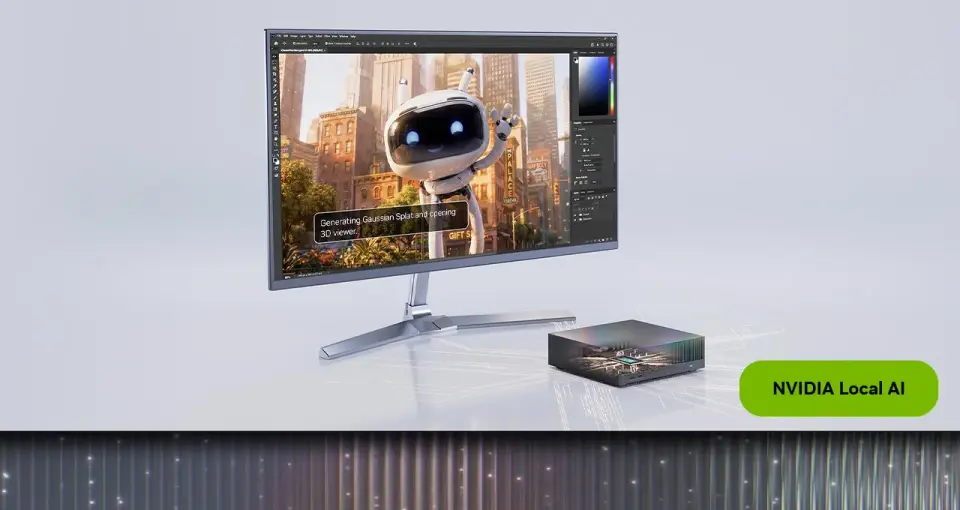
NVIDIA has released compact desktops powered by its RTX Spark N1X chip, featuring a 20-core Grace CPU, a 6,144-core Blackwell GPU, and up to 128 GB of unified memory. Priced starting at $4,399, these systems from ASUS, Dell, and MSI are designed for running large local AI models, such as 120-billion-parameter LLMs, without incurring cloud API costs. The devices support creative workflows, including image and video generation, and integrate with Adobe and Blender applications via native Windows on Arm support. Additional models from Acer, GIGABYTE, and HP are expected soon, alongside the Microsoft Surface RTX Spark Dev Box.
Key points
- The new RTX Spark compact desktops feature a 20-core NVIDIA Grace CPU, a Blackwell RTX GPU with 6,144 CUDA cores, and up to 128 GB of unified memory, delivering up to 1 petaflop of AI performance.
- Initial models from ASUS, Dell, and MSI are available now, with mini PCs from Acer, GIGABYTE, and HP, as well as the Microsoft Surface RTX Spark Dev Box, coming soon.
- The systems support running massive 120-billion-parameter large language models locally, rendering 90 GB+ 3D scenes in real time, and editing 4:2:2 video smoothly.
- Adobe has expanded native Windows on Arm support for Premiere, Photoshop, Illustrator, InDesign, and Substance 3D Painter, with Premiere offering over 50% quicker turnaround on H.264 video deliverables.
- Blender 5.3 integrates DLSS 4.5 Ray Reconstruction into the Cycles viewport for near-final-quality ray-traced previews in real time.
- NVIDIA Switchyard, available in Hermes, automatically routes agent tasks between local and cloud models to manage costs, while native CUDA support and Windows Subsystem for Linux enable local AI workflows.
Background
NVIDIA launched its RTX Spark compact desktops on November 18, 2026, to compete with Apple's Mac Studio and AMD workstations in the local AI market. The devices are priced starting at $4,399 and feature the N1X Superchip with a 20-core Grace CPU, 6,144-core Blackwell GPU, and up to 128 GB of unified memory. They are designed for running large local AI models, such as 120-billion-parameter LLMs, without cloud API costs. Initial models from ASUS, Dell, and MSI are available now, with others from Acer, HP, and Lenovo following soon. This launch follows the release of the Microsoft Surface Laptop Ultra, which also uses the RTX Spark chip but faces criticism for its high price and Windows-on-ARM limitations compared to Apple's M5 MacBook Pro.
Why it matters
The launch of NVIDIA RTX Spark compact desktops marks a significant shift in the AI hardware market, targeting users who need to run large local AI models without relying on cloud services. By offering up to 128 GB of unified memory and 1 petaflop of AI performance, these systems enable developers and creators to handle massive 120-billion-parameter LLMs, real-time 3D rendering, and high-resolution video editing locally. This reduces dependency on cloud API charges and keeps sensitive data on-premises. The integration with Adobe and Blender applications via native Windows on Arm support further solidifies NVIDIA's position in the creative and development sectors, challenging Apple's dominance in the high-end workstation market. As AI workflows become more complex, the ability to run agents and scheduled tasks on dedicated hardware becomes increasingly valuable for professionals.
What to watch
Additional RTX Spark mini PCs from Acer, GIGABYTE, and HP are expected to launch soon, along with the Microsoft Surface RTX Spark Dev Box. NVIDIA and Adobe will continue to expand native Windows on Arm support and RTX acceleration across their creative applications, with Adobe previewing a next-generation image processing engine with extensive GPU acceleration. Developers can now bring any GGUF model from Hugging Face and run it within Windows ML using the llama.cpp backend, while the DxCGC backend offers an experimental release for game developers to compile and run machine learning models through DirectX 12. NVIDIA DGX Station for Windows will also support Windows Server 2028, expanding hardware choice for organizations needing to run AI closer to their enterprise applications and data.
Want the full story? Read the original reporting
Read on TechPowerUp