
Big Walk Turns Social Friction Into a Cooperative Puzzle
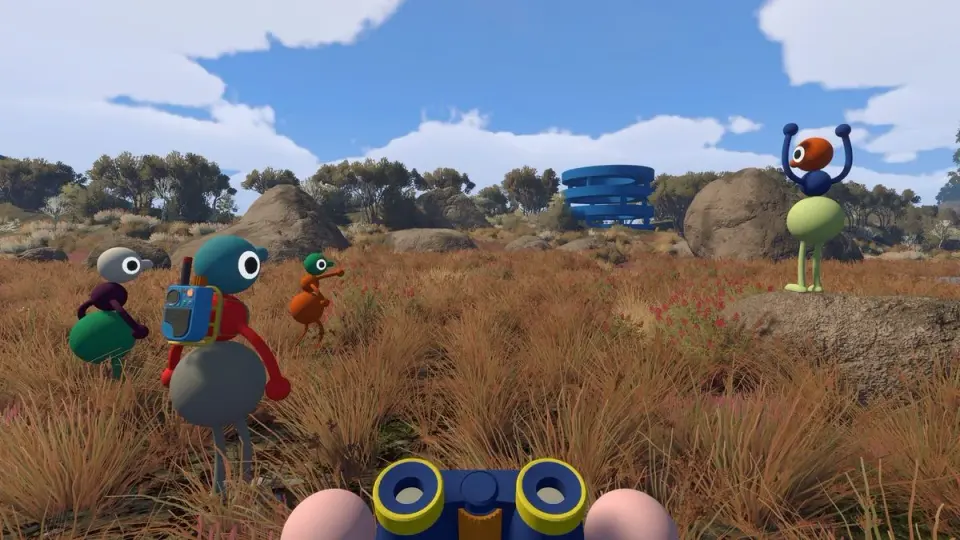
Big Walk, a new co-op puzzle adventure from House House, forces players to rely on proximity chat and physical coordination to navigate a vast, photorealistic island. The game, which launched on August 4, 2026, is praised for its emphasis on shared discovery and communication, though some critics note that the extensive walking and backtracking can occasionally feel tedious.
Key points
- Big Walk is a multiplayer-only game requiring at least two players, with a maximum of 12, and is developed by House House, the studio behind Untitled Goose Game.
- The game features a large open world with a day/night cycle, where players must solve puzzles to collect 'red beans' or 'gourds' to unlock new areas and infrastructure like trains.
- Communication is central to the gameplay, utilizing proximity voice chat, walkie-talkies, and non-verbal gestures, as the game discourages the use of external chat apps like Discord.
- The game is available on PC, PlayStation 5, Nintendo Switch 2, and Mac, and was included in the PS Plus Essential lineup for August 2026.
- Critics and players highlight the joy of shared discovery and the 'friendslop' experience, but some note that the lack of explicit guidance and the need for constant coordination can be a barrier.
Background
Big Walk was announced as a major title for House House, following their 2019 hit Untitled Goose Game. It was revealed as part of the PS Plus Essential August 2026 lineup, alongside Signalis and Dying Light 2 Stay Human: Reloaded Edition, and launched on August 4, 2026. The game was compared to Zelda: Breath of the Wild for its open-world exploration, but with a mandatory co-op twist.
How outlets are covering it
Aftermath's Riley MacLeod emphasizes the game's charm in its chaos, noting that the fun comes from 'totally screwing things up' and the joy of overcoming limitations together. The Guardian's review highlights the game's 'architectural fever dream' setting and its focus on 'childlike playfulness' and enriching connections, contrasting it with the 'attention-holding logic' of modern digital life. The Verge's Jay Peters compares it to a 'co-op Breath of the Wild,' focusing on the vast world and the lack of explicit guidance, which forces players to communicate. Game Informer's Eric Van Allen praises the 'tactile' movement and the 'summer camp' feel of the puzzles but notes that the walking can become finicky and the pace slows as players focus on unlocking the island. All sources agree on the game's strong emphasis on communication and shared experience, but they differ on whether the mandatory co-op and lack of solo play are a barrier or a feature.
Why it matters
Big Walk represents a shift in co-op game design, moving away from competitive or split-screen experiences to a more intimate, communication-focused model. Its success, if it is one, could influence how future games design for social interaction and shared discovery, potentially making 'friendslop' a more sustainable and valued genre. The game's inclusion in PS Plus also suggests a market for such niche, social-focused titles.
What to watch
Players who have not yet started Big Walk will need to coordinate schedules with friends to begin the game, as progress is tied to a specific host. The game's long-term success will depend on whether the initial excitement of shared discovery can sustain player interest through the more tedious backtracking and puzzle-solving phases. House House may also release updates or new content to keep the community engaged.
Want the full story? Read the original reporting
Read on Aftermath