
US Launches Massive Retaliatory Strikes on Iran After Intercepted Missile Attack
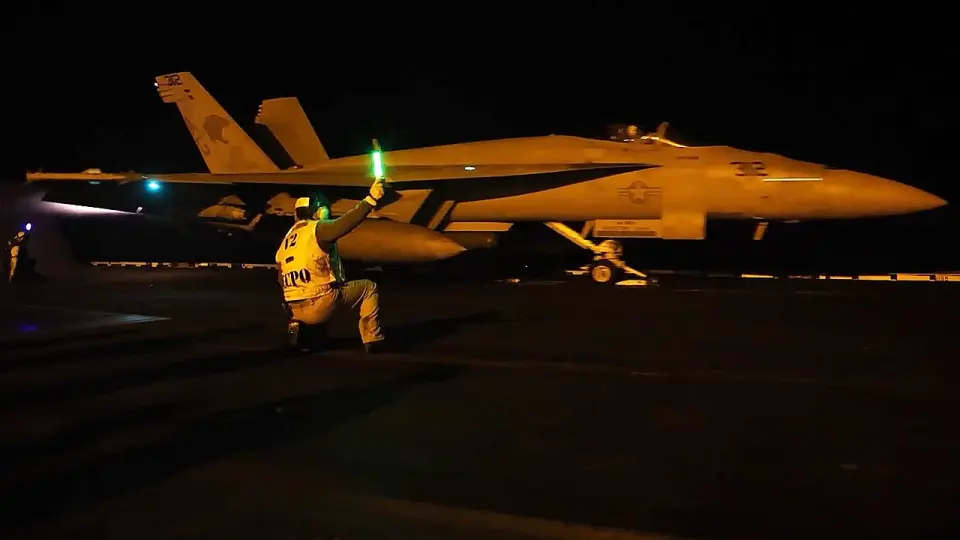
US forces conducted a two-hour 'heavy wave' of strikes against dozens of Iranian targets, including command centers and missile facilities, in retaliation for a surprise ballistic missile attack on US troops in Jordan. All incoming missiles were intercepted, but the escalation has triggered a surge in oil prices and renewed threats from Iran's Revolutionary Guard.
Key points
- US Central Command (CENTCOM) confirmed the completion of a major strike operation against Iran, targeting military command centers, drone facilities, and coastal defense sites.
- The strikes were a direct response to a surprise Iranian ballistic missile attack on US forces at Muwaffaq Salti Air Base in Jordan, which was fully intercepted by air defenses.
- Iran's Revolutionary Guard Corps (IRGC) threatened to 'punish the aggressor' and asserted 'full control' of the Strait of Hormuz, warning that nations aiding the US would face harsh consequences.
- Brent crude oil prices jumped approximately 7.3% to $88.09 per barrel following the escalation, while the US and Saudi Arabia also conducted joint strikes against Iran-backed militias in Iraq.
- President Trump vowed to 'hit them hard,' while the Senate rejected a Democrat-backed War Powers resolution aimed at limiting the conflict, with 64% of US adults opposing the war in a recent poll.
Background
This escalation follows a five-month conflict that began in late February 2026. Previous incidents, including the deaths of US service members in Jordan and attacks on Saudi oil facilities by Houthis, have already strained regional stability. An interim peace deal mediated by Pakistan collapsed in recent weeks, leading to a resumption of hostilities. The current flare-up occurs as mediators attempt to restore calm, though the US has halted previous fire to allow diplomatic space, which has now been disrupted by the latest Iranian attack.
How outlets are covering it
Fox News emphasized the 'heavy wave' of strikes and Trump's vow to 'beat' Iran, framing the action as a necessary defense against a 'more dangerous' regime. AP News highlighted the broader regional impact, including joint US-Saudi strikes in Iraq that killed at least 20 fighters and six Iranian advisers, and noted the risk of a return to all-out war. CNBC focused on the economic fallout, citing a 7.9% spike in oil futures and the IRGC's assertion of control over the Strait of Hormuz. The New York Times, while behind a paywall, framed the event as Trump encountering a 'more determined adversary' in a widened war. All sources agree on the interception of the initial Iranian missiles but differ in emphasis: Fox on military dominance, AP on diplomatic collapse, and CNBC on market volatility.
Why it matters
The conflict has moved beyond a bilateral dispute to a regional crisis involving Iraq, Jordan, and Saudi Arabia. The closure of the Strait of Hormuz and attacks on energy infrastructure threaten global supply chains and have already driven oil prices to $90 per barrel. With public support for the war declining in the US and the Senate rejecting War Powers limits, the risk of prolonged, high-intensity conflict remains high.
What to watch
Iran has threatened immediate retaliation, while the US maintains a blockade of Iranian ports, having redirected 20 commercial vessels. Diplomatic efforts are ongoing, with Pakistan attempting to revive the June memorandum of understanding, but mediators report 'cold water' on swift de-escalation. The US Navy is also overhauling its torpedo stockpiles to prepare for a potential 'two-war' strategy, indicating long-term military preparation.
- American forces hit ‘dozens’ of Iranian targets following attempted attack on US troops Fox News
- Iran war live: US strikes Iran again as war widens with attack on Egypt port Reuters
- US launches strikes on Iranian targets a day after it foiled missile attack on American forces AP News
- U.S. Strikes Iran Again, as Trump Encounters a More Determined Adversary in Widened War The New York Times
- Iran says it will 'punish the aggressor today' after 'heavy wave' of U.S. strikes CNBC
Want the full story? Read the original reporting
Read on Fox News