
Lab-grown brain organoids reveal an intrinsic developmental clock that records years in culture
TL;DR
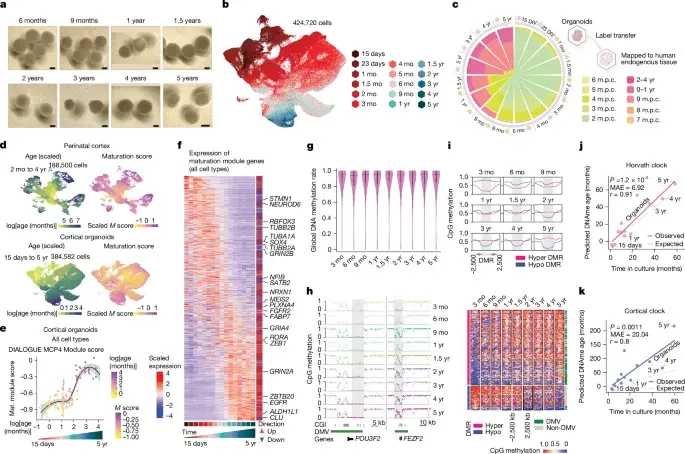
Researchers cultured human cortical organoids for over five years and found that they age along with in vivo humans, showing transcriptional maturation and DNA methylation changes that track culture time. Epigenetic clocks predicted the organoids’ age with high accuracy, and mixed-age (heterochronic) organoids demonstrated that older progenitors retain a memory of past development and can be steered to produce late-stage neurons, skipping earlier fates. This work positions long-term organoid culture as a powerful in vitro model to study postnatal human brain maturation and neoteny.
Topics:top-newsneuroscience#aging#brain-organoids#developmental-timing#epigenetics#memory-of-development#neuroscience
- Human brain organoids record the passage of time over multiple years Nature
- Unprecedented: Scientists Have Built Miniature Brains That Experience The Passage Of Time ScienceAlert
- ‘Mini brains’ kept alive for years appear to age like real brains Scientific American
- Brain organoid maturation is driven by a lifelike developmental clock National Institutes of Health (NIH) | (.gov)
- 5-year-old brain organoids can sense the passing of time New Scientist
Want the full story? Read the original reporting
Read on Nature