
Poland's Constitutional Crisis Peaks as President Physically Confronts Judges
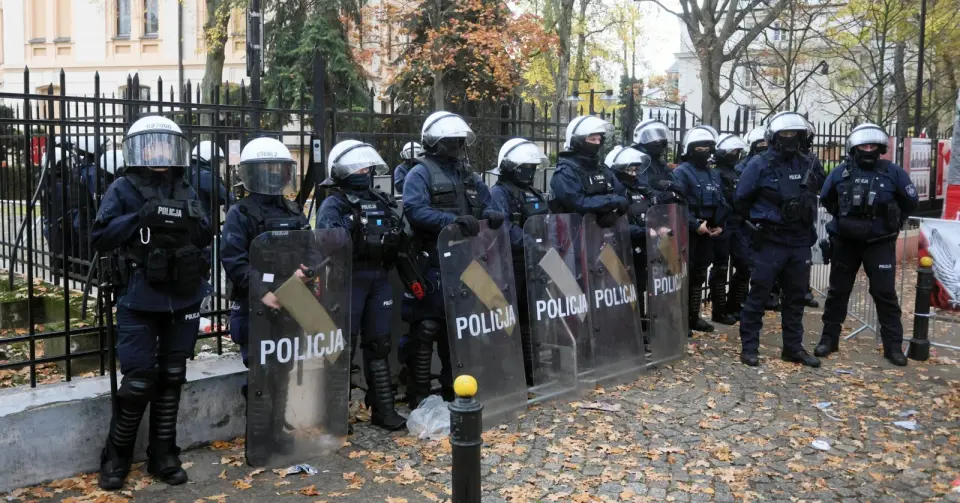
Polish President Karol Nawrocki physically forced his way into the Constitutional Tribunal on Saturday morning after government-backed judges suspended Chief Justice Bogdan Święczkowski. Nawrocki, an ally of the opposition Law and Justice party, had aborted a state visit to Senegal to return to Warsaw. He accused the government of staging a coup, while Prime Minister Donald Tusk defended the move as necessary to restore judicial independence. Riot police surrounded the building, and Nawrocki called for urgent political consultations to resolve the standoff.
Key points
- President Karol Nawrocki physically pushed past judges, including Anna Korwin-Piotrowska, to enter the Constitutional Tribunal building around 1 a.m. on Saturday.
- Nawrocki had been flying to Senegal for a state visit but turned his plane around mid-air after the crisis broke out on Friday evening.
- Government-backed judges suspended Chief Justice Bogdan Święczkowski and his deputy, Bartłomiej Sochański, with Korwin-Piotrowska assuming acting leadership.
- Nawrocki accused the government of a 'forcible takeover' of a constitutional body, while Justice Minister Waldemar Żurek called the president's behavior 'shameful'.
- Riot police surrounded the court, blocking Święczkowski's entry and detaining three protesters who attempted to breach the security fence.
- Nawrocki announced urgent consultations with parliamentary groups on Saturday afternoon to 'restore the legal order', though coalition partner The Left refused to attend.
Background
The dispute stems from a years-long crisis over the Constitutional Tribunal's legitimacy. Since 2015, the former Law and Justice (PiS) government appointed judges to gain a majority, a move later ruled improper by European courts. The current Tusk government, in power since 2023, refused to recognize these judges and ignored the court's rulings. In March 2026, the government began filling vacancies, but President Nawrocki refused to swear in five new judges, including Korwin-Piotrowska, citing procedural flaws. This led to a standoff where the government-backed judges attempted to take control of the court, while Święczkowski and PiS allies resisted.
How outlets are covering it
Notes From Poland and USA Today emphasize the physical confrontation, with Nawrocki pushing past judges and verbally declaring them 'not Constitutional Tribunal judges'. BBC and CNN highlight the broader political clash, noting that Tusk's government views the move as restoring rule of law, while PiS and Nawrocki frame it as a coup. BBC notes that European courts had previously ruled the PiS-appointed judges improper, while CNN points out that PiS leader Jarosław Kaczyński and far-right politicians rallied outside the court. Notes From Poland and BBC note that coalition partner The Left refused to attend Nawrocki's consultations, while Poland 2050 and PSL agreed to participate. USA Today notes that Nawrocki refused to swear in three of six judges earlier in the year, while BBC and CNN confirm he refused to swear in five of eight new judges this year.
Why it matters
The crisis threatens to paralyze Poland's top court and deepen the constitutional standoff between the pro-European government and the nationalist opposition. It could impact Poland's EU relations and the rule of law, with European courts having previously criticized the PiS-era judicial reforms. The physical confrontation and police deployment signal a potential escalation in political violence, while the refusal of some coalition partners to engage in consultations suggests a deepening political divide. The crisis also raises questions about the legitimacy of the court and the government's ability to restore judicial independence.
What to watch
Nawrocki is expected to hold urgent consultations with parliamentary groups on Saturday afternoon to 'restore the legal order'. The government may pursue criminal charges against Święczkowski and his deputy, while the opposition may continue to rally outside the court. The outcome of the consultations will determine whether the standoff is resolved or escalates further. The crisis may also impact Poland's EU relations and the rule of law, with European courts having previously criticized the PiS-era judicial reforms.
- Polish president in physical confrontation with judges amid power struggle at constitutional court Notes From Poland
- Police deployed during stand-off over control of top Poland court BBC
- Polish president accuses Tusk of forced takeover of country's top court USA Today
- Police detain 3 protesters during overnight rally as Polish president backs suspended judge CNN
- Poland crisis explained: a dispute over legitimacy and the courts Euronews.com
Want the full story? Read the original reporting
Read on Notes From Poland