
Europe’s 27-Year Wait Ends as Total Eclipse Darkens Iceland and Spain
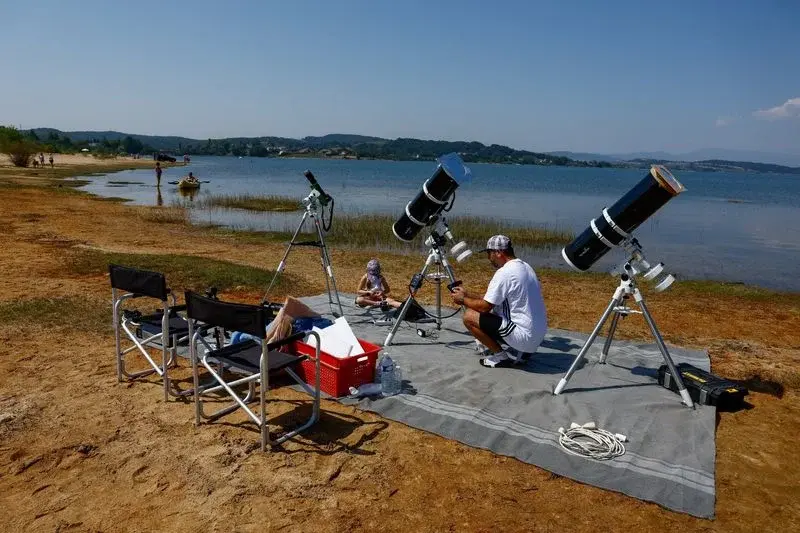
On August 12, 2026, a total solar eclipse swept across western Iceland and northern Spain, marking the first such event in Western Europe in 27 years. Millions gathered to watch the sky darken for up to two minutes, while authorities managed massive crowds and extreme wildfire risks.
Key points
- Totality hit Iceland’s western coast at 17:44 GMT, lasting up to 2 minutes and 13 seconds, though clouds obscured views in some areas.
- Spain expected up to 6 million visitors in rural northern regions and the Balearic Islands, with 25,000 police officers deployed for security.
- Interior Minister Fernando Grande-Marlaska warned of extreme wildfire risks due to heatwaves, deploying nearly 100 planes and helicopters for monitoring.
- NASA launched balloons and flew a WB-57 aircraft from Iceland to study atmospheric changes during the sudden darkness.
- The event is part of the 'Iberian Eclipse Trio,' followed by another total eclipse in August 2027 and an annular eclipse in January 2028.
Background
Previous coverage noted the August 12 eclipse as a rare double-header with the Perseid meteor shower peak, with optimal viewing spots identified in Castile and León, Spain, and Látrabjarg, Iceland. Earlier reports highlighted the narrow path of totality and the importance of eye safety, while noting that North America would only see a partial eclipse.
How outlets are covering it
Reuters emphasized the logistical scale in Spain, highlighting the massive police operation and wildfire precautions, while The Guardian focused on the communal and emotional experiences of viewers across the UK, Cornwall, and London, noting the partial eclipse’s impact on daily life and wildlife behavior. Both sources confirmed the historic nature of the event for Europe, but Reuters stressed the scientific and security aspects, whereas The Guardian highlighted the cultural and social moments, such as shared picnics and impromptu telescope gatherings.
Why it matters
The eclipse served as a major tourism and scientific opportunity, showcasing remote regions and advancing atmospheric research, while also testing emergency response systems due to extreme wildfire risks and crowd management challenges.
What to watch
The next total solar eclipse visible from the Iberian Peninsula is scheduled for August 2, 2027, followed by an annular eclipse in January 2028, completing the 'Iberian Eclipse Trio.' The next total eclipse visible from the UK, France, and mainland Europe is not expected until September 2081.
- Millions of people in Iceland and Spain set for 'event of the century' eclipse AOL.com
- WATCH LIVE: Total solar eclipse darkens skies over Spain, Iceland PBS
- Live Updates: Europe’s First Total Solar Eclipse in Decades Is Turning Day to Dark The New York Times
- Europe solar eclipse live: millions flock to viewing spots in Spain, UK and Iceland The Guardian
- Spain's solar eclipse trilogy: Spectacle starts August 12 dw.com
Want the full story? Read the original reporting
Read on AOL.com