
NASA CHAPEA Crew Exits Houston Habitat After 378-Day Mars Simulation
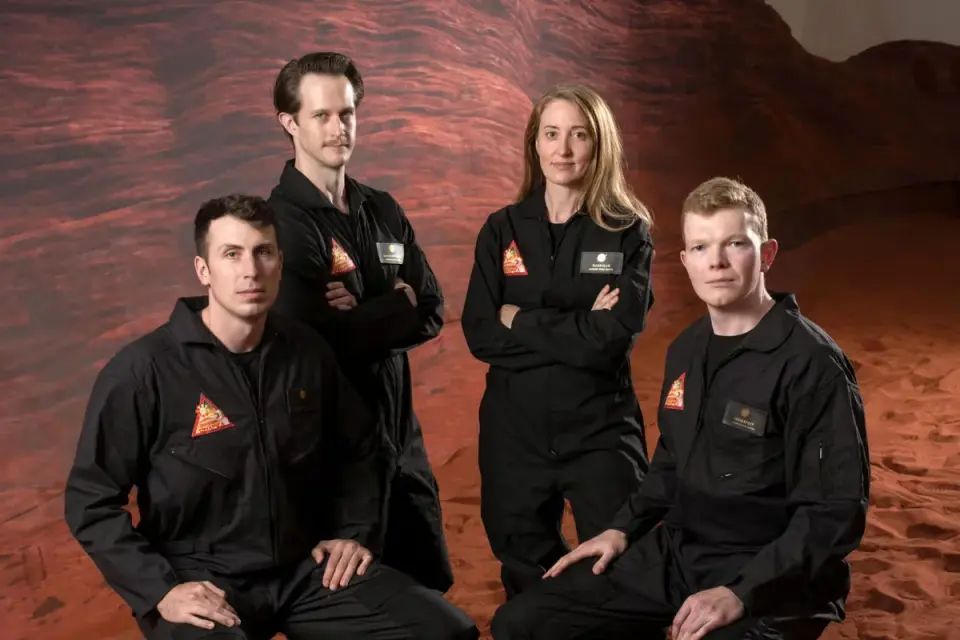
Four NASA volunteers emerged from a 3D-printed habitat in Houston on October 31, 2026, after 378 days of isolation to simulate a Mars mission. The Crew Health and Performance Exploration Analog (CHAPEA) Mission 2 tested long-duration isolation, communication delays, and crop cultivation to prepare for future lunar and Martian exploration. The crew will undergo two weeks of post-mission evaluations, while NASA plans to transition the program into a broader Moon and Mars Exploration Analog (MMEA) starting in 2027.
Key points
- The CHAPEA Mission 2 crew, consisting of Ross Elder, Ellen Ellis, Matthew Montgomery, and James Spicer, exited their 1,700-square-foot habitat at NASA’s Johnson Space Center on October 31, 2026.
- The 378-day isolation began on October 19, 2025, and involved simulating Mars conditions, including communication delays of up to 44 minutes and a two-week blackout period mimicking solar interference.
- Crew members performed tasks such as growing crops in simulated Martian soil, maintaining habitat systems, and conducting simulated spacewalks to generate data for future Artemis and Moon Base missions.
- NASA director Vanessa Wyche emphasized that the mission provided critical insights into resource management, crew health, and behavioral support for long-duration spaceflight.
- Following the exit, the crew will participate in two weeks of post-mission evaluations and debriefing with NASA scientists to analyze health and performance data.
- NASA plans to evolve the CHAPEA program into the Moon and Mars Exploration Analog (MMEA), with a potential start date of August 2027, focusing on preparation for the lunar base and eventual Mars missions.
Background
This event follows the first CHAPEA mission, which ran from 2023 to 2024, and aligns with NASA’s broader strategy to return humans to the Moon before attempting a Mars landing in the 2030s. Recent developments include the launch of Japan’s MMX mission to Phobos and NASA’s SkyFall helicopter deployment plans, highlighting a multi-agency push toward deep-space exploration. The CHAPEA data aims to address human factors in spaceflight, complementing robotic missions like Mars Odyssey and MRO, which have exceeded their design lifespans.
How outlets are covering it
The Independent and Houston Public Media both highlighted the crew’s emotional and physical endurance, with Ellen Ellis emphasizing the urgency of maintaining U.S. space leadership amid political shifts, including the proposed National Space Academy. Houston Public Media detailed the logistical challenges, such as the 44-minute communication delays and the crew’s limited contact with the outside world, while NASA’s official advisory focused on the scientific utility of the data for Artemis and Moon Base missions. All sources agreed on the mission’s success in simulating Mars conditions, but Houston Public Media uniquely noted the crew’s isolation from current events, including the Artemis II mission and Trump’s visit to Johnson Space Center during their stay.
Why it matters
The CHAPEA Mission 2 provides critical human-factor data for NASA’s long-term exploration goals, informing how astronauts can maintain health, productivity, and morale during extended isolation. The findings will directly influence the design of lunar habitats and future Mars missions, ensuring that human crews can survive and thrive in deep space. Additionally, the transition to the MMEA program signals a shift toward more comprehensive analog testing, bridging the gap between robotic exploration and crewed missions.
What to watch
The CHAPEA crew will complete two weeks of post-mission evaluations and debriefing with NASA scientists. NASA is expected to launch the Moon and Mars Exploration Analog (MMEA) program as early as August 2027, potentially coinciding with the Artemis IV lunar mission. The data collected will refine food systems, communication protocols, and medical support for future deep-space missions.
- NASA crew emerges after 378 days in isolation in 3D-printed habitat The Independent
- Crew from NASA's simulated Mars mission emerges after 378 days in isolation Reuters
- They spent more than a year inside a NASA hangar in Houston simulating life on Mars. Now, they’re finally out Houston Public Media
- Four volunteers just finished a year in isolation in Houston, all in the name of space exploration KHOU
- NASA Invites Media to Crew Completion of Yearlong Mars Simulation NASA (.gov)
Want the full story? Read the original reporting
Read on The Independent