
ESA’s Hera Reveals Stadium-Sized Crater and Debris Field on Asteroid Dimorphos
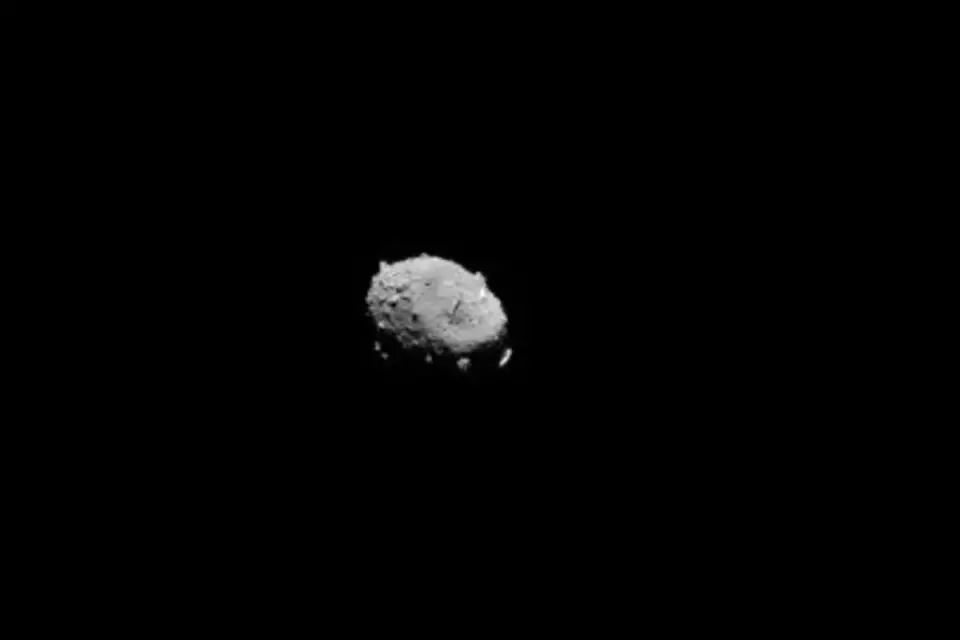
The European Space Agency has released the first close-up images from its Hera spacecraft, revealing a stadium-sized crater on asteroid Dimorphos caused by NASA’s 2022 DART impact. The images show the asteroid’s face is flattened and it is tumbling chaotically, while hundreds of unexpected boulders now encircle the binary asteroid system. These findings confirm that the DART mission successfully altered the asteroid’s orbit by 33 minutes, though the extent of the physical damage and debris field exceeded initial predictions. Scientists are now using this data to refine planetary defense models, with further close-up observations and CubeSat deployments scheduled for late 2026 and early 2027.
Key points
- ESA’s Hera spacecraft, which arrived at the Didymos-Dimorphos system in early November 2026, has released the first detailed images of asteroid Dimorphos since NASA’s DART mission impacted it in September 2022.
- The images reveal a crater so large it spans the entire width of the 151-meter-wide asteroid, effectively flattening one face, a result that surprised scientists who debated whether the impact would create a crater, reshape the body, or do both.
- Hera has detected hundreds of previously unknown boulders orbiting the binary asteroid system, some as large as a washing machine, which pose a collision risk for the spacecraft and complicate future navigation.
- The DART impact shortened Dimorphos’s orbit around Didymos by 33 minutes, a change 25 times greater than the most conservative predictions, confirming the viability of kinetic impact deflection.
- The images were unveiled at the Museum of Natural History in Berlin, with scientists emphasizing the importance of validating planetary defense techniques to prevent future catastrophic impacts.
Background
NASA’s Double Asteroid Redirection Test (DART) deliberately struck the asteroid Dimorphos on September 26, 2022, at a speed of approximately 13,700 mph to test whether a spacecraft could alter an asteroid’s trajectory. While ground-based telescopes confirmed the orbital change, the physical aftermath remained unclear. ESA’s Hera mission, launched in October 2024, was designed to survey the impact site and provide detailed data on the crater, debris, and mass of Dimorphos to improve future deflection models. The Didymos-Dimorphos system poses no threat to Earth but serves as a testbed for planetary defense strategies.
How outlets are covering it
All four sources agree that the Hera images reveal a stadium-sized crater and a chaotic tumble of Dimorphos, confirming the success of the DART mission. However, they differ in emphasis: The Independent and CNN focus on the visual spectacle of the crater and the 'nightmare' of the unexpected boulder field, while The New York Times highlights the scientific mystery of the crater’s size and the 'booster effect' of the debris. The Washington Post emphasizes the 'utterly transformed' nature of the asteroid and the challenge of mapping its new state. All sources note the surprise of the debris field, with CNN and The New York Times quoting scientists describing it as a 'nightmare' for navigation, while The Independent focuses on the 'chaotic tumbling' of the asteroid.
Why it matters
The findings from Hera provide critical data for refining planetary defense strategies. By understanding how a rubble-pile asteroid like Dimorphos reacts to a kinetic impact, scientists can better predict the outcomes of future deflection attempts. The discovery of the extensive debris field highlights the risks and complexities of such missions, while the confirmed orbital change validates the DART technique as a viable method for protecting Earth from potential asteroid threats.
What to watch
Hera is scheduled to approach the asteroids to a distance of about 13 kilometers in December 2026 to capture higher-resolution images and measure Dimorphos’s mass. In January 2027, the spacecraft will deploy two CubeSats, Juventas and Milani, to venture closer and potentially land on Dimorphos to study its internal structure and composition. The mission will continue until at least June 2027, with the goal of providing a comprehensive model of the DART impact for future planetary defense planning.
- Images reveal huge crater after Nasa collision with asteroid to test Earth’s defences The Independent
- Europe’s Hera Mission Releases Close-Up Images of the Asteroid Hit by a NASA Spacecraft The New York Times
- ESA mission reveals stadium-size crater left by first planetary defense test CNN
- NASA hit an asteroid to test planetary defense. Here’s what happened. The Washington Post
- Hera spacecraft gets 1st up-close look at stadium-sized hole punched in asteroid by NASA DART mission Space
Want the full story? Read the original reporting
Read on The Independent