
Euclid telescope releases first major data set, mapping 900 million galaxies and 15,000 gravitational lenses
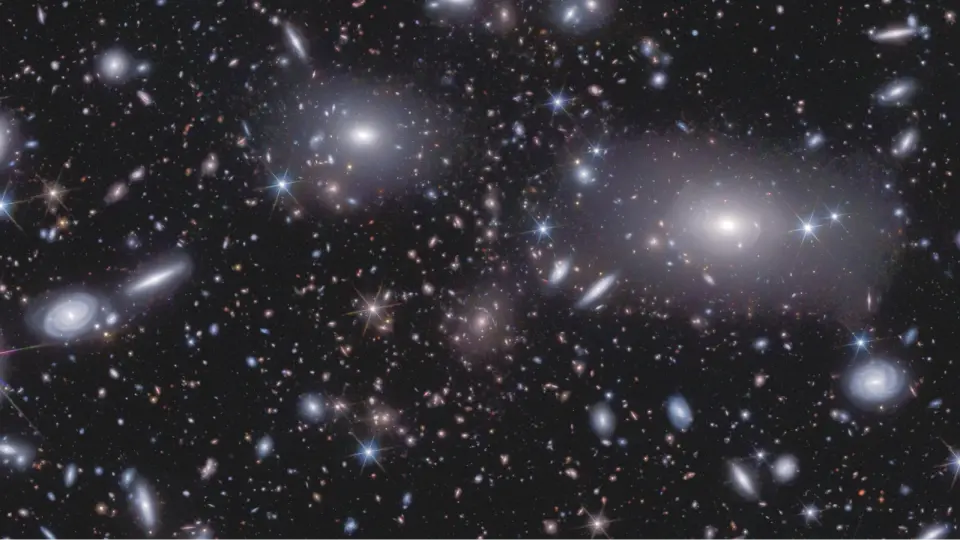
The European Space Agency’s Euclid space telescope has released its first major data set, DR1-Foundation, cataloging over 900 million galaxies and 60 million quasars. This initial release covers 14% of the telescope’s total survey area and includes 15,000 strong gravitational lensing candidates, providing a foundational dataset to map the distribution of dark matter and dark energy across the universe.
Key points
- The data release, named DR1-Foundation, was published on November 12, 2026, after 13 months of observation.
- The dataset contains 1.7 million gigabytes of data, covering a sky area 9,500 times larger than the full moon.
- Euclid identified 15,000 strong gravitational lensing candidates, a significant increase from the approximately 1,000 previously known cases.
- The telescope aims to map 95% of the universe’s contents, specifically dark matter and dark energy, which constitute the majority of cosmic mass and energy.
- The next major data release is expected in June 2027, focusing on weak gravitational lensing and galaxy distribution.
Background
Euclid was launched in July 2023 with a six-year mission to create the largest 3D map of the universe. Previous coverage highlighted its potential to probe dark matter, while earlier Hubble data demonstrated the utility of gravitational lensing in mapping cosmic structures. This release marks the first major scientific output from the mission.
How outlets are covering it
Live Science emphasizes the sheer scale of the data, noting 900 million galaxies and 15,000 lenses as a scientific milestone. Phys.org highlights the cosmological implications, focusing on the 95% of the universe composed of dark matter and energy, and notes that the first cosmological analyses are expected in June 2027. The Guardian focuses on the technological leap, contrasting Euclid’s wide-field, high-resolution capability with Hubble’s narrower but deeper imaging, and notes that the 15,000 lensing candidates could help determine the nature of dark matter. ESA provides detailed imagery of the Messier 81 galaxy group, illustrating the telescope’s resolution and the presence of foreground galactic cirrus.
Why it matters
This data release provides the first comprehensive, high-resolution map of a significant portion of the universe, enabling scientists to test theories about dark matter and dark energy. The 15,000 gravitational lensing candidates offer a new way to study the distribution and properties of dark matter, potentially resolving fundamental questions in cosmology and physics.
What to watch
The next major data release is expected in June 2027, which will include results on galaxy distribution and weak gravitational lensing. Scientists will use the current dataset to begin constructing a 3D model of the universe and analyzing the statistical properties of dark matter.
- Euclid telescope unveils breathtaking photos of 900 million galaxies in first major data release Live Science
- Space telescope Euclid sets the new standard for cosmology Phys.org
- European survey reveals 900m galaxies – and possibly secrets of ‘dark universe’ | Astronomy The Guardian
- Euclid views the core of the Messier 81 galaxy group ESA
- Dark matter breakthrough coming? Euclid space telescope unveils its 1st look into the dark universe (video) Space
Want the full story? Read the original reporting
Read on Live Science