Tag

Gravitational Lensing

All articles tagged with #gravitational lensing

Dense Dark Matter Clumps Might Unify Three Cosmic Puzzles
science11 days ago

Dense Dark Matter Clumps Might Unify Three Cosmic Puzzles

A UC Riverside study proposes that dense clumps of self-interacting dark matter (SIDM) can undergo gravothermal collapse to form compact cores that explain three different observations—an ultra-dense object in the gravitational lens JVAS B1938+666, perturbations in the GD-1 stellar stream, and the unusually young, metal-rich Fornax 6 globular cluster in the Fornax dwarf galaxy—linking distant lensing, our Galaxy, and a satellite galaxy under one mechanism, unlike collisionless CDM. The work, published in Physical Review Letters, is supported by the John Templeton Foundation and the DoE.

Webb Telescope Spots One of the Earliest Galaxies, Tracing the First Stars
astronomy12 days ago

Webb Telescope Spots One of the Earliest Galaxies, Tracing the First Stars

Using the James Webb Space Telescope, astronomers captured LAP1-B, one of the universe’s earliest and faint galaxies, dating to about 13 billion years ago (roughly 800 million years after the Big Bang). Gravitational lensing by a foreground cluster amplified its light ~100x, enabling spectroscopy that reveals extremely low metal content and signatures of Population III stars, including a high carbon-to-oxygen ratio. The data also suggest the galaxy sits in a massive dark matter halo, offering critical clues about how the first galaxies formed and evolved in the early cosmos (Nature).

JWST Finds Pristine Galaxy from Cosmic Dawn via Gravitational Lens
science14 days ago

JWST Finds Pristine Galaxy from Cosmic Dawn via Gravitational Lens

Using JWST and a foreground galaxy cluster to lens the faint object LAP1-B, astronomers observe a tiny, 800-million-year-old galaxy whose glow comes from gas rather than stars. Its extremely low heavy-element content, plus emission from highly ionized carbon, points to fingerprints of the first Population III stars. With stellar mass only a few thousand suns and a dark-matter–dominated halo inferred from gas dynamics, LAP1-B serves as a rare fossil from cosmic dawn, shedding light on early star formation and the pre-reionization era.

Roman Space Telescope Could Weigh Hidden Neutron Stars via Gravitational Microlensing
science21 days ago

Roman Space Telescope Could Weigh Hidden Neutron Stars via Gravitational Microlensing

NASA’s Nancy Grace Roman Space Telescope could spot and weigh isolated neutron stars in the Milky Way using astrometric microlensing in its Galactic Bulge Time Domain Survey; by tracking tiny shifts in background starlight as a neutron star passes in front, Roman can directly measure the masses of otherwise invisible remnants, helping map the neutron star–black hole population and shedding light on neutron-star birth kicks, with even a few detections significantly advancing stellar evolution models.

Public Invited to Map the Cosmos by Finding Gravitational Lenses in Euclid Data
science1 month ago

Public Invited to Map the Cosmos by Finding Gravitational Lenses in Euclid Data

The European Space Agency’s Euclid survey has released a massive data set (about 72 million galaxies, roughly 30 times larger than earlier) and invites the public to help identify gravitational lenses via the Space Warps citizen-science project. AI has pre-selected around 300,000 candidate images, but human inspection remains key to spotting the subtle arcs and rings. The goal is to discover more than 10,000 new lenses, with early results from just 0.04% of the data yielding 500 lenses, enabling scientists to measure total mass (including dark matter) and study cosmic expansion. No physics degree is required—just curiosity.

Euclid Lens Hunt Invites the Public to Map Dark Matter with Space Warps
space-science1 month ago

Euclid Lens Hunt Invites the Public to Map Dark Matter with Space Warps

The European Space Agency’s Euclid telescope is powering a new citizen-science project on Zooniverse called Space Warps, enlisting volunteers to identify strong gravitational lenses in Euclid’s high‑quality images. This work helps study dark matter, dark energy, and cosmic expansion, with around 300,000 AI‑preselected images guiding the search and the team expecting to uncover more than 10,000 new lens candidates from Euclid Data Release 1.

NASA's Roman Space Telescope to map the cosmos with a wide sky survey
space1 month ago

NASA's Roman Space Telescope to map the cosmos with a wide sky survey

NASA's Nancy Grace Roman Space Telescope has been fully assembled and will begin prelaunch work ahead of a fall 2026–May 2027 launch aboard SpaceX's Falcon Heavy from Kennedy Space Center. With an 8-foot mirror and a field of view about 100 times larger than Hubble's, Roman will survey the sky to study dark matter and dark energy while also hunting exoplanets through gravitational lensing in a Galactic Bulge Time-Domain Survey.

Einstein Cross Lens Hints at Complex Galaxy Growth
space1 month ago

Einstein Cross Lens Hints at Complex Galaxy Growth

Astronomers have identified a rare Einstein Cross gravitational lens in the elliptical galaxy J1453g, enabling precise weighing of the lensing mass. The cross magnifies a distant quasar, revealing a central stellar population in a relatively young galaxy that resembles the Milky Way, challenging the idea that elliptical galaxies form rapidly with predominantly low-mass stars and suggesting a more complex formation history, possibly involving slower growth or past mergers. The findings, published in Nature Astronomy, imply galaxy evolution may be more dynamic than current models predict.

Gigamaser Beacon Detected From 8 Billion Light-Years Away by MeerKAT
science2 months ago

Gigamaser Beacon Detected From 8 Billion Light-Years Away by MeerKAT

Astronomers using the MeerKAT radio telescope detected a bright, narrow 18-centimeter hydroxyl emission line from the distant galaxy system HATLAS J142935.3-002836 at z=1.027 (about 8 billion light-years away). The signal is amplified by a foreground galaxy’s gravitational lensing and the background merger’s dense, energized gas, pushing it toward megamaser/gigamaser levels. The rapid detection in a few hours demonstrates MeerKAT’s capability to find distant hydroxyl emitters in wide surveys.

Gravitational lens splits distant supernova into four images to probe cosmic expansion
science2 months ago

Gravitational lens splits distant supernova into four images to probe cosmic expansion

A distant Type I superluminous supernova, SN 2025wny at z=2.01, was gravitationally lensed by a foreground galaxy into four images arriving at different times. By analyzing these time delays and light curves, astronomers aim to refine measurements of the universe's expansion and shed light on dark energy, potentially addressing the Hubble tension.

Distant Galaxy Collision Yields Brightest Gigamaser Yet
science2 months ago

Distant Galaxy Collision Yields Brightest Gigamaser Yet

Astronomers using the MeerKAT radio telescope have detected the brightest and most distant hydroxyl gigamaser, produced when gas in colliding galaxies stimulates hydroxyl molecules to emit intense microwaves. The signal, traveling about 7.8–8 billion light-years, is magnified by a foreground galaxy acting as a gravitational lens, making it appear exceptionally bright. The discovery advances study of high-redshift OH megamasers and galaxy mergers and is published (preprint available) in Monthly Notices of the Royal Astronomical Society Letters.

Cosmic laser beacon: brightest megamaser seen from 8 billion light-years away via gravitational lensing
space2 months ago

Cosmic laser beacon: brightest megamaser seen from 8 billion light-years away via gravitational lensing

Astronomers using the MeerKAT radio telescope have detected the brightest and most distant hydroxyl megamaser from a galaxy merger about 8 billion light-years away. The signal, amplified by gravitational lensing, may qualify as a gigamaser and provides a rare beacon to study how ancient galaxies form and evolve; scientists hope to find many more such megamasers to map the cosmos’s history.

Cosmic Space Laser: Gigamaser Detected in Distant Galaxy
space2 months ago

Cosmic Space Laser: Gigamaser Detected in Distant Galaxy

Astronomers using the MeerKAT radio telescope detected a record-breaking microwave laser (a gigamaser) in a galaxy about 8 billion light-years away, magnified by gravitational lensing. The emission, arising from excited hydroxyl molecules during a galaxy merger, is roughly 100,000 times the luminosity of a star and is the most powerful maser yet observed. Upgrades to MeerKAT could uncover hundreds to thousands more such megamasers, offering insight into conditions in the distant universe.

Cosmic water reservoir: distant quasar harbors trillions of oceans
science3 months ago

Cosmic water reservoir: distant quasar harbors trillions of oceans

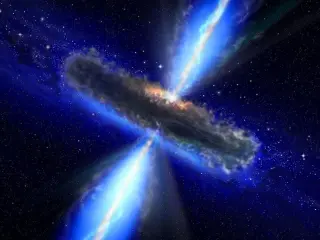
Astronomers report that the quasar APM 08279+5255, about 12 billion light-years away, contains roughly 140 trillion times the amount of water in Earth’s oceans, making it the largest known reservoir of water in the cosmos. Water was detected through multiple emission lines, aided by gravitational lensing that magnifies the source. The finding shows water is pervasive even in the early universe and helps illuminate how black holes grow and galaxies form, with lensing suggesting there may be more such water-rich systems hiding in existing catalogs.