
Complete male fruit fly brain map reveals how genes shape behavior
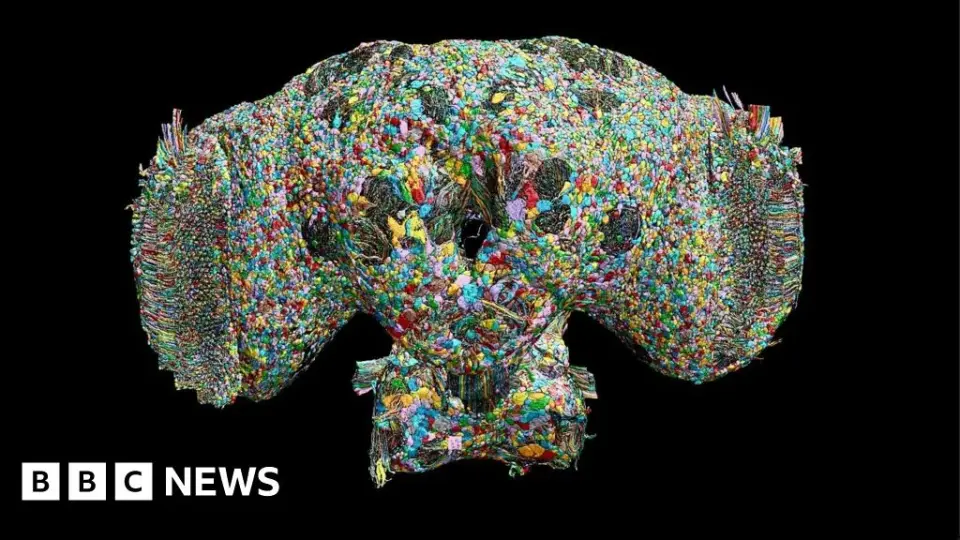
Researchers have published the first complete map of the male fruit fly brain, detailing 166,000 neurons and 125 million connections. By comparing this to the previously mapped female brain, scientists identified that 5% of neural differences drive distinct behaviors like aggression and courtship. This breakthrough helps explain how genes influence brain wiring, offering insights for understanding human conditions like autism and schizophrenia, as well as improving AI efficiency.
Key points
- The map includes 166,000 neurons and 125 million synaptic connections, making it the largest brain map by neuron count to date.
- Approximately 95% of neurons are shared between male and female flies, but the remaining 5% account for significant behavioral differences.
- Specific wiring differences explain male aggression, visual tracking during courtship, and the production of mating songs.
- The project utilized AI to reconstruct 3D neural shapes from millions of 2D electron microscope images.
- The findings aim to clarify how genetic variations affect brain wiring in humans, particularly regarding disorders like schizophrenia.
Background
This follows the completion of the female fruit fly brain map two years ago. While previous archive items covered unrelated topics like bat longevity and Titan exploration, this study builds on the decade-long partnership between HHMI Janelia, Google Research, and Cambridge to advance connectomics in model organisms.
How outlets are covering it
BBC emphasizes the behavioral implications, noting that small wiring differences drive major actions like fighting or singing, and highlights the potential for understanding human genetic conditions. Google Research focuses on the technical achievement, describing the map as a foundational resource for neuroscience and AI, noting that the fly brain is more efficient than a supercomputer. Both sources agree that while the research does not directly explain human gender differences, it provides a clear model for how genes shape neural circuits and behavior. Google also highlights the expansion into vertebrate brains, such as zebrafish and fish, as the next step in connectomics.
Why it matters
Understanding the link between genes and brain wiring could lead to better treatments for mental health conditions and improve AI systems by mimicking biological efficiency. The open-source nature of the data allows global researchers to explore neural pathways without needing to repeat the costly mapping process.
What to watch
Researchers plan to apply these methods to map entire vertebrate brains, including zebrafish and portions of mouse brains. The goal is to eventually understand how to repair damaged neural pathways in humans, potentially leading to treatments for cognitive ailments like Alzheimer's and depression.
- Fly brain wiring map may hold clues for autism and schizophrenia bbc.com
- A connectomics milestone: Mapping the complete male fruit fly brain Google Research
- 5 amazing visuals show how the male fruit fly’s brain map is advancing neuroscience blog.google
- The blueprint for taste: Scientists map the neural circuitry behind feeding decisions in fruit flies Medical Xpress
- Completing the connectome: How pursuing a map of the fly brain rewired neuroscience Phys.org
Want the full story? Read the original reporting
Read on bbc.com