
Tropical Storm Narra Forces Indefinite Delay of China's Chang'e 7 Moon Mission
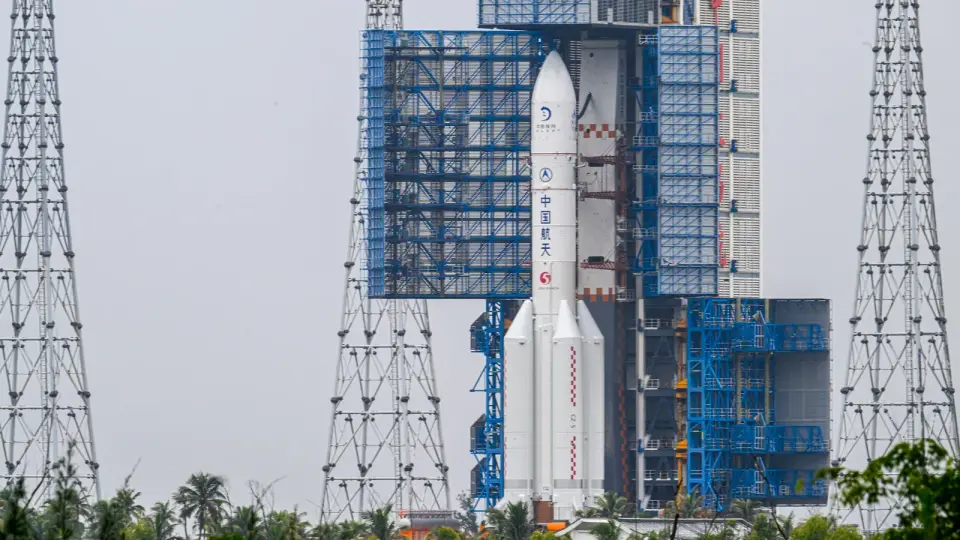
China's Chang'e 7 lunar mission has been indefinitely postponed due to unfavorable weather conditions, specifically the growth of Tropical Depression Narra in the Gulf of Tonkin. The China Manned Space Agency confirmed that the probe does not meet launch conditions for the current window, with no new date announced. The mission, designed to search for water ice at the Moon's south pole, was originally scheduled to launch from the Wenchang Space Launch Site on Hainan Island.
Key points
- The China Manned Space Agency stated that Chang'e 7 cannot launch within the planned window this year due to a 'comprehensive assessment' of conditions.
- Tropical Depression Narra in the Gulf of Tonkin, located west of Hainan Island, created unsafe launch conditions, leading to an indefinite delay.
- The mission aims to explore permanently shadowed craters near the Moon's south pole to search for water ice and other resources.
- Chang'e 7 includes an orbiter, lander, rover, and a mini-hopper probe, representing a significant technological advancement for China's lunar program.
- No new launch date has been announced, and China's space agency remains tight-lipped about specific future timelines.
Background
Chang'e 7 is part of China's broader lunar exploration program, which includes the successful Chang'e 6 mission that returned samples from the Moon's far side in 2024. The current mission is critical for China's goal of landing astronauts on the Moon by 2030 and competes with international efforts, including NASA's Artemis program and private sector missions, to exploit lunar water resources. Previous archive coverage highlighted the strategic importance of the lunar south pole for future settlements and the geopolitical implications of China potentially reaching this milestone before the United States.
How outlets are covering it
Space.com and CNN emphasize the immediate cause of the delay as weather-related, specifically citing Tropical Depression Narra. In contrast, Politico and the China Manned Space Agency's official statement frame the postponement as a decision based on 'prudence, reliability, and absolute mission success' following a 'comprehensive assessment,' without explicitly detailing the weather in their initial statements. Ars Technica provides a broader geopolitical context, highlighting the potential for China to assert territorial rights or claim a strategic win in the US-China space race if the mission succeeds, noting that the delay may impact this timeline. While all sources agree on the indefinite nature of the delay, they differ in attributing the cause to specific weather events versus general mission safety assessments.
Why it matters
The delay of Chang'e 7 impacts the timeline for China's lunar exploration program and its competition with the United States and other nations for lunar resources. The mission's success would provide critical data on water ice at the Moon's south pole, essential for future crewed missions and long-term settlements. The postponement also affects the geopolitical dynamics of the space race, potentially altering the narrative of China surpassing the United States in lunar exploration. Additionally, the indefinite delay introduces uncertainty into international collaborations and competitive efforts aimed at the lunar south pole.
What to watch
China's space agency has not announced a new launch date for Chang'e 7, leaving the timeline uncertain. The mission may be rescheduled for a future window, possibly in 2027, depending on weather conditions and other factors. International observers will monitor China's announcements for any updates on the mission's status and potential implications for the US-China space race. Meanwhile, other nations and private companies will continue their efforts to explore the lunar south pole, potentially filling the gap left by China's delay.
- Bad weather delays launch of China's historic Chang'e 7 mission to moon's south pole Space
- China postpones launch of unprecedented water-hunting moon mission amid space race CNN
- China abruptly postpones ambitious lunar mission Politico
- The United States is about to wake up to the threat from China’s space program Ars Technica
- China's bid for lunar water launches Sunday as the new space race heats up ABC News - Breaking News, Latest News and Videos
Want the full story? Read the original reporting
Read on Space