
Ladybird Browser Launches First Downloadable Alpha for Mac and Linux
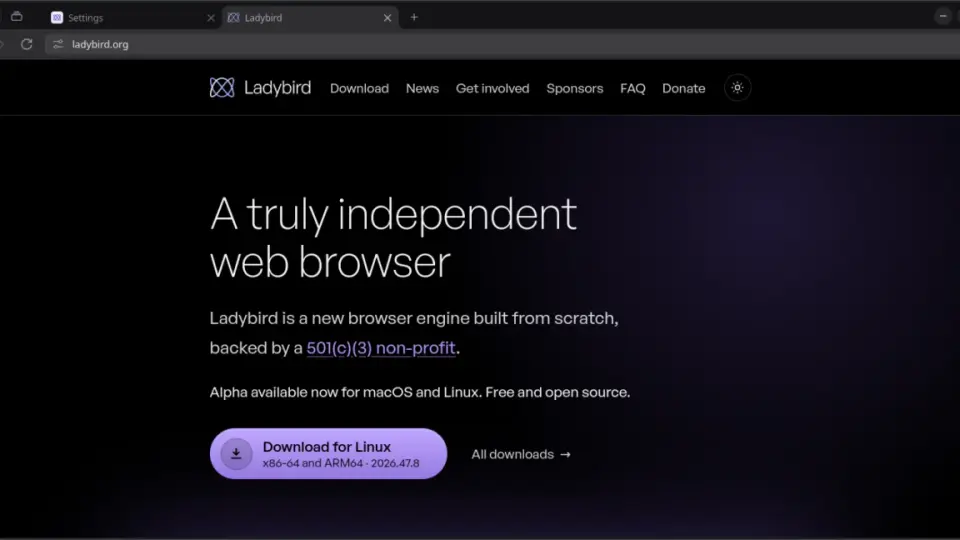
The Ladybird project released its first downloadable alpha version on November 23, 2026, offering prebuilt installers for macOS and Linux. This marks the first time users can install the browser without compiling it from source. The browser features a rendering engine and JavaScript engine built entirely from scratch, distinct from the dominant Blink, Gecko, and WebKit engines. While the alpha is functional and surprisingly capable for daily browsing, it lacks extensions and is not yet recommended as a primary daily driver due to stability and security concerns. The project is backed by a nonprofit and funded through donations, with no sponsored search deals.
Key points
- The Ladybird browser released its first downloadable alpha on November 23, 2026, offering prebuilt versions for macOS and Linux. Previously, users had to compile the browser themselves from source.
- Ladybird’s rendering engine and LibJS JavaScript engine were written from scratch, making it the first new browser engine in years. It is distinct from Blink (Chrome, Edge, Brave, Opera), Gecko (Firefox), and WebKit (Safari).
- The project is led by Andreas Kling and backed by the Ladybird Browser Initiative, a 501(c)(3) nonprofit funded by sponsorships and donations. Sponsors have no say in the project roadmap, and the default search engine is 'None.'
- The alpha is a rolling release channel that updates automatically. It includes a built-in tool for reporting websites that fail to render or crash the browser. Kling invites security researchers to test the browser, noting that it is not yet trustworthy as a daily driver.
- Testing by Ars Technica, ZDNET, and others found the alpha to be surprisingly capable. It handled most websites without issue, though it lacks extensions and may struggle with high-performance video. A Windows version is planned for a later stage.
Background
The Ladybird project originated as a component of SerenityOS, an independent operating system project led by Andreas Kling. It was spun off as a standalone project in 2022, and Kling stepped back from SerenityOS in 2024 to focus solely on Ladybird. The project has been transitioning its codebase from C++ to Rust, starting with the JavaScript engine in 2026. As of March 2025, Ladybird ranked fourth-highest on the Web Platform Tests, behind Chrome, Safari, and Firefox. The nonprofit was established in July 2024 with a $1 million donation from GitHub co-founder Chris Wanstrath, and other sponsors include Shopify, Cloudflare, and Proton. A beta release is expected in 2027 and a stable release in 2028.
How outlets are covering it
Ars Technica emphasizes the browser’s surprising capability for an alpha build, noting that it handled most websites without issue and that the project’s independence from commercial interests is a significant achievement. ZDNET highlights the browser’s performance in benchmarks, finding that it kept up with competitors in real-world loading tests despite lower benchmark scores. Hackaday focuses on the importance of browser diversity, arguing that a new engine is needed to counter the dominance of Blink and WebKit. The Verge notes the browser’s independence and the transition from C++ to Rust, but also highlights the lack of extensions and the need for further development. All sources agree that the alpha is a significant milestone but not yet ready for daily use.
Why it matters
The release of Ladybird’s first downloadable alpha is significant because it represents the first new browser engine in years, offering an alternative to the dominant Blink, Gecko, and WebKit engines. This can help surface Chromium-specific assumptions and push the web ecosystem toward published standards. The project’s independence from commercial interests, with no sponsored search deals and no influence from sponsors on the roadmap, aligns with a growing demand for privacy-focused and open-source software. The alpha’s surprising capability suggests that a small team of independent developers can build a competitive browser engine, challenging the notion that only large corporations can develop such software.
What to watch
The Ladybird project plans to release a Windows version in a later stage. A beta release is expected in 2027 and a stable release in 2028. The project will continue to push out regular, automatic updates to the alpha channel, and security researchers are invited to test the browser and report issues. The project may also add an extension system in future releases, though this is not yet confirmed.
- Ladybird's new alpha shows there's life beyond Chromium Ars Technica
- The Ladybird Browser Reaches Alpha Hackaday
- Ladybird, the first new browser engine in years, is now available to test The Verge
- I tested a new browser built from scratch – here’s why it looks promising ZDNET
- Ladybird Alpha Hits 2 Platforms, Skips Windows shattered.io
Want the full story? Read the original reporting
Read on Ars Technica