
ESA’s Hera Reveals Stadium-Sized Crater and Chaotic Tumble on Asteroid Dimorphos After 2022 DART Impact
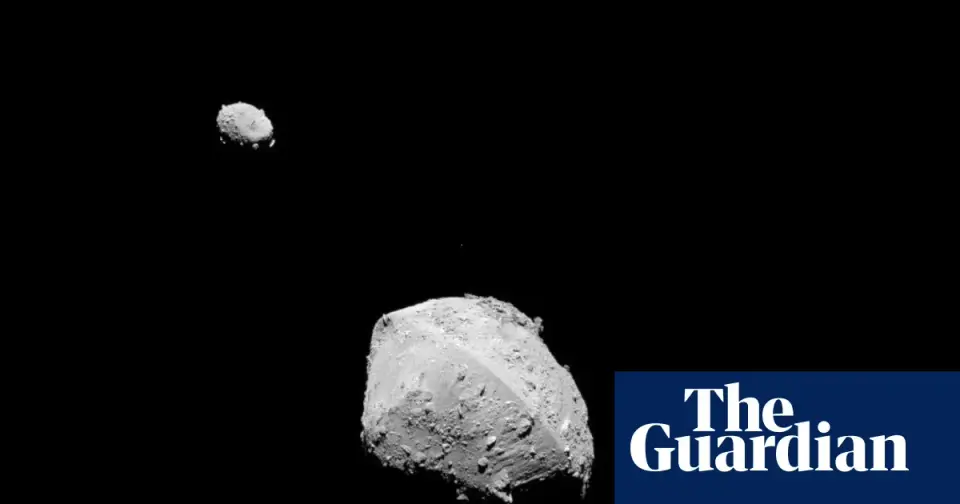
ESA’s Hera spacecraft has released the first close-up images of asteroid Dimorphos, revealing a stadium-sized impact crater and chaotic tumbling motion resulting from NASA’s 2022 DART collision. The images also show hundreds of previously unknown boulders orbiting the binary asteroid system, providing critical data to refine planetary defense strategies.
Key points
- ESA’s Hera spacecraft arrived at the Didymos-Dimorphos binary asteroid system in early November 2026 and released initial close-up images on Nov. 25, 2026.
- Images show that the 2022 DART impact flattened one face of Dimorphos into a crater spanning the asteroid’s entire width, described as stadium-sized.
- Dimorphos is now tumbling chaotically in its orbit, a change from its previous stable rotation, while the rest of its surface appears largely unchanged.
- Hera detected hundreds of previously unknown boulders, some the size of a football to a washing machine, encircling the asteroid pair; their origin (impact debris vs. pre-existing) is under investigation.
- The DART impact in September 2022 shortened Dimorphos’s orbital period around Didymos by 33 minutes, far exceeding the 73-second success threshold.
- Hera is currently surveying the system from 25-30 km away and plans a closer approach in December to measure Dimorphos’s mass and deploy two CubeSats in January.
Background
NASA’s DART mission deliberately struck Dimorphos on Sept. 26, 2022, to test kinetic impactor technology for planetary defense. The impact shortened the asteroid’s orbit by 33 minutes, confirming the feasibility of deflection. ESA’s Hera mission, launched Oct. 7, 2024, was designed to assess the aftermath and refine deflection models. Prior to Hera’s arrival, scientists debated whether the impact created a crater, reshaped the asteroid, or left it unchanged; the new images confirm all three effects occurred simultaneously.
How outlets are covering it
The Guardian and CNN emphasize the structural changes to Dimorphos, highlighting the stadium-sized crater and chaotic tumbling as key findings. The New York Times focuses on the broader implication for planetary defense, framing the images as validation of the deflection concept. The BBC highlights the investigative nature of the Hera mission, comparing it to a crime scene investigation, and notes the uncertainty regarding the origin of the newly discovered boulders. All sources agree on the success of the DART impact but differ in emphasis: The Guardian and CNN stress the physical aftermath, while the BBC and NYT focus on the strategic and scientific implications for future missions.
Why it matters
The findings from Hera provide the first direct visual evidence of how an asteroid responds to a kinetic impact, crucial for refining planetary defense models. Understanding the crater formation, tumbling motion, and debris field will help scientists predict the effectiveness of future deflection attempts. The discovery of orbiting boulders also poses engineering challenges for future missions, requiring adjustments to spacecraft trajectories and landing procedures.
What to watch
Hera is scheduled to approach Dimorphos to a distance of 13 km in December 2026 to take higher-resolution images and measure the asteroid’s mass. In January 2027, the spacecraft will deploy two CubeSats, Milani and Juventas, which will conduct radar and spectral surveys before landing on Dimorphos. The mission aims to complete its primary objectives by mid-2027, after which Hera will be repurposed as a software testing platform.
- Nasa knocked an asteroid off course. New closeup photos may shed light on aftermath The Guardian
- ESA mission reveals stadium-size crater left by first planetary defense test CNN
- What Happened After NASA Slammed a Spacecraft Into an Asteroid? See for Yourself. The New York Times
- Hera mission images from asteroid crash show stadium-sized crater BBC
- Hera glimpses the results of DART asteroid impact SpaceNews
Want the full story? Read the original reporting
Read on The Guardian