
France Faces Unprecedented Riots as Cost-of-Living Protests Turn Violent
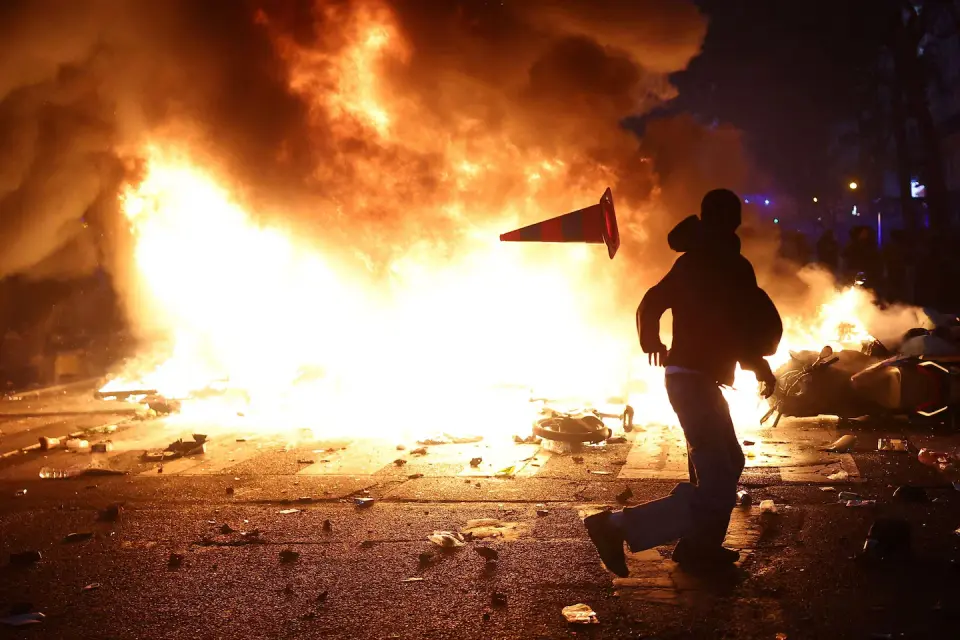
France experienced its most violent unrest in years on Saturday, October 17, 2026, as protests over rising living costs and school conditions escalated into widespread riots. Over 2,000 people were detained, and historic buildings, including the Limoges town hall, were burned. President Emmanuel Macron vowed to hold those responsible for the chaos accountable, while political leaders blamed each other for the failure to prevent the violence.
Key points
- Over 2,000 people were detained nationwide, with 855 arrested in the Paris region alone.
- The 19th-century town hall in Limoges was set on fire, causing its roof to collapse.
- President Macron condemned the violence, blaming 'insurrectionist elements' and 'radical far-left groups.'
- Prime Minister Sébastien Lecornu and Interior Minister Laurent Nuñez faced calls for resignation from opposition parties.
- The unrest follows weeks of student-led protests over education funding and public spending cuts.
Background
This escalation follows weeks of student-led unrest in France and across Europe, beginning in late September 2026. Previous protests focused on overcrowded classrooms, teacher shortages, and poor infrastructure, leading to hundreds of school closures and clashes with police. The current violence marks a significant shift from peaceful demonstrations to organized looting and destruction of public property, occurring ahead of the 2027 presidential elections.
How outlets are covering it
The Washington Post and The Guardian emphasize the scale of destruction and the government's crisis response, noting that the violence was unprecedented. Boston.com highlights President Macron's address to the nation, where he vowed to hold those who 'sought to bring down the Republic' accountable. Political perspectives are sharply divided: the government and far-right leader Marine Le Pen blamed 'ultra-left' groups and criminals, while far-left leader Jean-Luc Mélenchon accused the government of 'playing with fire' and failing to address societal demands. Mayors of major cities, including Paris and Limoges, described the events as a 'colossal failure of the state' due to inadequate policing and intelligence.
Why it matters
The unrest highlights deep societal tensions in France over economic inequality and public spending. The violence threatens social stability and could influence the upcoming presidential election, as political leaders seek to capitalize on the chaos. The government's response and the extent of the damage will shape public opinion and policy decisions in the coming months.
What to watch
President Macron is expected to address the nation on Sunday night, outlining the government's response to the unrest. Mayors of Paris, Marseille, and Lyon have requested meetings with the prime minister to discuss the damage and security measures. Investigations are underway into the injuries sustained by protesters and police, including a 17-year-old who lost an eye and another who lost a hand. The government faces pressure to improve policing tactics and address the underlying economic grievances that fueled the protests.
- Destructive protests sweep across France, with buildings burned and hundreds detained The Washington Post
- Huge Riots and Anti-Government Protests in France: What to Know The New York Times
- France’s Macron vows to hold accountable those who ‘sought to bring down the Republic’ Boston.com
- In France's Limoges, the fire-ravaged town hall rekindles memories of Notre Dame Reuters
- French government in crisis talks after ‘colossal failure of the state’ The Guardian
Want the full story? Read the original reporting
Read on The Washington Post