
France's Education Crisis Ignites Nationwide Riots as Budget Cuts Deepen
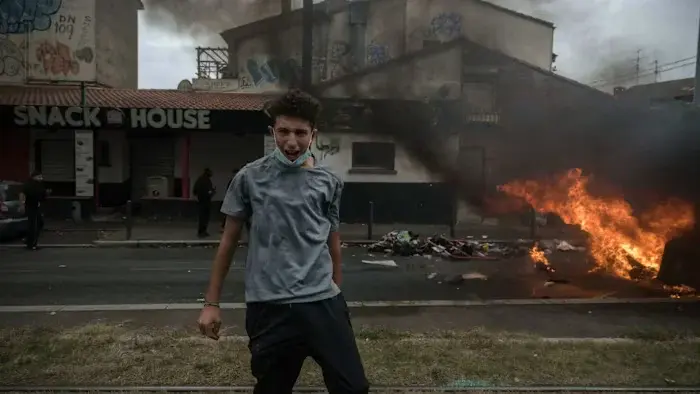
Violent student protests have spread across France, resulting in over 3,000 detentions and the closure of hundreds of schools. The unrest, sparked by grievances over crumbling infrastructure and teacher shortages, has escalated into urban violence with fires and police clashes. While the government and far-right leaders blame the far-left party La France Insoumise for orchestrating the chaos, students and unions argue the movement is a legitimate response to years of underfunding. The crisis coincides with a difficult 2027 budget negotiation, where the government seeks to freeze public sector wages despite rising borrowing costs and international warnings about France's declining educational standards.
Key points
- More than 3,000 people have been detained this week, with 65 staff and 170 students injured; over 100 high schools have suffered severe damage, including fires in Nantes, Lyon, and Paris.
- The protests, which began in the Paris region, have spread nationwide, forcing the closure or disruption of education at more than 560 to 1,000 schools depending on the day, with public transport suspended in Marseille and Strasbourg.
- Prime Minister Sébastien Lecornu and far-right leader Marine Le Pen have accused Jean-Luc Mélenchon’s La France Insoumise (LFI) of exploiting student anger for partisan ends, with intelligence services labeling the unrest a 'maneuver' by the far-left.
- Students cite overcrowded classrooms, dilapidated buildings, long school days, and teacher shortages as primary grievances, noting that France’s education system has seen an 'unprecedented' drop in math skills and declining reading abilities according to recent OECD data.
- The government announced a €1.1bn increase in the 2027 education budget but plans to freeze teachers' salaries as part of a broader 54 billion euro fiscal adjustment aimed at addressing France's high debt-to-GDP ratio of 119% and deficit of 5.1%.
- Justice Minister Gérald Darmanin has instructed prosecutors to hold parents liable for damages caused by their children during the protests, while Education Minister Édouard Geffray has called on parents to keep children off the streets, describing the situation as 'urban violence'.
Background
France has a history of student unrest, with the 1968 revolt nearly toppling the De Gaulle government and the 2018 gilets jaunes uprising compounding Macron’s first-term crisis. Recent archive coverage from October 2, 2026, noted that trade unions had joined the student movement and that a new student consultation platform was set to launch, indicating the unrest is part of a broader pattern of social and political instability in the country. The current crisis is exacerbated by France’s ongoing fiscal challenges, including its status under the EU’s excessive deficit procedure and rising borrowing costs, which have made budget negotiations particularly contentious.
How outlets are covering it
The Financial Times and CNBC emphasize the political dimension, highlighting the government’s and far-right’s accusations that La France Insoumise is orchestrating the unrest for partisan gain. The Financial Times notes that intelligence services view the protests as a 'maneuver' by LFI, while CNBC frames the crisis as a major political headache for the government amid budget negotiations. CBS News and The Guardian, on the other hand, focus more on the students’ grievances and the legitimacy of their demands, with The Guardian quoting students who describe the conditions as 'shameful' and 'unbearable.' CBS News notes that the government acknowledges the grievances are legitimate but condemns the violence, while The Guardian highlights the students’ peaceful intentions and the presence of 'ultra-violent fringe groups' that have co-opted the movement. The perspectives diverge on whether the unrest is primarily a political manipulation or a genuine expression of student frustration, with the government and far-right blaming LFI, while students and some left-wing figures argue the movement is a response to years of neglect and underfunding.
Why it matters
The student protests highlight the deepening social and political tensions in France, where economic pressures and educational neglect are fueling widespread unrest. The crisis threatens to destabilize the government’s efforts to implement necessary fiscal reforms, as the 2027 budget negotiations are already fraught with political division and economic turmoil. The international implications are significant, as France’s declining educational standards and rising borrowing costs have soured investor sentiment, with bond yields near multi-decade highs. The unrest also underscores the growing divide between the government and the public, particularly among young people, who feel that their concerns are being ignored in favor of political maneuvering. If the protests continue, they could further erode public trust in the government and exacerbate the political fragmentation that has characterized France’s recent history.
What to watch
The government is expected to continue its efforts to manage the crisis, with Education Minister Édouard Geffray scheduled to meet with teachers’ unions, student representatives, and parents’ groups to discuss potential solutions. The 2027 budget negotiations will likely be a focal point, as the government seeks to implement fiscal adjustments while addressing the students’ demands for increased education spending. The political dynamics will also be closely watched, as the far-left and far-right continue to blame each other for the unrest, with Mélenchon’s polling at 17% potentially qualifying him for the presidential run-off against Le Pen. The situation may also see further escalation if the protests continue to spread and violence persists, potentially leading to more arrests and injuries. The government’s ability to balance fiscal responsibility with social stability will be a key factor in determining the outcome of the crisis.
- French schools burn as student unrest spreads Financial Times
- School protests send shivers down French government's spine BBC
- France student protests spread from Paris, with violent clashes forcing hundreds of high schools to close CBS News
- A violent classroom revolt is becoming France's next big crisis CNBC
- ‘We just want to be listened to’: student protests shut schools across France theguardian.com
Want the full story? Read the original reporting
Read on Financial Times