
Trump, Xi, and Putin Convene in Shenzhen for Historic Trilateral Summit
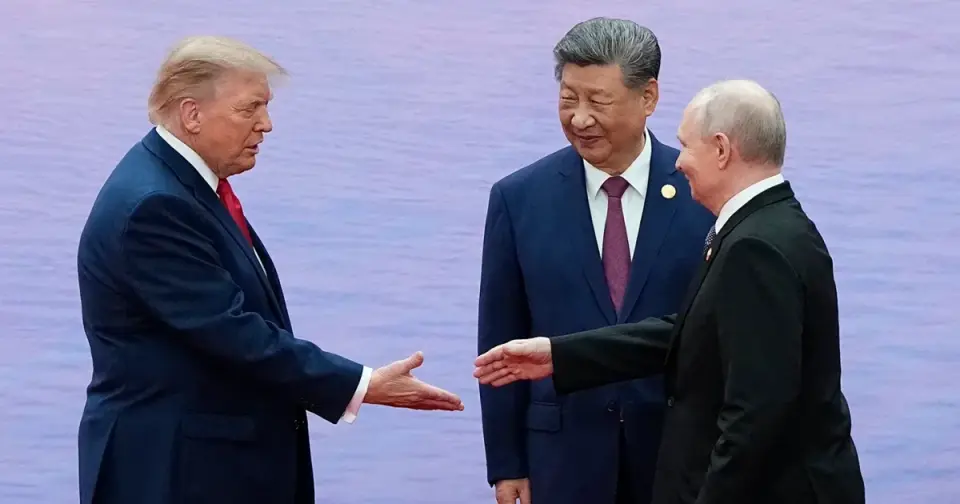
US President Donald Trump, Chinese President Xi Jinping, and Russian President Vladimir Putin are set to meet on Thursday in Shenzhen, China, on the sidelines of the Asia-Pacific Economic Cooperation (APEC) summit. The gathering, described by some analysts as a modern equivalent of the 1945 Yalta Conference, marks a significant shift in US foreign policy, moving away from the post-Cold War strategy of driving a wedge between Moscow and Beijing. While the leaders will discuss nuclear disarmament, trade, and the Iran conflict, the inclusion of the Ukraine war remains contentious, with White House officials previously stating it would not be on the agenda. The meeting occurs amid heightened tensions regarding US-China tech relations and following Trump’s recent domestic political setbacks.
Key points
- The trilateral meeting is scheduled for Thursday in Shenzhen, following a welcome banquet on Wednesday where the three leaders were seen interacting cordially.
- Trump aims to discuss nuclear disarmament, including potentially bringing China into arms control talks, as well as trade and the Iran conflict.
- The Ukraine war is a point of contention; while Trump recently added it to the agenda, White House officials and Beijing have indicated it is a separate track not involving China.
- The summit follows Trump’s recent losses in the US midterm elections, with critics arguing his domestic weakness may limit his leverage against Xi and Putin.
- The meeting is viewed by some as a symbolic power projection, with limited expectations for concrete outcomes, particularly regarding nuclear reductions or ending the war in Ukraine.
Background
This summit follows Trump’s recent trip to the Philippines for the ASEAN summit, where he signed a preliminary trade agreement with Thailand. The timing is significant as it occurs shortly after his party’s midterm election losses, which have raised questions about his political leverage. Previous coverage noted that the Nvidia CEO scandal has complicated US-China tech relations, adding a layer of tension to the diplomatic discussions. The APEC summit provides a platform for Beijing to host global leaders, showcasing China’s role as a central player in international affairs despite ongoing geopolitical rivalries.
How outlets are covering it
NBC News emphasizes the symbolic weight of the meeting, comparing it to the Yalta Conference and highlighting the shift in US policy toward engaging both Russia and China simultaneously. CNBC focuses on the atmosphere of the APEC summit, noting the cordial interactions between the leaders and the absence of high-profile tech figures like Jensen Huang and Elon Musk, which contrasts with previous US-China engagements. CNN offers a critical perspective, questioning the optics of Trump’s relationship with authoritarian leaders and suggesting that the summit may prioritize personal validation over substantive policy outcomes. The New York Times underscores the historical parallels to Yalta, framing the meeting as a potential reshaping of the global order by the world’s three largest military powers. Overall, while all sources acknowledge the significance of the gathering, they differ in their assessment of its potential impact, with some viewing it as a diplomatic breakthrough and others as a symbolic gesture with limited practical results.
Why it matters
The outcome of this trilateral summit could have profound implications for global security and economic stability. A successful engagement on nuclear disarmament could reduce the risk of nuclear proliferation, while trade discussions may influence global supply chains and economic growth. The handling of the Ukraine war and Iran conflict could affect regional stability and US alliances. Furthermore, the summit sets a precedent for future US-China-Russia interactions, potentially shaping the balance of power in the 21st century. For the US, the summit’s success or failure will also reflect on Trump’s ability to navigate complex international relationships amid domestic political challenges.
What to watch
Analysts expect limited concrete outcomes from the summit, with the focus likely remaining on symbolic gestures and the establishment of a framework for future dialogue. The next steps may include follow-up discussions on nuclear arms control and trade, as well as continued negotiations on the Ukraine conflict, though the latter may remain a separate track. The summit’s impact on US-China tech relations, particularly regarding the Nvidia scandal, will also be closely monitored. Future APEC summits and bilateral meetings may build on the momentum of this gathering, potentially leading to more regularized trilateral engagements. The domestic political landscape in the US will also influence the administration’s approach to these discussions, with Trump’s weakened position potentially affecting his negotiating power.
- World waits as Trump, Xi and Putin prepare for high-stakes meeting NBC News
- I watched Trump, Xi and Putin gather in China. Here are my top takeaways CNBC
- Republicans back Trump, Xi, Putin meeting but warn they are ‘not our friends’ The Hill
- Russia and China are not America’s friends. Why does Trump think they are? CNN
- The Shadow of Yalta Hangs Over Trump’s Summit in China The New York Times
Want the full story? Read the original reporting
Read on NBC News