
Voyager 1 reaches one light-day from Earth, marking 50-year milestone
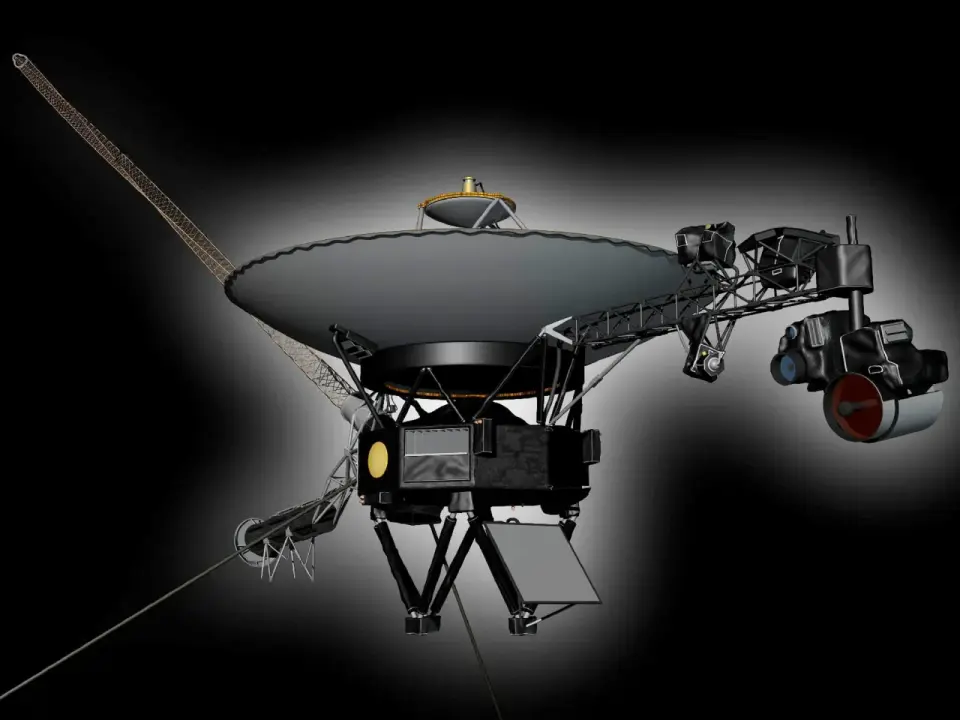
NASA’s Voyager 1 has reached a distance of one light-day from Earth, a milestone achieved nearly 50 years after its 1977 launch. The probe is now approximately 26 billion kilometers away, meaning radio signals take 24 hours to reach it and another 24 hours for a reply. While cameras have been disabled to conserve power, the spacecraft continues to study interstellar magnetic fields and plasma. This achievement highlights the vastness of space, as Voyager 1 is expected to take roughly 18,000 years to travel a full light-year.
Key points
- Voyager 1 crossed the one-light-day threshold on November 18, 2026, becoming the most distant human-made object.
- The spacecraft is located approximately 26 billion kilometers (16.1 billion miles) from Earth.
- Signal delays now require 48 hours for a round-trip communication between Earth and the probe.
- Voyager 1 is traveling at 3.5 astronomical units per year, significantly faster than its twin, Voyager 2.
- Voyager 2 is not expected to reach the same distance until 2035 due to different trajectory choices.
- The probe continues to transmit data on interstellar magnetic fields despite power constraints.
Background
Voyager 1 and 2 launched in 1977 to explore the outer planets. They entered interstellar space in 2012 and 2018, respectively. Recent coverage noted a global public campaign inviting fans to flash Morse code signals to honor the milestone. The probe carries a Golden Record intended to convey human culture to extraterrestrial life.
How outlets are covering it
Al Jazeera and The New York Times emphasize the symbolic and emotional weight of the milestone, describing it as a 'staggering' realization of the universe's vastness. Space.com provides a technical explanation for why Voyager 1 reached the milestone nearly a decade before Voyager 2, citing trajectory choices during planetary flybys that gave Voyager 1 a higher speed. Science News focuses on the ongoing scientific value of the probe despite its aging hardware. All sources agree on the distance and the significance of the event, but differ in their emphasis on the technical history versus the philosophical implications.
Why it matters
This milestone underscores the limits of current space travel technology and the immense scale of interstellar distances. It serves as a reminder that even after nearly 50 years, Voyager 1 has only reached the edge of our solar system's influence, not the distance to other stars. The continued operation of the probe, despite power constraints, demonstrates the resilience of early space technology and its ongoing contribution to understanding the interstellar medium.
What to watch
NASA expects Voyager 1 to continue operating into the 2030s, as long as its nuclear power sources last. Engineers are implementing power-saving measures to maximize the spacecraft's lifespan. Voyager 2 is projected to reach the one-light-day distance in 2035. A documentary for the mission's 50th anniversary is scheduled for 2027.
- NASA’s Voyager 1 hits record one light-day distance, 50 years after launch Al Jazeera
- After 49 Years, Voyager 1 Is a Mind-Blowing One Light-Day From Earth The New York Times
- NASA's Voyager 1 launched second, so how did it beat Voyager 2 to a light-day by nearly a decade? Space
- Voyager 1 reaches a historic milestone: one light-day from Earth Science News
- A New Milestone for Life on Earth The Atlantic
Want the full story? Read the original reporting
Read on Al Jazeera