
AI and Gigapixel Tech Aim to Finish 30-Year Restoration of St. Francis Basilica
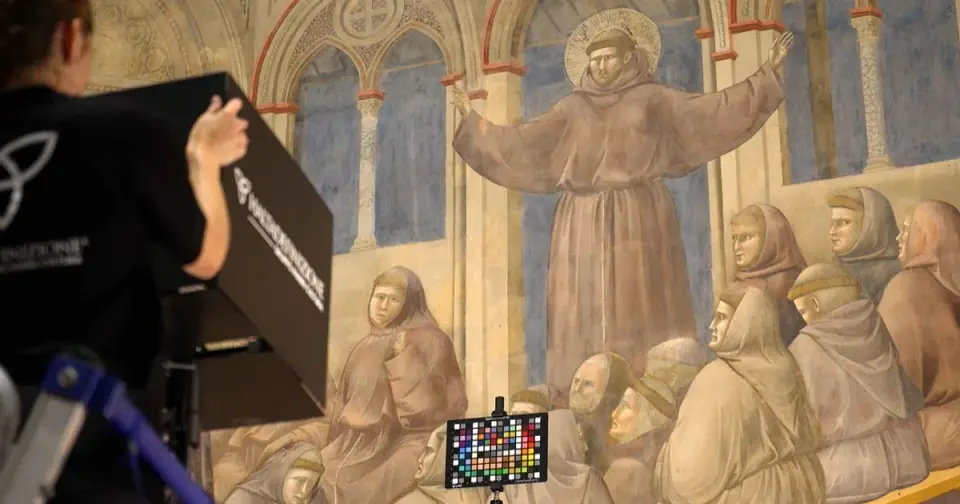
As the 800th anniversary of St. Francis of Assisi’s death approaches, a new restoration project in Italy is using artificial intelligence and gigapixel photography to complete work stalled by the 1997 earthquakes. While the primary source focuses on the digital twin of the Assisi basilica, a secondary source highlights a separate but related restoration of Giotto’s frescoes in Florence, revealing how modern technology is reshaping the preservation of medieval Christian art.
Key points
- The Basilica of Saint Francis in Assisi suffered severe damage from two earthquakes in 1997, leaving thousands of fresco fragments unplaced for three decades.
- A team led by Giovanni Borelli is creating a high-resolution digital twin of the basilica using robotic cameras and AI to assist in matching broken pieces and analyzing structural cracks.
- Chief restorer Sergio Fusetti states that human effort has reached its limit, and AI is now required to identify where the remaining 80,000 fragments belong.
- The digital twin is expected to be completed and made public next year, serving as a blueprint for future reconstruction and a tool for virtual tourism.
- In a parallel development, Giotto’s 'Stories of St. Francis' in Florence’s Santa Croce basilica were recently restored after being whitewashed for centuries, costing $1.5 million.
Background
The 800th anniversary of St. Francis’s death, marked on October 4, 2026, has prompted renewed attention to Franciscan heritage. Pope Leo XIV recently linked this anniversary to the Franciscan Jubilee Year, emphasizing peace and ecological care. Italy observed the date with national ceremonies in Assisi, highlighting the saint’s enduring cultural and spiritual significance.
How outlets are covering it
CBS News emphasizes the technological innovation in Assisi, focusing on the use of AI and gigapixel imaging to solve the long-standing puzzle of unplaced fresco fragments. Religion Unplugged, however, shifts the focus to Florence, detailing the restoration of Giotto’s frescoes in the Bardi Chapel. While CBS highlights the potential of digital twins for preservation and accessibility, Religion Unplugged frames the Florence restoration as a recovery of artistic intent obscured by centuries of neglect and poor conservation practices. The two outlets present different facets of the same broader trend: the application of modern technology to revive medieval religious art.
Why it matters
This story illustrates the evolving intersection of faith, art, and technology. The use of AI to restore damaged cultural heritage not only preserves historical artifacts but also makes them accessible to a global audience through virtual reality. It reflects a broader shift in how institutions approach conservation, moving from traditional manual methods to data-driven, non-invasive techniques that can reveal details invisible to the naked eye.
What to watch
The digital twin of the Basilica of Saint Francis is scheduled for completion and public release next year. Meanwhile, the restored Giotto frescoes in Florence are now open to the public, allowing visitors to view the artwork closer to its original 14th-century appearance. Both projects are expected to attract increased tourism and scholarly interest in the coming months.
- 60 Minutes Transcript: Restoring the Basilica of Saint Francis of Assisi CBS News
- Friars at the Basilica of Saint Francis turn to AI, lasers and gigapixel cameras to repair 13th century church CBS News
- St Francis' anniversary: See one of the most important Giotto frescos restored to life Daily Gate City
- 800 Years After St. Francis’s Death, His Story Gets A Vivid New Restoration religionunplugged.com
Want the full story? Read the original reporting
Read on CBS News