The main hall of Shuri Castle in Okinawa, Japan, has reopened to the public after a seven-year restoration following a 2019 fire. The ceremony featured traditional Ryukyu court dances and cultural performances, with officials emphasizing the site's historical and cultural significance.
The University of Birmingham has paused plans to move the Shakespeare Institute from Stratford-upon-Avon to its Edgbaston campus following intense backlash from actors, academics, and former students. The institute, housed at Mason Croft since 1995, holds a unique archive of 60,000 volumes, including annotated scripts, rehearsal notes, and personal papers from prominent figures like Samuel West and Dame Janet Suzman. While the university assures the collection will remain intact, critics argue the archive’s location in Shakespeare’s birthplace is essential to its cultural significance. A campaign led by Samuel West, supported by over 16,000 signatures, is pushing for the move to be reversed entirely rather than just delayed. An emergency meeting is scheduled to determine next steps, with concerns that relocation could disrupt access to materials owned by living theatre-makers.
Actor Samuel West has called for the complete cancellation of plans to move the Shakespeare Institute from Stratford-upon-Avon to Birmingham, following a temporary pause in the relocation by the University of Birmingham. West, who leads a petition with over 16,000 signatures, argues that the move weakens the cultural identity of the Midlands. While the university has suspended the transfer to Edgbaston, student groups warn that the uncertainty remains harmful and that the institute's location in Stratford is essential to its academic and theatrical significance.
Christie’s withdrew a 1952 Frida Kahlo painting from its New York evening sale hours before bidding began due to a legal dispute over its export status. The work, estimated at $2 million to $3.5 million, is central to a conflict between Mexican authorities and a campaign group claiming it belongs to a protected national trust. While the National Institute of Fine Arts and Literature (INBAL) asserts the painting left Mexico before 1984 protections took effect, critics argue it was part of a trust established by Diego Rivera and should not have left the country. The withdrawal was made in collaboration with the seller pending further research, but the case remains under investigation by Mexican officials.
The University of Birmingham has announced plans to relocate the Shakespeare Institute from its historic home in Stratford-upon-Avon to its Edgbaston campus by September 2027. The move, described by the university as an academic decision to ensure long-term sustainability, has triggered a fierce backlash. Director Michael Dobson has threatened to resign, while local MP Manuela Perteghella and prominent actors have condemned the decision as a cultural loss. A petition opposing the move has gathered over 12,000 signatures, with critics arguing the relocation will destroy the institute's unique connection to Shakespeare's birthplace and jeopardize its 60,000-volume library.
The National Museum of Natural History in Paris has acquired the skeleton of Dubreuillosaurus valesdunensis, a 167-million-year-old carnivorous dinosaur, through a state-led agreement that prevented its sale at auction. Discovered in 1994 in Normandy, this specimen is the only known representative of its species and features one of the most complete theropod skulls found in Europe. The acquisition preserves a critical scientific resource for studying megalosaur anatomy, as many other regional fossils were destroyed during World War II. The skeleton will be integrated into the museum's palaeontology gallery, which is scheduled to reopen in summer 2027, while ongoing research will include advanced scanner analyses for biomechanical reconstruction.
A suspected arson attack on October 23 largely destroyed the Kehlsteinhaus, a 1938 Nazi retreat in the Bavarian Alps. While a 33-year-old suspect with mental health issues is detained, authorities and experts are divided on whether to rebuild the site, leave it as a ruin, or repurpose it to prevent neo-Nazi pilgrimage.
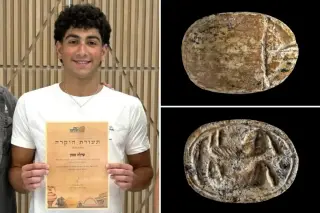
A 17-year-old American student visiting Israel discovered a 3,300-year-old Egyptian-style scarab amulet at Tel Gezer. The artifact, dated to the Late Bronze Age, was reported to authorities and added to the national collection.
Evelyna Bellamy’s new monograph for The Chromologium argues that the ease of producing images via AI does not diminish the need for careful curation. The essay proposes 'translation' as a practice of accountable selection, where designers must explicitly record what relationships from a source are preserved, changed, or left behind. Using a study called 'Wine & Verdigris,' Bellamy demonstrates how a single reference can yield different interpretations for composition, action, or documentation, emphasizing that technical provenance tools like C2PA do not replace human judgment on meaning or cultural authority.
A New York Times feature highlights the Via Transilvanica, a 1,000-mile hiking trail in Romania that showcases medieval villages and ancient forests rather than Dracula-themed attractions. While the trail offers a grounded view of the region’s living history, other outlets explore the complex legacy of Vlad III, the historical figure behind the vampire legend. Recent cultural adaptations, including the 2024 film 'Nosferatu,' continue to shape global perceptions, yet local experts emphasize the area’s rich multicultural past and modern developments.
Italian police recovered a 17th-century painting stolen from a church near Naples in 2004 using a new AI system. The artwork, depicting Saint Agnese, had been altered to hide its identity but was detected at an antiquity fair in Parma in October 2024. The system, known as Swoads, has helped recover over 300 major artworks and 165,000 smaller items since 2023. While experts note AI cannot replace human investigators or catch high-profile thefts, it significantly speeds up the search process by matching visual patterns in a database of over one million stolen items.
National Geographic has released its 'Best of the World' list for 2027, featuring 25 destinations globally. Six European locations were selected, including Poland's Tricity area, Norway's Vestland, and Leipzig, Germany. The list also highlights five U.S. destinations, such as Madison, Wisconsin, and the Pacific Coast Highway, alongside global picks like Salvador, Brazil, and Malawi.
Defense Secretary Pete Hegseth requested a World War II-era globe associated with Gen. Dwight D. Eisenhower for his office. Staff members damaged the artifact during a botched relocation attempt inside the Pentagon, leaving a visible gash on the 1930s replica.
A Colombian judge has ordered the protection of historical artifacts at the National Museum in Bogotá after President Abelardo de la Espriella ordered the removal of exhibits detailing political violence. The directive sparked public protests on October 17, 2026, with demonstrators viewing the move as an erasure of the country's recent conflict history. The judicial intervention aims to preserve the integrity of the museum's collection and prevent the permanent loss of these cultural records.
The British Museum is offering early ticket access to residents living near the Battle of Hastings site to manage overwhelming demand for the Bayeux Tapestry exhibition. This measure follows a chaotic opening where 100,000 tickets sold out instantly, causing two-hour queues and early closures. While the 11th-century embroidery is displayed flat for the first time, crowds have forced photography bans and strict crowd control. The loan, insured for £800m, ends in July 2027, with a 1066 reenactment drawing additional spectators.