
Study confirms Antarctic ice loss is inevitable this century, with high emissions driving up to 25 cm sea-level rise
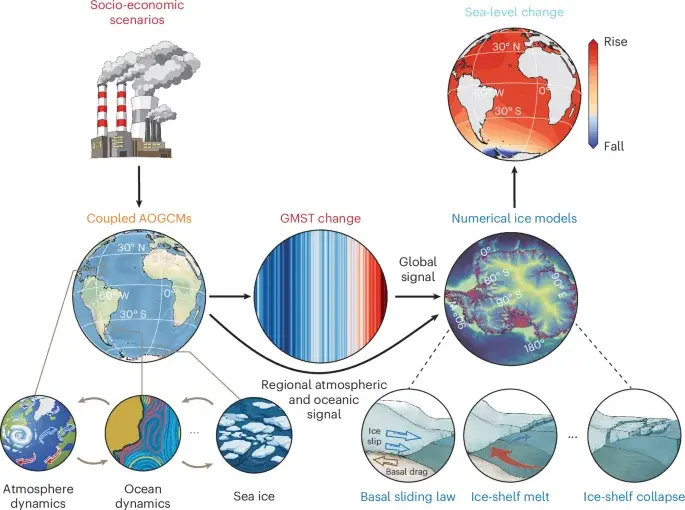
A new study in Nature concludes that the Antarctic Ice Sheet is committed to mass loss by 2100, even under aggressive emissions cuts. Using machine learning to analyze ice-sheet models, researchers found that higher emissions significantly increase projected sea-level rise, potentially reaching 25.4 cm by 2100 under worst-case scenarios. The study highlights that physical assumptions in models, not just emissions, drive uncertainty, and that satellite data confirms the inevitability of ice loss.
Key points
- Antarctic ice loss is 'locked in' for the 21st century, with a 92% probability of mass loss even if global warming is limited to 1.5°C.
- Under very high-emissions scenarios, the 95th percentile projection for Antarctic contribution to sea-level rise by 2100 is 25.4 cm, with a median of 15.7 cm.
- A machine-learning emulator trained on the ISMIP6 dataset allows researchers to test thousands of physical assumptions rapidly, reducing reliance on slow, single-run simulations.
- Ice-model features, such as sliding laws and ice-shelf melt parameterizations, account for 64% of projection uncertainty in raw simulations, outweighing climate forcing uncertainties.
- Satellite observations from GRACE and GRACE-FO were used to calibrate the models, ensuring projections align with observed mass loss trends since 2002.
Background
Recent archive coverage noted a temporary mass gain in East Antarctica due to record snowfall in 2021-2023, but emphasized this did not alter the long-term loss trend. Other 2026 studies have highlighted the rapid disappearance of Arctic epishelf lakes and the complex terrain of Antarctic ice shelves, underscoring the dynamic and vulnerable nature of polar ice systems. The current study builds on these observations by providing a probabilistic framework for future loss.
How outlets are covering it
The primary Nature study emphasizes the inevitability of ice loss and the role of model assumptions in uncertainty, using a Bayesian calibration approach. The Conversation, featuring the study's authors, highlights the practical implications for coastal communities, noting that 25 cm of rise could flood homes of over 10 million people. The Guardian and UA.NEWS focus on the immediate context of record-low Antarctic sea ice in 2026, linking reduced sea ice to weakened ice shelves and accelerated ice loss, though they do not detail the machine-learning methodology. While the Nature study focuses on long-term projections, the secondary sources emphasize the 'now problem' of current sea ice decline and its cascading effects on the ice sheet.
Why it matters
This study provides a critical update to sea-level rise projections, confirming that Antarctic ice loss is not contingent on future emissions but is already committed. The quantification of uncertainty sources helps policymakers and coastal planners prioritize rapid emissions reductions and improved model constraints. The finding that even low-emission scenarios lead to significant ice loss underscores the urgency of adaptation measures for densely populated coastal areas.
What to watch
Researchers plan to integrate Marine Ice Cliff Instability (MICI) into their framework once more models include it. Coastal communities and infrastructure planners will use the probabilistic projections to inform long-term adaptation strategies. Further studies will focus on refining ice-shelf melt parameterizations and sliding laws to reduce uncertainty in sea-level rise forecasts.
- Committed Antarctic Ice Sheet mass loss by the end of the twenty-first century Nature
- Antarctica’s ice loss is locked in, and extra snowfall won’t save it – that’s bad news for low-lying coastal areas elsewhere The Conversation
- Antarctic winter sea ice falls to third-lowest level on record as scientists warn of ‘now problem’ The Guardian
- U. researchers publish paper expecting Antarctica to continue losing ice through 2100 The Daily Targum
- Antarctica has recorded its third-lowest sea ice extent UA.NEWS
Want the full story? Read the original reporting
Read on Nature