Tag

Sea Level Rise

All articles tagged with #sea level rise

Glacier-edge lakes accelerate Greenland ice loss, study finds
environment3 days ago

Glacier-edge lakes accelerate Greenland ice loss, study finds

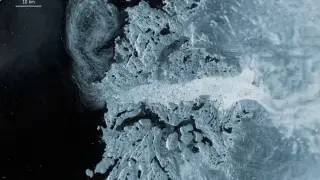
A new satellite-based study from the University of Leeds shows meltwater lakes forming at the ends of retreating Greenland glaciers (ice-marginal lakes, IMLs) actively speed up ice loss by lifting glacier fronts, reducing friction, and increasing calving, with fronts up to about three times faster and effects measurable up to 3.5 km inland. The finding implies current ice-sheet models should include IMLs to better project Greenland’s contribution to future sea level rise, alongside ongoing warming that already drives about 0.8 mm/year of sea-level rise and substantial ice loss.

Lost Antarctic Sub to Return with Ran II for New Ice‑Shelf Discoveries
science19 days ago

Lost Antarctic Sub to Return with Ran II for New Ice‑Shelf Discoveries

A pioneering autonomous submarine, Ran, vanished beneath Antarctic ice in January 2024 after mapping under Thwaites and other shelves. Its successor, Ran II, funded by the Voice of the Ocean Foundation and insurance, is due in winter 2026/2027 and will feature improved navigation and decision-making to continue exploring the hidden underside of ice shelves. Ran’s missions revealed a complex, dunes‑like ice base and nonuniform melting driven by ocean currents, prompting updated models of ice loss and sea‑level rise. The program will also support Baltic Sea research through a Gothenburg–VOTO partnership, leveraging AI and next‑gen AUVs for faster analysis of vast data sets.

Humans Are Slowing Earth's Spin at a Record Pace, Study Finds
planet-earth22 days ago

Humans Are Slowing Earth's Spin at a Record Pace, Study Finds

New research ties climate-change–driven sea-level rise to a record-fast lengthening of Earth's day: about 1.33 milliseconds per century today, with warming scenarios predicting up to 2.62 milliseconds per century by 2080. While the Moon’s gravity, glacial rebound, and winds modulate the effect, the human-caused signal is growing; past day lengths were inferred from fossil foraminifera. The current rate is among the fastest in 3.6 billion years and could affect precise timekeeping and spacecraft navigation in the future.

Pink Antarctic Rocks Reveal Hidden Subglacial Giant
science23 days ago

Pink Antarctic Rocks Reveal Hidden Subglacial Giant

Bright pink granite boulders atop West Antarctica’s Hudson Mountains led scientists to discover a massive buried granite body beneath Pine Island Glacier, about 100 km wide and 7 km thick. Radiometric dating places the rocks at ~175 million years old (Jurassic). Airborne gravity data linked surface rocks to a deep underground formation, shedding light on past ice behavior and helping refine models of ice dynamics and sea-level rise in a warming world.

Thwaites Glacier Could Lift Global Seas, Redrawing Coastal Maps
environment25 days ago

Thwaites Glacier Could Lift Global Seas, Redrawing Coastal Maps

Scientists warn that Antarctica's Thwaites Glacier could collapse, lifting global sea levels by about two feet over decades and threatening tens of millions in low-lying coastal areas. A New York Times analysis maps at-risk cities—especially in Asia—while noting that Thwaites acts as a plug for nearby ice on land, meaning its loss could unleash a broader rise. Defending cities would be costly, and policy choices and climate research funding will shape how communities prepare for the coming surge.

Thwaites Glacier could shed 200 gigatonnes of ice annually by 2067, raising sea levels and fueling collapse fears
science26 days ago

Thwaites Glacier could shed 200 gigatonnes of ice annually by 2067, raising sea levels and fueling collapse fears

Scientists warn that Antarctica’s Thwaites Glacier could lose about 200 gigatonnes of ice per year by 2067, potentially adding around 0.5 mm to global sea‑level rise annually and accelerating toward collapse. The findings, based on satellite‑calibrated ice‑sheet models, show that melting is five times faster than in the 1990s and concentrates in deep bedrock valleys inland. While a total collapse isn’t considered imminent, the study suggests a rapid retreat could occur within a couple of centuries under current emissions, with significant delay possible if greenhouse gas emissions are cut.

Climate change lengthens Earth's day, study finds
science26 days ago

Climate change lengthens Earth's day, study finds

A study by researchers from the University of Vienna and ETH Zurich finds Earth’s day is lengthening by about 1.33 milliseconds per century due to climate‑driven mass redistribution from melting polar ice and mountain glaciers, moving water from land to oceans and slowing Earth's rotation. This unprecedented pace in 3.6 million years could subtly affect GPS satellites and space missions over time, though the change is far too small for people to notice; by the end of the century, climate-driven effects could rival the Moon's influence on day length.

Earth’s Day Lengthening Hits Unprecedented Pace as Oceans Grow
climate-change29 days ago

Earth’s Day Lengthening Hits Unprecedented Pace as Oceans Grow

A new study using benthic foraminifera fossils and a physics‑informed deep‑learning model finds Earth’s rotation is slowing at its fastest rate in millions of years due to climate-driven continental‑ocean mass redistribution. From 2000–2020, the length of a day increased by about 1.33 milliseconds per century, the most rapid slowdown since the Late Pliocene. The extra ocean mass near the equator drags on Earth’s rotation, and researchers say by the end of the 21st century climate change could affect day length even more than the Moon, with even millisecond changes impacting precise navigation.

New study says sea-level risk may be higher than previously estimated
environment1 month ago

New study says sea-level risk may be higher than previously estimated

A peer‑reviewed Nature study shows most prior sea‑level projections used coastal baselines that were too low, likely underestimating risk. By anchoring sea levels to measured coastlines, the study finds a 1‑meter rise could flood about 37% more land, affecting 77–132 million people, with the Global South most at risk, and calls for updated, standardized coastal‑hazard assessment methods.

Global Sea Level Exceeds Predictions, Southeast Asia at the Frontline
climate1 month ago

Global Sea Level Exceeds Predictions, Southeast Asia at the Frontline

Global coastal sea level is about 1 foot higher than previously assumed, with gaps up to 3 feet in Southeast Asia, because many studies relied on models without satellite measurements; a review of 385 papers found 90% used model-based estimates, risking 132 million more people being exposed sooner than projected. The authors call for recalibrating baselines by integrating satellite data with models, while long-term rise projections stay the same.

Unprecedented Rapid Collapse of Antarctica's Hektoria Glacier Spurs Climate Alarm
environment1 month ago

Unprecedented Rapid Collapse of Antarctica's Hektoria Glacier Spurs Climate Alarm

Antarctica’s Hektoria Glacier retreated 8 km in two months, with about half of it collapsing—the fastest such event on record—serving as clear real-time evidence that climate warming is accelerating; scientists warn this could hasten sea‑level rise, signal larger ice losses across the continent, and underscore the need for rapid cuts in greenhouse gas emissions, as reported by ScienceDaily, the Potsdam Institute, and related scientific meetings.

Rethinking sea-level baseline widens coastal risk estimates
science1 month ago

Rethinking sea-level baseline widens coastal risk estimates

A Nature study finds that hundreds of sea-level assessments underestimate baseline coastal water heights by about 1 foot, which could mean up to 37% more land could flood and 77–132 million more people could be at risk if sea levels rise ~3 feet by the end of the century, with the Pacific and Southeast Asia most affected; the discrepancy stems from how land and water elevations are measured and may require planners to account for waves and tides rather than assuming a zero baseline.

Sea-level rise underestimation challenged by new global analysis
science1 month ago

Sea-level rise underestimation challenged by new global analysis

A meta-analysis of 385 studies from 2009–2025 finds global sea levels are about 30 cm higher than widely used estimates, with some regions in the global south potentially 100–150 cm higher due to reliance on global geoid-based references rather than local measurements. This suggests coastal risks are underestimated and, after a 1 m relative rise, about 37% more coastline could be submerged, affecting up to 132 million people. The researchers call for re-evaluating coastal hazard methods and incorporating local sea-level data into climate policy and IPCC assessments.

Antarctic Deep Drill Reveals 23 Million Years of Climate History
science1 month ago

Antarctic Deep Drill Reveals 23 Million Years of Climate History

Researchers drilled 523 meters through Crary Ice Rise in West Antarctica to recover a 228-meter sediment core, capturing a 23-million-year climate record that includes evidence of past open-ocean conditions and ice-margin retreat during warmer periods, informing predictions of how the West Antarctic Ice Sheet may respond to warming and its potential sea-level contribution.