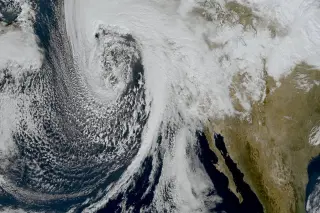
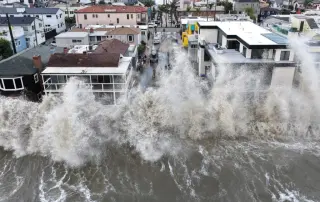
A record-breaking El Niño is driving unprecedented emergency preparations across California, with officials pre-positioning millions of sandbags and clearing flood channels to mitigate severe winter storms, coastal erosion, and flooding expected to peak between December and February.
A potentially record-breaking El Niño is intensifying, threatening Washington State’s coastal communities with severe flooding during the upcoming king-tide season. While local governments scramble for infrastructure fixes, the phenomenon is also disrupting marine ecosystems globally, from Peru’s penguin colonies to Chile’s aquaculture sector.
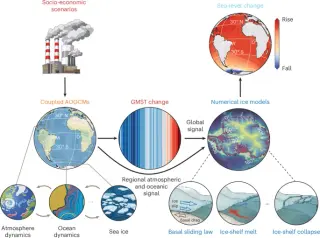
A new study in Nature concludes that the Antarctic Ice Sheet is committed to mass loss by 2100, even under aggressive emissions cuts. Using machine learning to analyze ice-sheet models, researchers found that higher emissions significantly increase projected sea-level rise, potentially reaching 25.4 cm by 2100 under worst-case scenarios. The study highlights that physical assumptions in models, not just emissions, drive uncertainty, and that satellite data confirms the inevitability of ice loss.
A historic El Niño event, potentially the strongest in a millennium, is set to trigger record-breaking global temperatures and extreme weather. California faces near-certain coastal flooding due to temporary sea-level rises and king tides, alongside increased rainfall. While this may offer short-term relief for drought, it will not resolve long-term water crises.
Two years after Hurricane Helene killed 108 people in North Carolina, federal and state policy gaps continue to allow residents to rebuild in high-risk flood zones. Outdated maps and minimal regulations permit mobile homes and campers on riverfront lots previously destroyed by storms. While WRAL highlights the meteorological factors that worsened the 2024 flooding, ProPublica focuses on the systemic failure to prevent repeated displacement and loss of life in vulnerable communities.
A massive, slow-moving Kelvin wave is approaching California's coast, potentially raising sea levels by up to 12 inches. This surge, driven by a historically intense El Niño, threatens to exacerbate winter storm surges and flooding. Governor Gavin Newsom has declared a state of emergency, mobilizing resources and urging residents to prepare for elevated tides and coastal erosion.
California is preparing for a potentially historic 'super El Niño' this winter, which threatens severe coastal flooding and erosion but also offers a critical opportunity to replenish depleted groundwater. Governor Gavin Newsom has declared a state of emergency to mobilize resources for flood control and infrastructure protection. Simultaneously, state agencies and local communities are leveraging the expected heavy rainfall to capture stormwater through expanded spreading grounds, restored floodplains, and farmland irrigation. While the 2025-26 season already captured significant water, experts warn that more aggressive infrastructure and flexible dam management are needed to fully capitalize on the wet conditions and mitigate long-term drought impacts.
A record-breaking El Niño event, dubbed 'Godzilla,' is intensifying in the equatorial Pacific, with sea surface temperatures already surpassing historical highs. Experts project this event could cause approximately 451,000 additional heat-related deaths between June 2026 and February 2027. While the phenomenon is natural, its severity is amplified by human-caused warming, which has increased El Niño intensity by 36% since the industrial era. Governments are mobilizing emergency resources, including California’s state of emergency declaration, while international bodies urge water management and emission reductions to mitigate long-term impacts.
A new report from the Climate Impact Lab projects that the current record-breaking El Niño will cause approximately 451,000 excess heat-related deaths globally between June 2026 and February 2027. The event is intensifying global temperatures by 1.2 degrees Celsius above normal, a level typically expected in two decades. While the phenomenon is natural, its severity is amplified by fossil fuel-driven warming, disproportionately affecting nations in the Global South. Researchers urge immediate emergency measures, including heat warnings and cooling centers, to mitigate the crisis before it becomes the new normal.
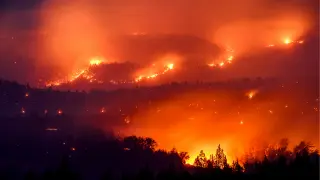
Indonesia faces a severe public health crisis as wildfires fueled by a 'Godzilla' El Niño have burned nearly 896,000 hectares of land since January. The resulting toxic haze has caused 175,000 respiratory cases, including 40,000 among toddlers, while authorities deploy 54,000 personnel and international aid to combat the fires.
A 'super El Niño' has shattered historical temperature records in the Pacific Ocean, with forecasts predicting a peak of 4.0C by December. The Climate Impact Lab projects this event could cause 451,000 excess heat-related deaths globally by February 2027, disproportionately affecting nations in the Global South. While the phenomenon is a natural cycle, scientists warn that underlying fossil-fuel-driven warming is amplifying its impacts, leading to severe droughts, wildfires, and food insecurity worldwide.
A new study projects that the current super El Niño will cause over 450,000 additional heat-related deaths globally by February 2027, with the heaviest toll in developing nations. In response to the historic weather event, California Governor Gavin Newsom has declared a state of emergency to mobilize resources against anticipated severe storms and flooding.
The 2026 Planetary Health Check, produced by the Planetary Boundaries Science Lab at the Potsdam Institute for Climate Impact Research (PIK), reports that seven of nine critical Earth system boundaries are breached at record highs. These include climate change, biosphere integrity, land system change, freshwater change, biogeochemical flows, novel entities, and ocean acidification, which crossed its threshold in 2025. Only stratospheric ozone depletion and atmospheric aerosol loading show improvement, though aerosol levels remain unsafe in some regions. Lead author Boris Sakschewski warns that the risk of irreversible change is rising as margins for error shrink. The report highlights recent extremes, including record ocean heat, Pakistan’s 2025 floods affecting 6.9 million people, and widespread European wildfires. Scientists note that carbon sinks may be weakening, potentially undermining net-zero goals, while emphasizing that solutions exist to return to a safe operating space.
World leaders gathered in New York for Climate Week 2026, coinciding with the UN General Assembly, to address the climate crisis amidst a record-breaking El Niño. Keynote speakers from Australia and Iceland highlighted the urgency of transitioning away from fossil fuels, citing security risks and economic imperatives rather than political stalling. The event emphasized that extreme weather events, such as those seen in Europe, Africa, and Asia, have validated scientific forecasts regarding increased frequency and intensity of climate impacts. While the US government’s recent moves to block offshore wind projects and weaken emissions standards were largely ignored by speakers, the focus remained on the necessity of rapid transition to protect national security and economic stability.
California Governor Gavin Newsom has declared a state of emergency to prepare for a record-breaking 'super El Niño' expected to bring severe winter storms and flooding. Simultaneously, a new study warns that the same climate phenomenon could cause nearly 451,000 additional heat-related deaths worldwide by February 2027, with the heaviest toll in developing nations.