
Himalayan Collapse Exposes Fatal Gaps in Regional Disaster Warning
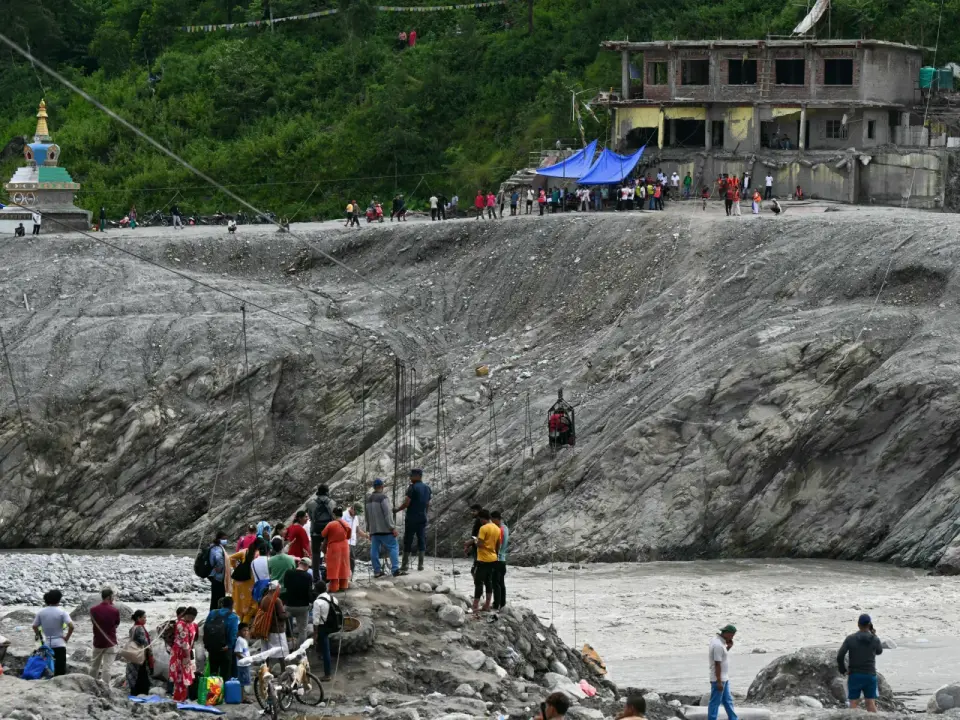
A massive rock-ice avalanche in Nepal on August 26, 2026, triggered a catastrophic debris flood that killed over 1,300 people and left thousands missing. Scientists attribute the event to a complex cascade of climate-driven factors, including permafrost thaw and glacier retreat, which exceeded the capacity of existing early-warning systems. The disaster highlights the urgent need for cross-border cooperation and anticipatory action across the Himalayan region.
Key points
- The August 26 event involved a 2-square-kilometer rock and ice collapse from Langtang Lirung, releasing energy equivalent to a magnitude 5.5 earthquake and traveling at 188 km/h.
- Over 1,300 people are confirmed dead, with more than 5,000 missing and 13,700 rescued; 12 hydropower plants were destroyed, and 900 workers were trapped in tunnels.
- World Weather Attribution scientists found that human-caused warming increased local temperatures by 1.5°C in July-August 2026, weakening permafrost and destabilizing slopes.
- Existing warning systems failed because they were designed for conventional rainfall or river levels, not for rapid, high-altitude geohazard cascades that provide minimal lead time.
- Experts urge transboundary data sharing and anticipatory action, as hazards in one country can trigger disasters in neighboring regions like Tibet, Kashmir, and Sikkim.
Background
Previous coverage in August and September 2026 established the initial death toll and confirmed the glacial collapse as the primary trigger, distinguishing it from seismic activity. Earlier reports also highlighted Nepal’s request for $20 million from the UN loss-and-damage fund and criticized media for downplaying the climate connection. This briefing synthesizes the latest scientific analysis and regional implications.
How outlets are covering it
Al Jazeera emphasizes the systemic failure of warning systems and the 'infrastructure trap' of hydropower projects in vulnerable valleys. World Weather Attribution provides a detailed scientific attribution, linking the collapse to specific climate drivers like permafrost degradation and the 2015 earthquake, while noting that such events exceed adaptation limits. CNN highlights the consensus among international experts that climate change preconditioned the disaster, with Friederike Otto stating that similar events are inevitable without fossil fuel cuts. The New York Times focuses on the broader regional risk, urging eight Himalayan nations to improve monitoring and cooperation, noting that the disaster is not isolated to Nepal but indicative of a shifting risk landscape across the 'Third Pole.'
Why it matters
The event demonstrates that traditional disaster management frameworks are inadequate for climate-amplified geohazards. It underscores the necessity for transboundary cooperation and anticipatory action to protect millions downstream in major river basins. The failure of existing systems to provide sufficient warning time highlights a critical gap in global climate adaptation strategies, particularly in high-altitude regions where infrastructure and population are increasingly exposed to rapid environmental changes.
What to watch
Nepal and neighboring countries are expected to expand early-warning infrastructure and evacuation shelters, though experts warn that technology alone is insufficient without robust communication and evacuation routes. International scientists are continuing to analyze the event to refine risk models, while Nepal pursues climate damage compensation. The focus is shifting from reactive disaster response to anticipatory action, with a push for stronger regional data sharing and monitoring networks to address interconnected hazards across the Himalayas.
- The Nepal floods question: When the Himalayas collapse, who gets warned? Al Jazeera
- Rapid Warming in the Himalaya Exacerbates Geohazard Cascades Beyond Adaptation Limits World Weather Attribution
- Here’s what one team of scientists thinks happened in Nepal’s deadly flood wave CNN
- Scientists Warn of Flood Risks to 8 Himalayan Countries after Nepal Disaster The New York Times
- New Insight On What Caused The Disastrous Nepal Floods forbes.com
Want the full story? Read the original reporting
Read on Al Jazeera