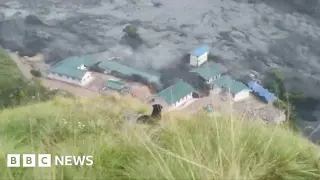
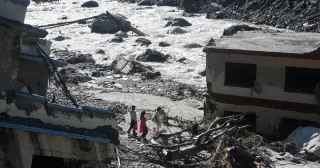
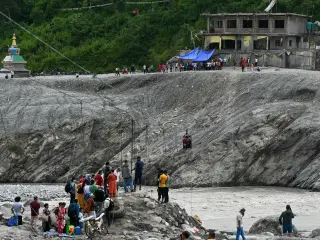
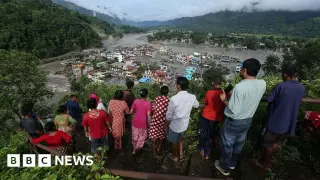
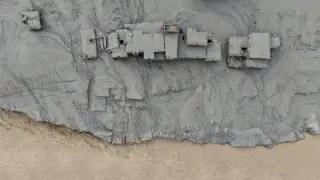
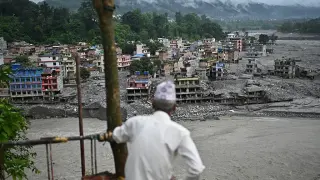
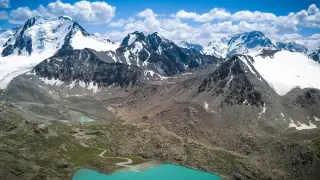
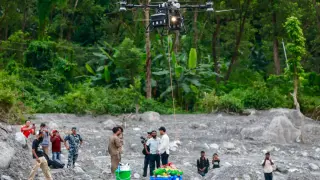
A sudden flash flood on the Budhi Gandaki River in Nepal's Gorkha district has swept away dozens of homes and bridges, damaging a hydropower station. While no deaths have been confirmed, five people remain missing, and rescue operations are underway. This event occurs just two months after a catastrophic glacial flood killed over 1,400 people in the region.
Nepal has suspended search operations for the August 26 floods, leaving over 5,000 people officially missing. Families cannot access compensation or inheritance because current law requires a 12-year wait to declare someone dead, creating a bureaucratic crisis amid a $4.8 billion reconstruction effort.
Nepal has officially ended the search and rescue phase for the August 26 floods, which killed at least 1,455 people and left 5,285 missing. Authorities are transitioning to a rehabilitation phase, requiring nearly $5 billion for recovery. The disaster, triggered by a glacier collapse on the Nepal-China border, destroyed 12 hydroelectric projects and displaced thousands. While 13,795 people were rescued, including late survivors from hydropower tunnels, the government is now focusing on legally declaring the missing dead to allow families to access insurance and banking services. International concerns remain high, particularly regarding 189 missing Indians and 606 other foreign tourists.
Nepal PM Balendra Shah used his maiden UN General Assembly speech to criticize global logistics that prioritize weapons over food and climate aid. He proposed a Himalayan Climate Resilience Mechanism involving Nepal, India, and China, while highlighting the massive financial and human toll of the August 2026 Bhotekoshi floods.
Nepal’s Prime Minister Balendra Shah addressed the UN General Assembly on September 24, 2026, demanding that wealthy nations provide grant-based support rather than loans for climate disaster recovery. He cited the August flash floods, which killed at least 1,400 people, as a 'warning to the world' about the inequity of climate impacts. While Nepal contributes less than 0.1% of global greenhouse gas emissions, it faces reconstruction costs estimated at 10% of its GDP. Shah criticized the current international aid system as too bureaucratic, urging a shift toward 'responsibility, reparation, and resilience' for vulnerable nations.
A massive rock-ice avalanche in Nepal on August 26, 2026, triggered a catastrophic debris flood that killed over 1,300 people and left thousands missing. Scientists attribute the event to a complex cascade of climate-driven factors, including permafrost thaw and glacier retreat, which exceeded the capacity of existing early-warning systems. The disaster highlights the urgent need for cross-border cooperation and anticipatory action across the Himalayan region.
Nepal is using a new scientific study linking climate change to the August 2026 Himalayan floods as the primary evidence for a $20 million claim to the UN Fund for Responding to Loss and Damage. The study confirms that human-induced warming destabilized the geological conditions that triggered the catastrophic rock-ice avalanche, which killed over 1,400 people. While Nepal seeks $5 billion for total reconstruction, the UN fund currently has only $400 million available for nearly 120 competing claims.
Nepal has revised its missing person count for the August 26 floods to 6,150, adding nearly 1,000 names after district-level verification. Simultaneously, rescue teams recovered 10 bodies from two hydropower projects in Rasuwa district. The total death toll across Nepal and Tibet now stands at 1,446, with at least 6,669 people missing. At least 189 Indians remain unaccounted for. The recovery efforts involved specialized Indian Army personnel and Nepali rescuers digging by hand to reach underground powerhouses where excavators could not advance.
A new scientific assessment confirms that human-induced climate change significantly contributed to the August 26 glacier collapse on the Nepal-Tibet border. The event, described as a cascading disaster rather than a conventional flood, killed over 1,300 people and left thousands missing. Nepal is seeking $20 million from the UN Loss and Damage Fund, with total reconstruction costs estimated at $5 billion.
A massive rock-ice avalanche in Nepal on August 26, 2026, triggered a catastrophic debris flood that killed over 1,300 people and left 5,000 missing. A World Weather Attribution study concludes that while geology was the primary trigger, human-caused climate change significantly destabilized the slope through warming, permafrost thaw, and glacier retreat. The event exceeded the capacity of existing early warning systems, marking a new threshold for climate-driven loss and damage.
A team of over 20 international scientists from World Weather Attribution (WWA) has concluded that the August 2026 flash floods in Nepal, which killed at least 1,300 people and left over 5,000 missing, were caused by a complex cascade of factors rather than a single event. The disaster began when a massive section of rock and glacier ice, approximately 2,000 feet wide, sheared off Langtang Lirung mountain. This collapse released energy equivalent to a magnitude 5.2 earthquake, triggering a debris flood that traveled over 200 miles downstream. While the event was fundamentally different from typical riverine floods, researchers found that human-induced climate change significantly weakened the mountain’s stability. Key factors included rising temperatures that degraded permafrost, accelerated glacier thinning, and record-breaking warmth in July and August 2026. The report notes that no existing early warning system could have provided sufficient lead time for such an unprecedented event, highlighting the limits of current adaptation strategies in the Himalayas.
After days of desperate searching, Nepali and international rescue teams recovered five bodies at the Chilime Hydropower Station, confirming the deaths of workers trapped by catastrophic floods. A sixth individual remains missing. While one survivor, Sanjay Sah, has returned home after nine days in a tunnel, the overall death toll in Nepal has exceeded 1,386, with over 5,100 people still unaccounted for.
A massive glacial collapse on August 26, 2026, triggered catastrophic floods in Nepal and Tibet, killing at least 1,350 people and leaving 5,000 missing. The disaster, which caused $5 billion in damages, highlights how human infrastructure and climate change combine to turn natural hazards into deadly events.
A new report by consultancy Systemiq, produced with Indian government partners, finds that Himalayan glaciers are melting 65% faster than a decade ago. The study warns of a 'peak water' tipping point by mid-century, where catastrophic floods precede severe water scarcity for 2 billion people. This follows the August 2026 disaster in Nepal, which killed over 1,300 people and left thousands missing after a glacier collapse near Langtang Lirung triggered massive flash floods.
A glacial collapse on August 26, 2026, triggered catastrophic flash floods along the Nepal-China border, killing over 1,300 people and leaving more than 5,000 missing. Chinese-made DJI drones are now critical for delivering food and recovering bodies in inaccessible areas, while international aid groups focus on child welfare and trafficking prevention. Nepal observed a national day of mourning on September 7, with rescue efforts continuing in hydropower tunnels.