
Coordinated Nighttime Assaults Target Thai Southern Infrastructure
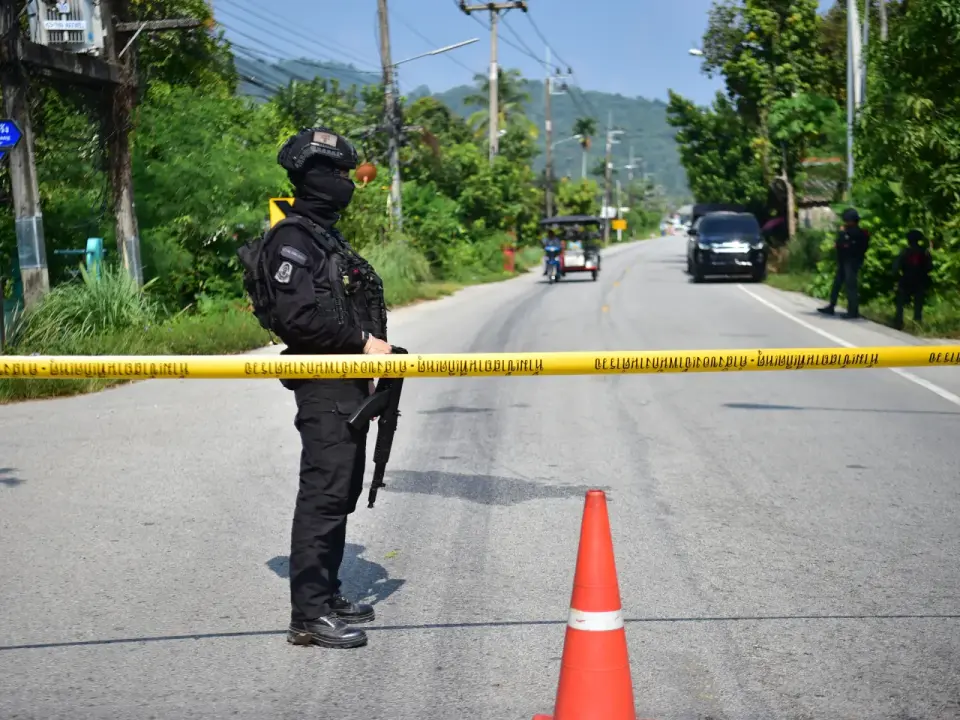
Fifty-one coordinated attacks struck Thailand’s southern border provinces late Saturday, wounding three civilians and damaging government and commercial infrastructure. The military’s Internal Security Operations Command (ISOC) confirmed the incidents, which included arson, bombings, and vehicle thefts, primarily in Narathiwat province. An overnight curfew was imposed, and railway services were suspended after track damage was reported. No group has claimed responsibility, though authorities had intelligence warnings for two months. Prime Minister Anutin Charnvirakul is scheduled to visit the region next week to discuss security and investment, coinciding with stalled peace talks with the National Revolutionary Front (BRN).
Key points
- Fifty-one coordinated attacks occurred between 8pm and midnight on Saturday across southern Thailand, with the majority concentrated in Narathiwat province.
- Three civilians, including two women and one man, were wounded in a roadside bombing in Narathiwat and are currently in stable condition.
- The Internal Security Operations Command (ISOC) reported damage to local government offices, telecommunications towers, electrical poles, and a 7-Eleven store, alongside the theft of a vehicle from a subdistrict administrative office.
- An overnight curfew was enforced in Narathiwat until 6am Sunday, and the national railway operator suspended part of a route due to track damage from a bombing.
- Army commander Norathip Poinok stated that intelligence reports had warned of attacks on local offices for approximately two months, though specific timing and locations were unknown.
- Prime Minister Anutin Charnvirakul is set to visit Hat Yai in Songkhla province next week to discuss security, flood prevention, and investment projects.
Background
Thailand’s southernmost provinces have experienced low-level conflict since 2004, resulting in over 7,000 deaths as rebels in the Muslim-majority region seek greater autonomy. Violence has persisted despite peace efforts, including a recent attack in July that killed five soldiers at a checkpoint in Narathiwat. The current surge in attacks occurs amid stalled negotiations with the BRN, the main separatist group, which have struggled to resolve disagreements over self-government and security measures. The region, including Pattani, Yala, and Narathiwat, was once part of the independent Malay sultanate of Patani.
Why it matters
The coordinated nature of the attacks signals a potential escalation in the long-standing insurgency, threatening the stability of the region just before high-level government visits and anticipated peace talks. The targeting of critical infrastructure, including railways and telecommunications, aims to disrupt daily life and undermine public confidence in state security. The military’s advance intelligence warnings highlight the challenges in preventing such coordinated assaults, while the government’s shift in negotiation strategy with the BRN indicates a strategic pivot to address the root causes of the conflict rather than merely reacting to violence.
What to watch
Investigations into the attack sites are ongoing, with security teams inspecting damaged government offices and infrastructure. The Thai government is preparing for Prime Minister Charnvirakul’s visit to Hat Yai next week to address security concerns and investment projects. Formal peace talks between the government and the BRN are expected to resume, with intelligence chief Thanut Suvarnananda aiming to transform the relationship from adversarial to cooperative. Continued security measures, including curfews and checkpoints, are likely to persist in the affected provinces.
Want the full story? Read the original reporting
Read on Al Jazeera