
Ukraine Confirms Six-Month Operational Run of Swedish ASC 890 Radar Planes
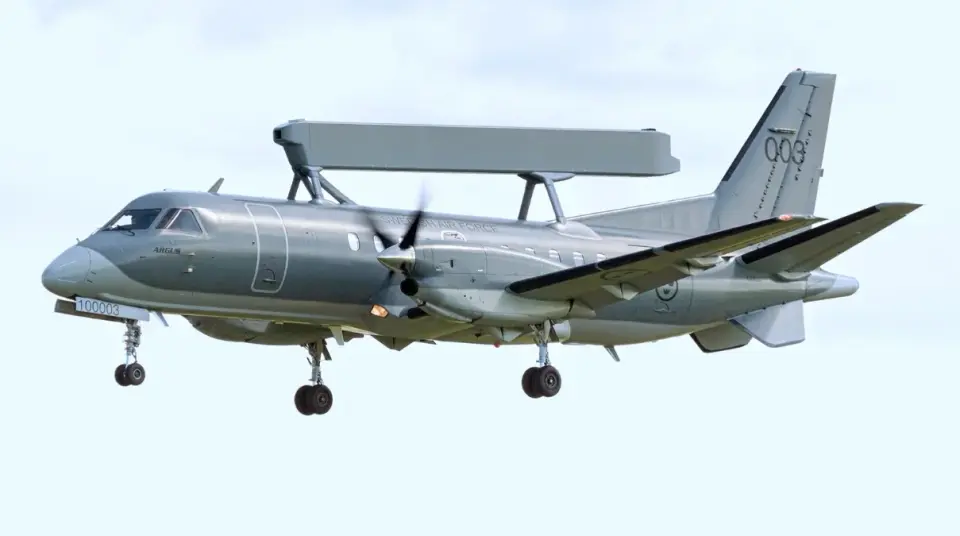
Ukraine’s Ministry of Defense confirmed on September 5, 2026, that two Swedish-supplied Saab ASC 890 airborne early warning aircraft have been conducting combat operations since March. The planes, donated as part of a $1.25 billion aid package announced in May 2024, provide critical radar coverage and command-and-control capabilities for Ukrainian fighters. Despite operating within the range of Russian long-range missiles, neither aircraft has been shot down in six months of service.
Key points
- Ukraine officially confirmed the operational use of two Saab ASC 890 airborne early warning aircraft on September 5, 2026, after six months of secret operations starting in March.
- The aircraft were donated by Sweden as part of a $1.25 billion aid package announced in May 2024, with transfer confirmed in August 2025.
- The ASC 890s feature a Saab Erieye active electronically scanned array radar capable of detecting targets up to 450 km away and tracking 1,000 airborne and 500 surface targets simultaneously.
- The planes integrate with Ukrainian F-16s, Mirage 2000s, and incoming Gripen fighters to create a network-centric air defense system, allowing fighters to remain stealthy while receiving target data.
- Despite the risk of being targeted by Russian R-37M missiles and S-300V4 systems, no ASC 890 has been shot down since operations began in March 2026.
Background
Ukraine has historically lacked airborne early warning capabilities, relying on ground-based radars that are vulnerable to counter-battery fire and limited by the Earth's curvature. The country previously attempted to develop its own radar aircraft, the Antonov An-71, in the 1980s, but the project failed due to Soviet collapse and funding issues. The introduction of the ASC 890 marks the first time Ukraine has operated a functional airborne radar platform, significantly enhancing its ability to detect low-flying drones and cruise missiles that evade ground sensors. This development follows recent Ukrainian strikes on Russian radar and electronic warfare systems, indicating a shift toward more sophisticated air defense integration.
How outlets are covering it
Euromaidan Press emphasizes the tactical vulnerability of the ASC 890s, noting that their large size and electromagnetic emissions make them easy to locate, though difficult to hit due to their distance from the front line. The outlet highlights the risk posed by Russian R-37M missiles and the lack of retreat options for the planes, contrasting them with Russian A-50Us that can redeploy deeper into Russian territory. Janes focuses on the technical specifications and strategic integration, describing the ASC 890 as a node in a NATO-standard network-centric combat system that allows Ukrainian fighters to remain quiet while being vectored into position. MiGFlug underscores the aircraft's role as a 'flying command post' that transforms Ukraine's air war from a blind, ground-based operation to a coordinated, high-altitude surveillance and control network. Aviation Week provides a neutral confirmation of the operational timeline, noting the transition from announcement in 2024 to combat use in 2026, without delving into the tactical risks or technical details as extensively as the other outlets.
Why it matters
The operational success of the ASC 890s represents a significant shift in Ukraine's air defense capabilities, enabling it to detect and intercept Russian drones and cruise missiles from a greater distance. This reduces the burden on ground-based air defense systems, which are in short supply, and allows Ukrainian fighters to operate more effectively by remaining stealthy while receiving real-time target data. The fact that the planes have survived six months of operations without loss suggests that Ukraine's integrated air defense network is effective enough to deter or counter Russian attempts to destroy these high-value assets. This development also signals a deeper integration of Western military technology into Ukraine's command-and-control structure, potentially setting a precedent for future NATO-standard air operations in the region.
What to watch
Ukraine is expected to continue operating the ASC 890s as part of its integrated air defense network, potentially expanding their use as more Gripen fighters are delivered. The success of these operations may influence future Western aid packages, with a focus on providing more advanced airborne surveillance and command-and-control capabilities. Russia may increase efforts to target these aircraft, potentially using more advanced missiles or electronic warfare systems, but the current lack of losses suggests that Ukraine's countermeasures are effective. The long-term impact will depend on Ukraine's ability to sustain these operations and integrate them with other air defense systems, as well as the broader strategic context of the conflict.
- Ukraine's Swedish radar planes have flown inside Russian missile range for six months. None has been shot down. Euromaidan Press
- Ukraine conflict: Kyiv confirms use of ASC 890 AEW&C aircraft Janes
- Ukraine Confirms Its Swedish ASC 890 Radar Plane Is Flying Combat MiGFlug
- Ukraine Has Started Combat Deployment of ASC 890 Long-Range Radar Detection Aircraft Мілітарний
- Ukrainian AEW Aircraft In Combat Operations Since March Aviation Week
Want the full story? Read the original reporting
Read on Euromaidan Press