
DIA Report Confirms China’s X-37B-Like Spaceplane and Warns of Orbital Laser Weapons
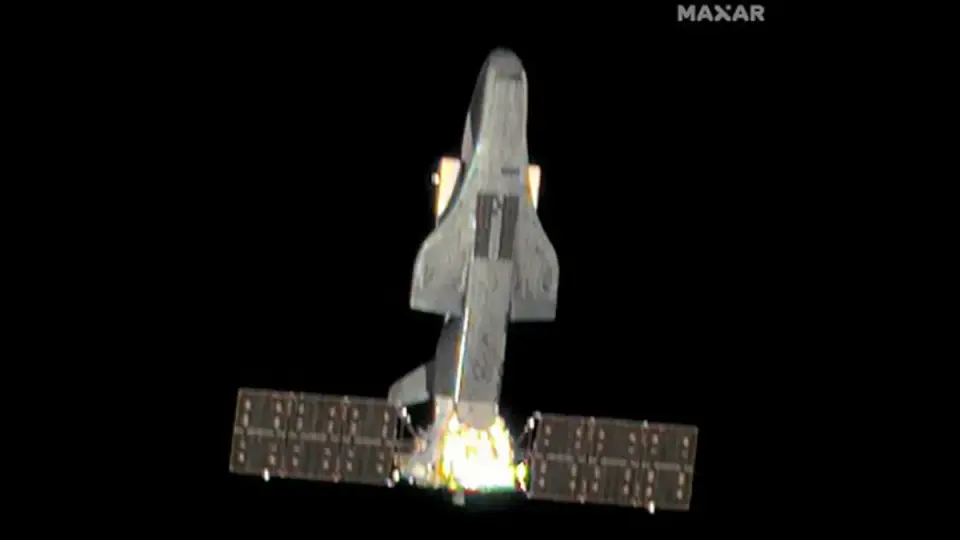
The U.S. Defense Intelligence Agency (DIA) released a new report confirming that a 2024 satellite image depicts a Chinese reusable spaceplane, closely resembling the U.S. X-37B. The report highlights China’s growing space capabilities, including four orbital missions since 2020, and warns that Beijing may deploy space-based directed-energy weapons by the late 2020s.
Key points
- The DIA’s 2026 'Challenges to Security in Space' report includes a high-resolution image of a Chinese spaceplane captured by Vantor (formerly Maxar) in 2024.
- The Chinese vehicle features delta wings, a payload bay, and solar panels, closely mirroring the U.S. X-37B design, though with a longer wing chord.
- China has conducted four orbital spaceplane missions since 2020, with the most recent launch occurring in February 2026.
- The DIA warns that China may field space-based directed-energy weapons by the late 2020s to disable or dazzle adversary satellites.
- The report notes that China has demonstrated the ability to capture and release sub-satellites in orbit, a capability also possessed by the U.S. X-37B.
Background
This development follows years of speculation regarding China’s 'Shenlong' spaceplane, with lower-resolution images first appearing in 2024. The U.S. Space Force had previously acknowledged the existence of such imagery but declined to release high-resolution details. The current report is the third iteration of the DIA’s unclassified space threat assessments, building on earlier concerns about the militarization of space and the rise of dual-use capabilities.
How outlets are covering it
While the TWZ and Ars Technica focus on the visual confirmation of the spaceplane’s design and its similarity to the X-37B, SpaceNews emphasizes the strategic threat posed by China’s potential deployment of directed-energy weapons. Ars Technica highlights the 'cat-and-mouse' nature of commercial non-Earth imaging, noting that Vantor’s satellite captured the image during a chance orbital encounter. The DIA report itself frames these developments as part of a broader trend of adversaries expanding their space-based military capabilities, including Russia’s pursuit of orbital combat systems.
Why it matters
The confirmation of a Chinese spaceplane capable of deploying and retrieving payloads in orbit signals a significant shift in the balance of power in space. The potential for space-based directed-energy weapons could lead to a new era of orbital conflict, where satellites are targeted for temporary or permanent disablement. This development underscores the increasing importance of space as a warfighting domain and the need for robust defensive and offensive capabilities to protect national security interests.
What to watch
Analysts expect further scrutiny of China’s space activities, particularly regarding the deployment of directed-energy weapons and the development of new spaceplane models like the Tengyun. The U.S. may accelerate its own space-based defense initiatives, including the procurement of inspector satellites and the development of countermeasures against orbital threats. International discussions on space governance and the prevention of an arms race in space are likely to intensify.
- U.S. Intel Confirms This Is China’s Secret Spaceplane TWZ
- DIA Releases Challenges to Security in Space DIA.mil
- China's top-secret spaceplane can't hide in low-Earth orbit Ars Technica
- China could field directed-energy weapons in orbit by late 2020s, U.S. intelligence says SpaceNews
- China’s super-secret space plane visible in clearest photo yet Popular Science
Want the full story? Read the original reporting
Read on TWZ