
Russia Unveils Low-Cost Stealth Munitions at El Alamein Amid Su-57 Export Push
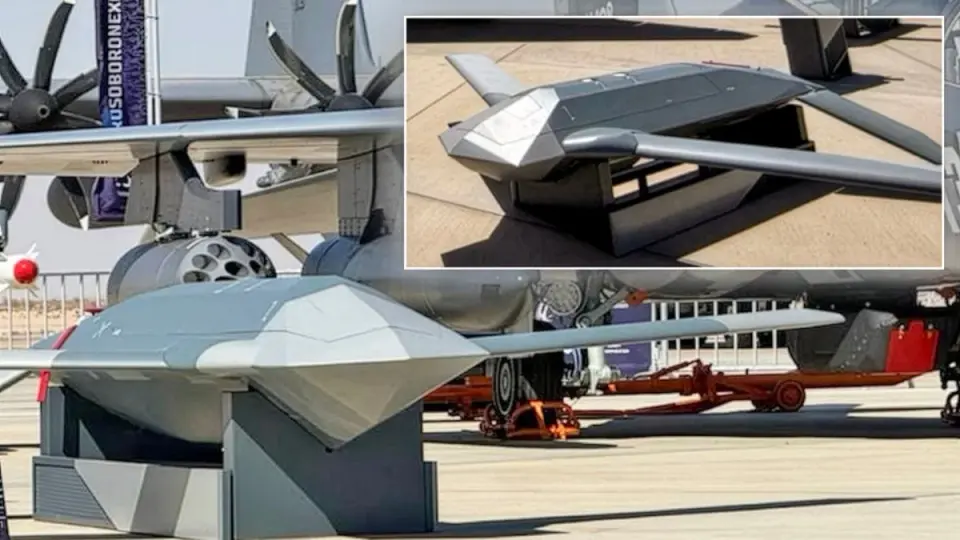
Russia showcased new low-observable air-launched weapons, including the S-71K and S-71M, at the El Alamein Airshow, signaling a shift toward mass-producible standoff munitions. Concurrently, Rosoboronexport confirmed new Su-57 export contracts, with Algeria expected to receive 36 jets by 2027. These moves highlight Moscow’s strategy to leverage wartime experience in Ukraine to market affordable, combat-tested systems to international buyers despite sanctions.
Key points
- The S-71K Kovyor and S-71M Monokhrom were displayed for the first time in public, featuring angular, low-observable airframes designed to reduce radar signatures.
- The S-71M utilizes a turbojet engine and inertial guidance, while the S-71K incorporates electro-optical guidance and greater onboard processing for flexible target engagement.
- The S8000 Banderol, also known as the 'Dan-T' loitering munition, was shown mounted on a Mi-28NM helicopter, indicating a multi-platform launch capability with a range of approximately 500 kilometers.
- Rosoboronexport confirmed new Su-57 export contracts without naming buyers, but industry records suggest Algeria is the primary recipient, with deliveries of 36 aircraft planned by 2027.
- The weapons are designed to be more affordable than traditional cruise missiles, allowing for higher production volumes to saturate enemy air defenses, a tactic refined during the war in Ukraine.
Background
This development follows earlier reports of Russian glide bomb usage in Ukraine and the Pentagon’s push for rapid weapons production in August 2026. It also aligns with the broader trend of low-cost precision strike systems, as seen in the Covenant missile factory expansion in Dallas. The El Alamein showcase occurs amidst growing China-Egypt military ties, where J-16 and Rafale drills recently took place, highlighting Egypt’s role as a testing ground for international air power.
How outlets are covering it
The War Zone emphasizes the technical evolution of the S-71 series as a cost-effective alternative to high-end cruise missiles, noting the blurred line between drones and missiles. Atalayar focuses on the geopolitical implications of the Su-57 export to Algeria, arguing it disrupts defensive parity in the Maghreb and challenges NATO’s southern flank. WION highlights the strategic shift toward manned-unmanned teaming, where the Su-57 acts as a command node for drone swarms, a concept also being developed by the US and China. While The War Zone details the specific weapon characteristics, Atalayar and WION provide broader context on the strategic and doctrinal shifts driving these exports.
Why it matters
The public display of these weapons signals Russia’s intent to commercialize its wartime innovations, potentially reshaping the global market for affordable precision strike capabilities. The Su-57 export to Algeria could alter the balance of power in North Africa and the Mediterranean, while the focus on low-cost, high-volume munitions reflects a broader global trend toward attritable warfare. This move also tests the effectiveness of Western sanctions, as Russia continues to secure international contracts despite restrictions on technology and financing.
What to watch
Expect further details on the Su-57 export contracts as deliveries to Algeria begin in phases, with the first batch of six jets for operational trials. Russia may also seek to expand the use of the Banderol/Dan-T munition to other platforms and export markets. The integration of AI-driven cockpit automation and drone swarms with the Su-57 could lead to new demonstrations of manned-unmanned teaming capabilities in future airshows or conflicts.
- Russia’s New Stealthy Lower-Cost Air-Launched Standoff Weapons On Display In Egypt TWZ
- Russia to show Africa’s most powerful military a never-before-seen weapon carried in its new flagship Su-57E export fighter Business Insider Africa
- Russians Brought Su-57E Jets to Egypt Equipped with Monochrome, Kover, and Dan-T Missiles Мілітарний
- Pourquoi les nouveaux chasseurs Su-57 de l'Algérie font-ils tiquer tout le Maghreb atalayar.com
- Su-57’s Drone army: Russia turns stealth fighter into an airborne commander WION
Want the full story? Read the original reporting
Read on TWZ