
Russia Deploys Anti-Drone Nets and Cages on Nuclear Submarines in Far East and Black Sea
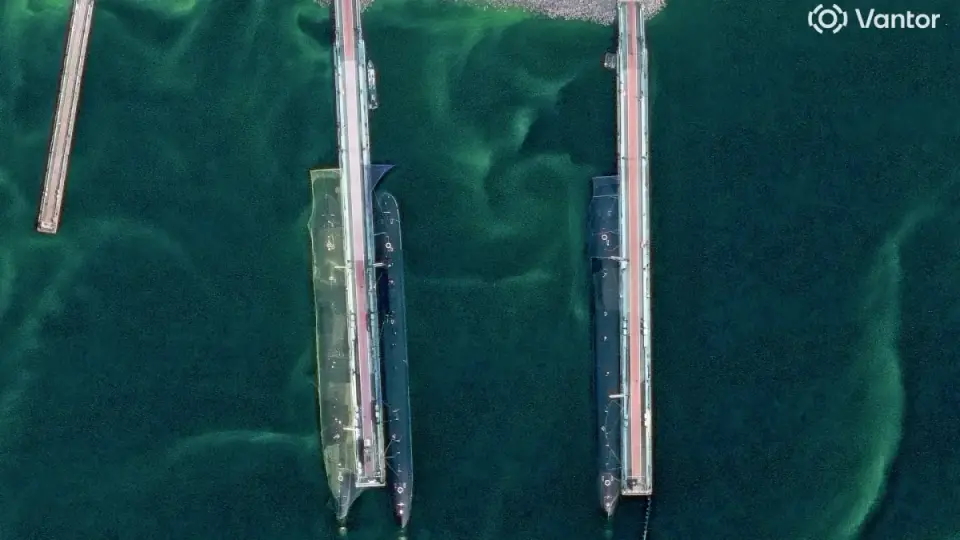
Satellite imagery reveals Russia is installing extensive anti-drone netting over nuclear ballistic missile submarines at the Rybachiy base in Kamchatka and protective cages on attack submarines at Novorossiysk. These defensive measures, which began in May 2026, reflect Moscow’s growing concern over Ukrainian long-range drone capabilities reaching critical naval assets thousands of miles from the front line.
Key points
- Vantor satellite imagery from August 2026 shows multiple Borei-class nuclear ballistic missile submarines at the Rybachiy base in Kamchatka covered by overhead nets, a measure first observed in May 2026.
- At the Novorossiysk base in the Black Sea, three of four Kilo-class attack submarines were fitted with counter-drone cages over their conning towers, with imagery from June 13, 2026, showing them partially submerged in the harbor basin.
- The UK Ministry of Defense assessed that the cages were installed as a preventive measure against Ukraine’s expanding ability to strike targets far from the front line, including via unmanned surface vessels and aerial drones.
- The fourth Kilo-class submarine at Novorossiysk, which lacked a cage, was observed maneuvering away from other vessels before submerging, suggesting it may have been deprioritized for protection or was undergoing a different readiness protocol.
- Floating booms have also been deployed around piers at Rybachiy to counter explosive-laden kamikaze drone boats, mirroring defensive trends seen at other Russian naval facilities.
Background
This development follows a broader trend of Russia fortifying high-value assets against Ukrainian unmanned systems. In 2024, rudimentary counter-drone screens were installed on the Delta-IV class submarine Tula in Murmansk, and mock conning towers were built at Novorossiysk to confuse autonomous targeting systems. The current measures represent a significant escalation in the scale and complexity of protection for Russia’s most strategic naval assets, extending to the Pacific Fleet despite its distance from the conflict zone.
How outlets are covering it
While all sources agree on the physical presence of the defenses, they emphasize different aspects. The War Zone highlights the strategic significance of protecting Borei-class submarines, which carry the world’s most heavily armed nuclear missiles, and notes the global trend of drone proliferation. Business Insider focuses on the expansion of these measures from two submarines in May to more than half a dozen in August, emphasizing the distance of Rybachiy from Ukraine. Military Watch Magazine stresses the vulnerability of large, static assets like submarines to sophisticated unmanned systems, linking the measures to Ukraine’s Operation Spiderweb. The UK Defence Journal provides the most detailed operational analysis, noting the unusual practice of submerging in harbor and the specific behavior of the unprotected fourth submarine.
Why it matters
The installation of these defenses signals that Russia perceives its nuclear deterrent and naval assets as vulnerable to Ukrainian long-range strikes, even in remote locations like Kamchatka. It indicates a shift in Russian force protection posture, moving from reactive measures to proactive, large-scale infrastructure changes to mitigate the threat of autonomous aerial and surface drones. This could influence future naval base designs and defensive strategies globally as drone technology becomes more accessible and capable.
What to watch
Analysts will monitor whether these measures are permanent or temporary, and if similar defenses are deployed at other Russian naval bases. The effectiveness of the nets and cages against actual drone attacks will be a key metric, as will any further Ukrainian strikes on Russian naval infrastructure. The UK Ministry of Defense and other intelligence agencies will likely continue to assess the operational impact of these defensive measures on Russian naval readiness and mobility.
- Russian Nuclear Ballistic Missile Submarines Are Now Cocooned In Nets TWZ
- World’s Most Heavily Armed Submarines Fortified with New Anti-Drone Protection at Russia’s Key Pacific Base Military Watch Magazine
- Images: Russia Put Anti-Drone Nets on More Submarines at Pacific Base businessinsider.com
- Russian subs submerge in harbour fearing Ukrainian drones UK Defence Journal
- Russia’s Submarines Are Getting a New Accessory: ‘Cope Cages’ The National Interest
Want the full story? Read the original reporting
Read on TWZ