
Putin Warns EU Gas Exclusion Will Spike Costs, Confirms Arctic Talks with US
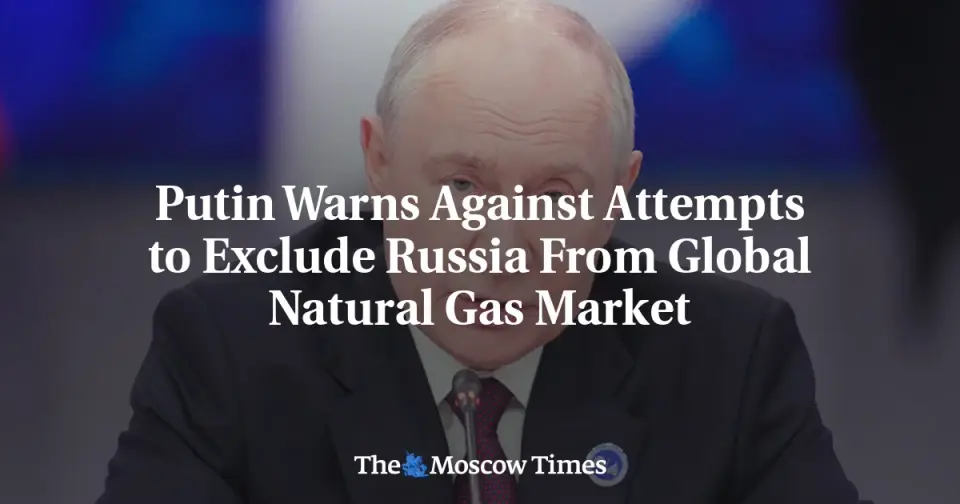
At the Gas Exporting Countries Forum in Moscow, President Vladimir Putin warned that Western efforts to exclude Russia from the global gas market will raise costs for European consumers. He confirmed ongoing discussions with US envoy Steve Witkoff regarding potential joint energy projects in the Arctic, noting that European partners previously worked in these fields alongside Russia. Putin stated that Russia has supplied $320.7 billion in energy resources to the EU since 2022, despite a drop in pipeline imports from 45% in 2021 to 19% in 2025. Deputy PM Alexander Novak highlighted that seaborne LNG has partially offset pipeline losses. Meanwhile, Egyptian officials at the same summit emphasized the need for global cooperation to stabilize gas markets and protect energy infrastructure, while Iran used the platform to criticize Western unilateral sanctions.
Key points
- Putin stated that excluding Russia from the gas market will lead to skyrocketing costs for European businesses and households.
- Russia confirmed it is exploring joint energy work with US partners in the Arctic, following recent talks with White House envoy Steve Witkoff.
- Russian gas imports in the EU fell from 45% in 2021 to 19% in 2025, though LNG shipments have partially offset this decline.
- Deputy PM Alexander Novak reported that Moscow has supplied $320.7 billion in energy resources to the EU since 2022, including $21.3 billion in the first nine months of 2026.
- Egyptian Minister Karim Badawi urged the GECF to strengthen its role in coordinating positions and supporting investment to address market volatility.
Background
This summit occurs amid heightened global energy tensions. In September 2026, European gas reserves hit a 15-year low, with prices at a three-year high, driving Eurozone inflation above 3%. Recent conflicts in the Middle East, including the US-Iran war, have disrupted shipping routes like the Strait of Hormuz, causing global inventories to remain critically low. Additionally, debates over US diesel export bans have highlighted the fragility of global supply chains, making stable gas supplies a critical concern for both producers and consumers.
How outlets are covering it
The Moscow Times focuses on Putin’s direct warnings to the EU and the strategic shift toward US cooperation in the Arctic, framing the situation as a consequence of Western isolation policies. Egypt Oil & Gas highlights a broader, more diplomatic perspective, emphasizing the need for international cooperation, infrastructure protection, and the economic value of gas beyond mere commodity trading. 8AM Media notes that Putin backed Iran’s criticism of Western unilateral sanctions, suggesting a coordinated stance among GECF members against Western pressure. The Kremlin website was inaccessible due to security errors, preventing direct verification of official statements, but the other sources corroborate the summit’s key themes.
Why it matters
The shift in Russian energy strategy toward the US Arctic could reshape global gas supply dynamics, potentially reducing European dependence on Russian pipeline gas while increasing US influence in Arctic energy. For the EU, the warning that exclusion will raise costs underscores the economic risks of its phase-out policy, especially as reserves remain low. For global markets, the emphasis on cooperation and infrastructure protection signals that energy security is now a central geopolitical issue, with disruptions in one region likely to impact prices and stability worldwide.
What to watch
Expect continued negotiations between Russia and the US on Arctic energy projects, potentially leading to new joint ventures. The EU may face rising gas prices as it completes its phase-out of Russian imports by fall 2027, possibly accelerating its reliance on LNG from other sources. GECF members may push for stronger coordination to counter Western sanctions, while Egypt and other producers will likely seek to expand investment and infrastructure to secure long-term markets.
- Putin Warns Against Attempts to Exclude Russia From Global Natural Gas Market The Moscow Times
- Plenary Session of the 8th GECF Summit Президент России
- Putin says curbing Russian gas raises consumer costs, hints at US cooperation Yahoo
- Egypt Stresses Global Energy Security, Cooperation at Moscow Gas Summit Egypt Oil & Gas
- Putin Backs Iran’s Criticism of Western Unilateral Sanctions 8AM Media
Want the full story? Read the original reporting
Read on The Moscow Times