
El Niño drives record Indonesian fires, choking regional air and threatening new capital
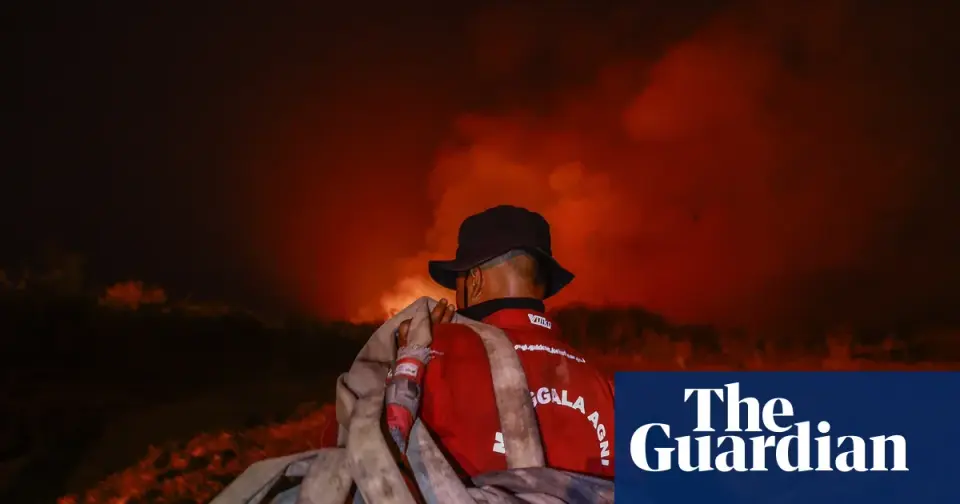
Wildfires fueled by a strong El Niño are ravaging Indonesia’s Sumatra and Kalimantan, destroying nearly 94,000 hectares in July alone. The resulting haze has spread to Malaysia, Singapore, and the Philippines, causing severe air pollution. Authorities are deploying water-bombing operations and arresting suspects, while experts warn the crisis will persist until rains arrive in November.
Key points
- Nearly 94,000 hectares burned across Indonesia in July, with fires concentrated in Sumatra and Kalimantan.
- Smoke haze has degraded air quality in Kuala Lumpur, Singapore, and the Philippines, prompting school closures and flight delays.
- President Prabowo Subianto has deployed helicopters and water pumps, including water-bombing operations near the future capital, Nusantara.
- Police have arrested 72 people suspected of deliberately starting fires to clear land for plantations.
- Nine orangutans have been evacuated from West Kalimantan, and nine national parks have closed due to smoke.
Background
This crisis follows a series of earlier reports in August and September 2026 detailing the onset of a 'super' El Niño. Previous coverage highlighted how this climate pattern, combined with a positive Indian Ocean Dipole, has intensified drought conditions across the archipelago. Earlier articles noted that peatland drainage and deforestation have made these ecosystems highly flammable, leading to recurring haze events that affect millions of people across Southeast Asia.
How outlets are covering it
The Guardian emphasizes the human and ecological toll, highlighting the evacuation of orangutans and the arrest of 72 suspects linked to 'slash and burn' practices. NASA’s Earth Observatory focuses on the scientific severity, noting that peat fires generate three times more fine particulate matter than other tropical fires and that current emissions are already 10% of the 2015 peak. The Inquirer highlights the government's tactical response, specifically the use of water-bombing to protect the construction site of the new capital city, Nusantara. While all sources agree on the El Niño’s role, NASA stresses that the fires are 'notoriously difficult to extinguish' due to underground smoldering, whereas the Guardian focuses on the immediate regional impact on neighboring countries.
Why it matters
The fires are not only an environmental disaster but a transnational public health crisis, with smoke causing respiratory issues across multiple countries. The destruction of Indonesia’s peatlands, which hold vast carbon stores, contributes significantly to global greenhouse gas emissions. Furthermore, the fires threaten the integrity of the new capital city, Nusantara, potentially impacting national infrastructure and economic plans. The situation underscores the long-term consequences of land-use changes and climate variability in tropical regions.
What to watch
Rain is not forecast to return until November, meaning the fires are expected to continue burning underground in peat deposits for several more months. Authorities are prioritizing firefighting in six provinces and monitoring hotspots via satellite data. Researchers are developing new algorithms to detect understory fires that current satellite sensors may miss. The focus will remain on containing the blaze until the wet season arrives, with ongoing efforts to restore wetlands and improve firefighting capacity.
- El Niño-fuelled wildfires destroy precious Indonesian forests – in pictures The Guardian
- Peatland Fires Darken Skies in Indonesia science.nasa.gov
- Haze From Indonesian Wildfires Blankets Parts of Malaysia and Philippines The New York Times
- Wildfires spread near Indonesia's new capital, prompting calls for action Reuters
- Indonesia uses water bombing to contain wildfires near future capital Inquirer.net
Want the full story? Read the original reporting
Read on The Guardian