
Williston Lake's Floating Forest Island Found Resting on Shoreline After 30km Drift
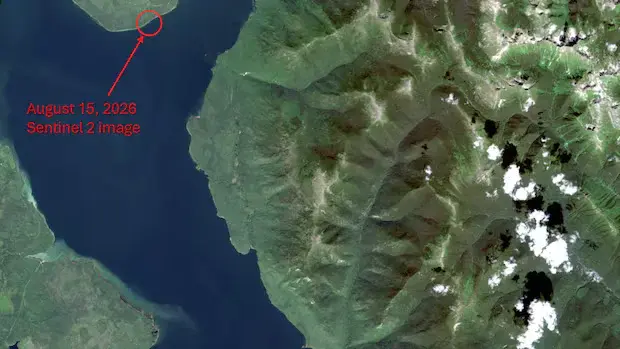
B.C. Hydro confirmed that a massive, forested floating island, previously spotted in the middle of Williston Reservoir, has been located resting on the shoreline in the Ospika Arm. The landmass, roughly 9,800 square meters in size, drifted approximately 30 kilometers northwest from its initial discovery site. While the island appears intact, officials warn it is unstable and advise against physical contact. The discovery resolves a months-long mystery regarding the island's sudden disappearance from satellite imagery, though its exact origin remains unconfirmed.
Key points
- B.C. Hydro identified the floating island on satellite imagery dated August 15, located at the north entrance of the Ospika Arm where the Ospika River meets the reservoir.
- The island measures approximately 70 meters wide and 140 meters long, covering an area of about 9,800 square meters, which is larger than a Canadian football field.
- The landmass drifted roughly 30 kilometers northwest from its last known location near the center of the reservoir, moving away from the W.A.C. Bennett Dam.
- B.C. Hydro spokesperson Bob Gammer stated that strong winds, rather than water currents, likely drove the island's movement across the open water.
- The utility warns that the island is unstable and poses a safety risk, advising boaters not to attempt to climb on or land near it.
- The island's origin is believed to be a mass of woody debris and vegetation that broke free from the shoreline due to record-high water levels, though this has not been definitively proven.
Background
Williston Reservoir, created in 1968 by the W.A.C. Bennett Dam, is the seventh-largest reservoir in the world. The floating island first gained international attention in August 2026 after boaters reported seeing a forested mass in the middle of the lake. It subsequently vanished from satellite views, causing speculation about whether it had sunk or moved. Prior to this latest confirmation, B.C. Hydro had initially dismissed reports as potential hoaxes before confirming the island's existence via satellite imagery in July. The reservoir has not reached full capacity since 2012, but recent high water levels in 2026 may have contributed to the island's formation and release.
How outlets are covering it
B.C. Hydro attributes the island's movement to strong winds and believes it broke free from the shoreline due to high water levels. However, Simon Fraser University earth sciences professor John Clague disputes the scale of erosion required to form such a large mat, noting that while trees collapse into the lake, they do not typically form such large, cohesive forested structures. Clague also expressed surprise at the distance the island traveled without breaking apart. National Geographic researchers suggest that such floating islands are an endangered landform, once more common before widespread damming and logging reduced the driftwood necessary for their formation. The Globe and Mail highlights that B.C. Hydro initially suspected the reports were an AI hoax before satellite confirmation. ZME Science notes that while the island's disappearance from satellite views was mysterious, it likely moved into a hidden cove or blended with the shoreline, rather than sinking.
Why it matters
The discovery of the floating island provides a rare opportunity to study the formation and movement of large, forested floating masses in a major reservoir. It highlights the impact of extreme water levels and wind patterns on shoreline stability and vegetation. The incident also underscores the challenges of monitoring large, complex water bodies like Williston Reservoir, where small features can easily go unnoticed. Furthermore, it raises questions about the long-term ecological and safety implications of such floating debris in managed water systems.
What to watch
B.C. Hydro will continue to monitor the island to determine if it breaks apart or moves again. The utility is considering whether the island's decomposition into a debris field will require further action. Researchers may seek to sample the island to understand its composition and age, though access is currently restricted due to safety concerns. The Tsay Keh Dene First Nation and local residents are also interested in inspecting the island, with plans to visit once water conditions calm.
- Lost island in northern B.C. lake — that appeared then disappeared — located, says B.C. Hydro CBC
- Canada Has a New Forested Floating Island. Scientists Think It Used to Have Many More. National Geographic
- Mysterious floating island reappears on B.C. lake The Globe and Mail
- A Forested Island the Size of Two Football Fields Appeared Out of Nowhere in Canada. Then It Mysteriously Vanished ZME Science
- B.C. boaters warned to avoid mysterious floating island CityNews Vancouver
Want the full story? Read the original reporting
Read on CBC