
Baku Summit Unites Rivals in CICA Push for AI Governance and Eurasian Connectivity
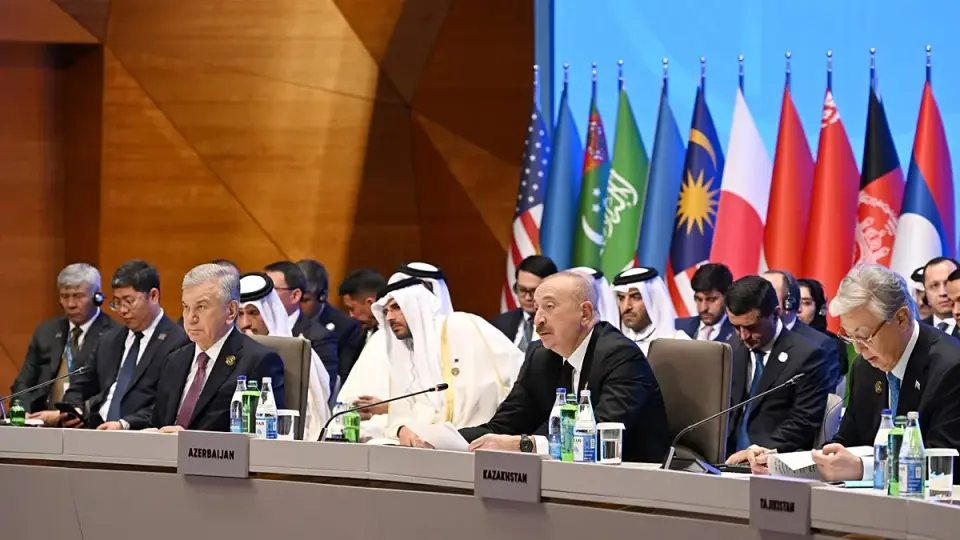
The 7th CICA summit in Baku brought together conflicting Middle Eastern and Asian leaders to address security, connectivity, and AI risks. Despite tensions, delegates adopted the Baku Declaration, extending Azerbaijan’s chairmanship and admitting Laos as a new member.
Key points
- Israel’s President Isaac Herzog addressed the summit, prompting delegations from Iran, Turkey, and others to leave the hall, while Qatar and the UAE remained.
- Kazakhstan’s President Kassym-Jomart Tokayev proposed adding AI as a sixth pillar of CICA cooperation and launching a Trans-Caspian fiber-optic cable with Azerbaijan.
- Bahrain’s Foreign Minister highlighted maritime security issues, citing 1,600 vessels held up and 23,000 seafarers affected by disruptions in the Strait of Hormuz and Bab el-Mandeb.
- China’s Foreign Minister Wang Yi urged Asian-led solutions to regional conflicts, calling for a diplomatic settlement between the US and Iran and unimpeded shipping lanes.
- The summit concluded with the adoption of the Baku Declaration, which established the first multilateral consensus on balancing AI economic opportunities and security risks.
Background
This summit follows a period of heightened regional instability, including the US-Iran war and BRICS summits in New Delhi where leaders called for restraint. Previous coverage noted selective diplomatic engagement, such as US visa approvals for Iranian leaders despite ongoing hostilities, and efforts to 'turn the page' on conflicts between Iran and the UAE. The current gathering in Baku represents a shift toward multilateral confidence-building measures in Asia amid these ongoing geopolitical tensions.
How outlets are covering it
Euronews emphasizes the rare convergence of opposing leaders, highlighting the tense exit of Iran and Turkey during Israel’s speech but noting the presence of Qatar and the UAE. The Astana Times focuses on Kazakhstan’s push to transform CICA into a full international organization, stressing the need for preventive diplomacy and digital infrastructure. Apa.az highlights India’s stance on terrorism and the need for Global South participation in global governance. Caspian Post details Turkmenistan’s proposal for the Ashgabat Climate Dialogue, focusing on environmental resilience. While all sources agree on the summit’s significance, Euronews and The Astana Times differ in emphasis: the former highlights diplomatic tensions, while the latter focuses on institutional and technological reforms.
Why it matters
The summit demonstrates a growing effort to create multilateral frameworks for managing conflicts and technological risks in Asia. The inclusion of AI governance and connectivity projects signals a shift toward practical cooperation, potentially reducing reliance on Western-led institutions. However, the visible tensions among Middle Eastern delegations suggest that deep-seated conflicts remain unresolved, limiting the summit’s immediate impact on regional peace.
What to watch
Azerbaijan will retain CICA chairmanship for 2026-2028, and Laos will join as a full member. Kazakhstan plans to host a UN digital solutions center in Almaty, while Turkmenistan aims to launch the Ashgabat Climate Dialogue. Further bilateral talks between Israel and Bahrain, and diplomatic efforts between the US and Iran, will likely follow, with continued focus on maritime security and AI regulation.
- Middle East and Asian leaders gather in Baku despite disagreements Euronews.com
- Turkmenistan Proposes Platform to Tackle Climate Change and Drought Caspian Post
- Kazakhstan Puts Forward New Initiatives on Security, Energy and Digital Cooperation at CICA Summit in Baku The Astana Times
- Indian FM: Changing geopolitical landscape necessitates more active participation of Global South countries Apa.az
- Kazakh President proposes developing transport corridors and green energy in Central Asia, South Caucasus Qazinform
Want the full story? Read the original reporting
Read on Euronews.com