
Berlin summit counters Shenzhen optics with new aid and security guarantees
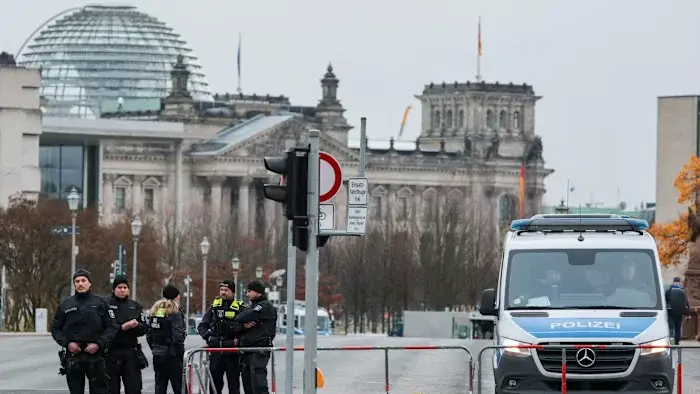
Western leaders gathered in Berlin to counter the optics of a trilateral meeting between Donald Trump, Vladimir Putin, and Xi Jinping in Shenzhen. The Coalition of the Willing, led by the UK, France, and Germany, announced new military aid, including 1,000 long-range drones from the UK, and reaffirmed support for Ukraine’s sovereignty. While US envoys suggested Moscow is open to Article 5-style security guarantees, European leaders insisted any peace deal must include European and Ukrainian participation, rejecting a 'Yalta 2.0' format that excludes them from negotiations.
Key points
- The Coalition of the Willing, comprising over 36 countries, met in Berlin to announce financial and military aid for Ukraine, including a £260 million package from the UK featuring long-range drones.
- The summit was timed to counter the optics of a trilateral meeting between Trump, Putin, and Xi in Shenzhen, which European leaders viewed as a potential 'Yalta 2.0' attempt to divide Europe.
- US envoy Jared Kushner stated that Trump believes peace is achievable and that Moscow is now comfortable with Ukraine having security guarantees based on NATO’s Article 5, though without formal NATO membership.
- European leaders, including German Chancellor Friedrich Merz and UK Prime Minister Andy Burnham, emphasized that Europe must be involved in peace talks and that any territorial agreements must start from the current contact line.
- Ukrainian President Volodymyr Zelenskyy attended the summit, noting that Putin has rejected previous proposals, while Russian officials indicated that European participation in talks would require further diplomatic rounds.
Background
Recent diplomatic efforts by the E3 (Germany, UK, France) to engage with US envoys Steve Witkoff and Jared Kushner have aimed to ensure European demands are reflected in Washington’s talks with Moscow. Previous archive coverage highlighted a 25 billion-euro funding gap in the EU’s proposed 45 billion-euro loan for 2027, underscoring the financial challenges in supporting Ukraine. The Berlin summit builds on these efforts, seeking to solidify European involvement in peace negotiations and counter concerns that major powers might exclude Europe from critical security discussions.
How outlets are covering it
The Financial Times and BBC both highlight the strategic timing of the Berlin summit to counter the Shenzhen meeting, but differ in emphasis. The FT focuses on the symbolic nature of the gathering and the potential for a 'Yalta 2.0' scenario, while the BBC provides more detail on the specific aid packages and the mixed messages from Moscow regarding European participation. The FT notes skepticism from analysts about the summit’s substantive outcomes, whereas the BBC emphasizes the upbeat tone from US envoys and the concrete steps toward security guarantees. Both sources agree on the importance of European involvement but differ in their assessment of Moscow’s willingness to engage.
Why it matters
The Berlin summit underscores the ongoing struggle for European agency in shaping the outcome of the Ukraine war. By announcing new aid and reaffirming support for Ukraine’s sovereignty, Western leaders aim to prevent a 'Yalta 2.0' scenario where major powers dictate terms without European input. The potential for Article 5-style security guarantees, if accepted by Moscow, could significantly alter the security landscape in Europe, while the continued Russian attacks on Ukrainian infrastructure highlight the urgency of the conflict. The summit’s success in securing tangible commitments and fostering a unified European position will be crucial in determining the future of peace negotiations.
What to watch
The next steps include further diplomatic rounds to determine the format of multilateral peace talks, with Russia indicating that several more discussions are needed before expanding the format. The EU may proceed with the gradual and conditional lifting of sanctions against Russia if peace talks progress. Additionally, the implementation of the announced aid packages, including the UK’s long-range drones, will be closely monitored. The outcome of these efforts will depend on Moscow’s willingness to engage and the ability of European leaders to maintain a unified front in negotiations.
- Ukraine’s western allies meet in Berlin to counter Yalta 2.0 optics Financial Times
- Europe ready for talks with Russia on ending war in Ukraine, leaders say BBC
- Trump envoys Witkoff and Kushner expected in Berlin for Ukraine talks, says US Reuters
- Wadephul: Berlin talks of 'Coalition of the Willing' send strong signal to Moscow DW.com
- Zelensky arrives in Berlin for talks with European leaders, Trump's envoys The Kyiv Independent
Want the full story? Read the original reporting
Read on Financial Times