
Krelin Sends Medieval Prince’s Relics to Ukrainian Front Lines
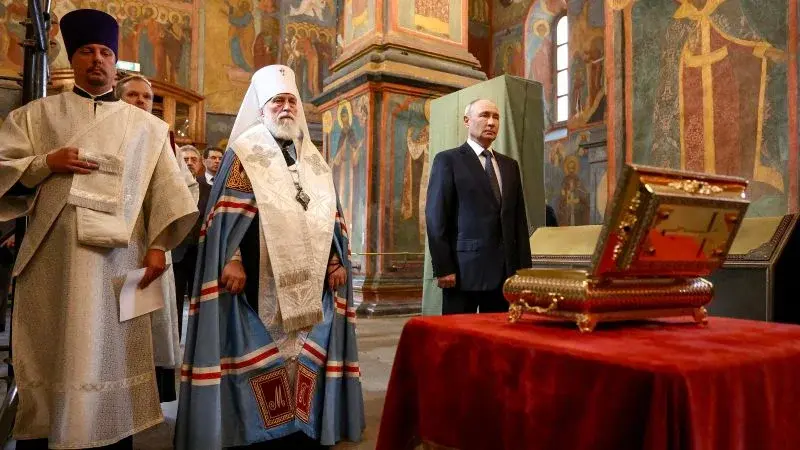
Russian military authorities have dispatched a fragment of the remains of Prince Dmitry Donskoy, a 14th-century warrior saint, to troops in occupied Ukraine. The relic, a piece of his right hand, was recovered during Kremlin restoration work in August and is being circulated among bases to boost morale. The Moscow Patriarchate frames this as divine support for a defensive war, while critics view it as state propaganda exploiting religious symbols to sustain a grinding conflict.
Key points
- A fragment of Prince Dmitry Donskoy’s right hand was sent to the front lines in early September 2026.
- The relic was discovered during restoration work at the Archangel Cathedral in August.
- The Moscow Patriarchate claims the relic will invisibly support soldiers alongside them.
- President Vladimir Putin described the recovery as a marvelous discovery and sign of providence.
- Religious scholars argue the move is a cynical exploitation of faith for patriotic purposes.
Background
This development follows a trend of increasing integration between the Russian state and the Orthodox Church since the 2022 invasion. In September 2026, Russia held parliamentary elections where the Kremlin-backed United Russia party secured a significant lead, framing the results as a mandate for the war effort. Earlier this year, relics of another medieval figure, Prince Alexander Nevsky, were also sent to troops, though reports suggested those items may have been lost. The current deployment of Donskoy’s remains coincides with a period of heightened military strain and a decline in regular religious practice among the general population, despite large state-organized processions.
Why it matters
The use of sacred relics highlights the Kremlin’s strategy of framing the war as a holy defense of the fatherland, leveraging deep historical narratives to maintain troop morale and public support. This blurring of religious and state roles raises ethical questions about the role of clergy in conflict zones and the manipulation of faith for political ends. As the war enters its fifth year, such symbolic gestures underscore the regime’s reliance on ideological mobilization to sustain a costly and protracted conflict.
What to watch
The relic will continue to be rotated among military bases in Russian-occupied Ukraine. The Russian Orthodox Church is expected to maintain its close alignment with state narratives, potentially expanding the role of military chaplains. Critics anticipate ongoing debate within the global Orthodox community regarding the church’s support for the war, while the Kremlin will likely continue to use religious symbolism to reinforce its wartime legitimacy.
Want the full story? Read the original reporting
Read on CNN